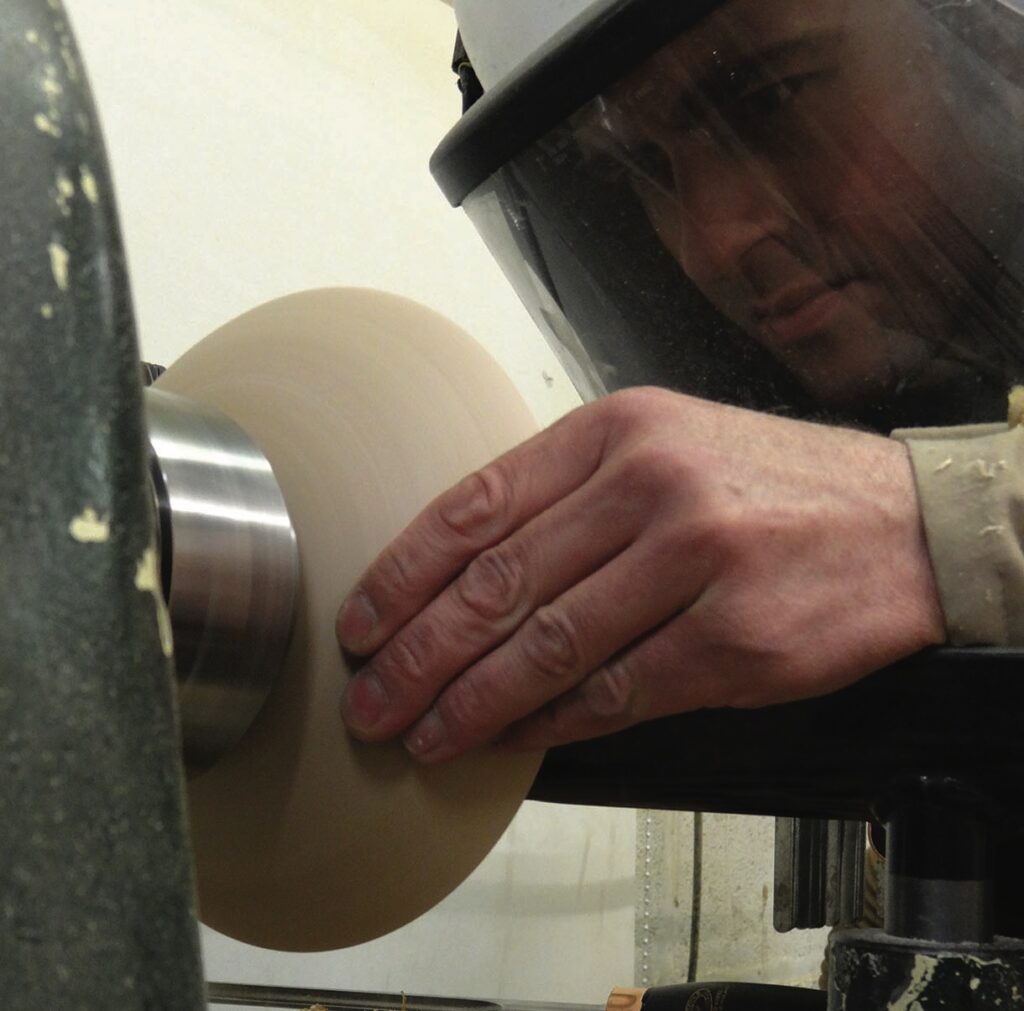
Richard Findley looks at common catches that occur when turning bowls with a bowl gouge
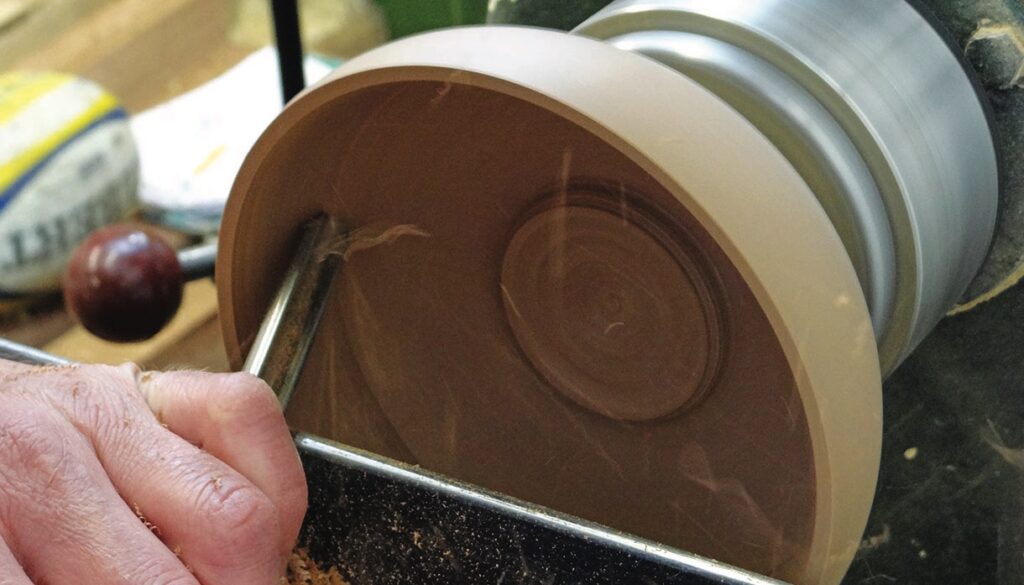
Having explored the most common catches in spindle work in previous articles, this article will look at the catches that happen when turning bowls with a bowl gouge.
Some turners will tell you that bowl turning is easy compared to spindle work, others are certain that bowls give by far the biggest challenge. Either way, catches can be found in most areas of turning and, while spindle turning catches can be dramatic and deeply frustrating, they are rarely dangerous, because the work is held securely between centres. Bowl work is generally only held at one end and a heavy catch can easily launch a bowl from the jaws of the chuck, and flying bowls equal potential danger. Likewise, catches in bowls can lead to exploding bowls if the material isn’t sound and, again, chunks of flying wood are a recipe for disaster. That said, during the photo shoot for this article I forced (or tried to force) a range of different catches and none managed to dislodge or shatter the bowls I turned, so while the risk probably isn’t great, it is nonetheless there. A face shield is the minimum protection I would recommend for bowl turning. Learning to properly chuck your bowls is also an essential skill for successful and safe bowl turning.
Bowl gouge grind
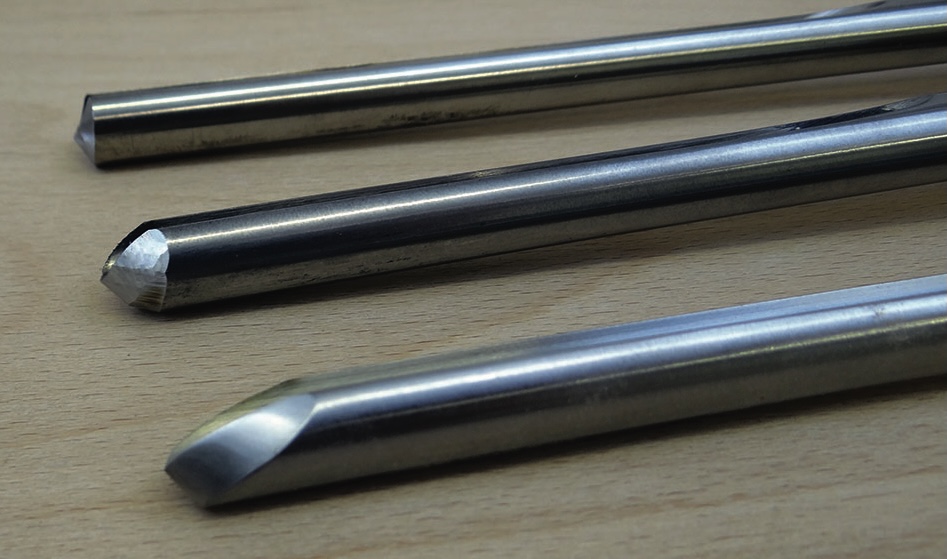
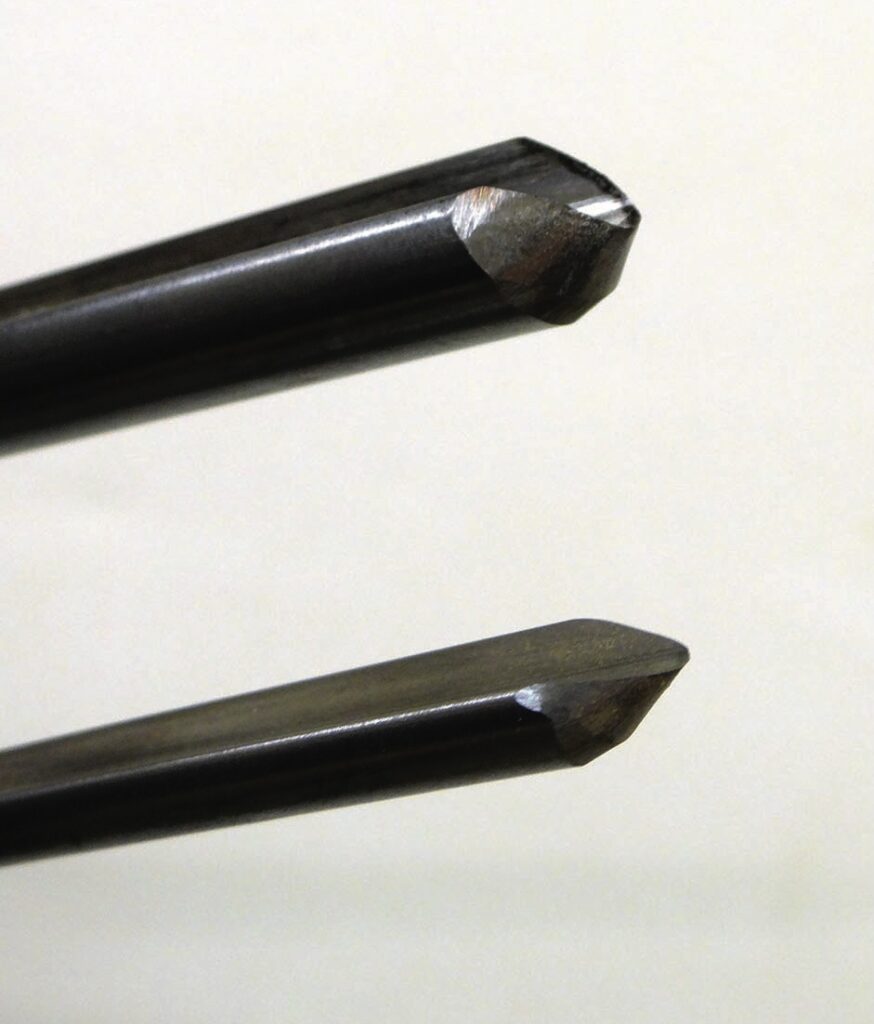
It seems to me that the grind used on the bowl gouge can help to minimise, or indeed increase, the risk of catches during the turning process. There are two main grinds most often sold by tool manufacturers: traditional square grind and long grind – sometimes known as Celtic, Irish or Ellsworth grinds. My preferred shape would fall into the long grind category but, as you will see in the picture, it is far from being a full long grind shape.
Some turners will tell you a traditional grind will give a superior finish from the tool and is better for various other reasons that I am unsure of. Others will tell you the wings need to be ground back almost to the handle to achieve the best cuts. My advice would be to carefully try out a few grinds, possibly with some guidance, and see what suits you best.
I developed my preferred shape years ago, simply by starting out with a traditional square grind and, at each sharpen, gradually taking the wings further back until the tool did what I wanted it to do. I found the wings got in my way in the traditional shape and I wanted to be able to do the shear cut I’d seen the professionals use, which requires a long grind. Once I had a shape that allowed me to work inside a bowl without the wings getting in my way and a shape that allowed me to produce a fine shearing cut on the outside of a bowl I stopped and used that as my favoured bowl gouge profile. I should say the grind I use is certainly not new or revolutionary or worthy of a ‘signature’ range of bowl gouges, but simply suits me and my style of turning.
Wing catches
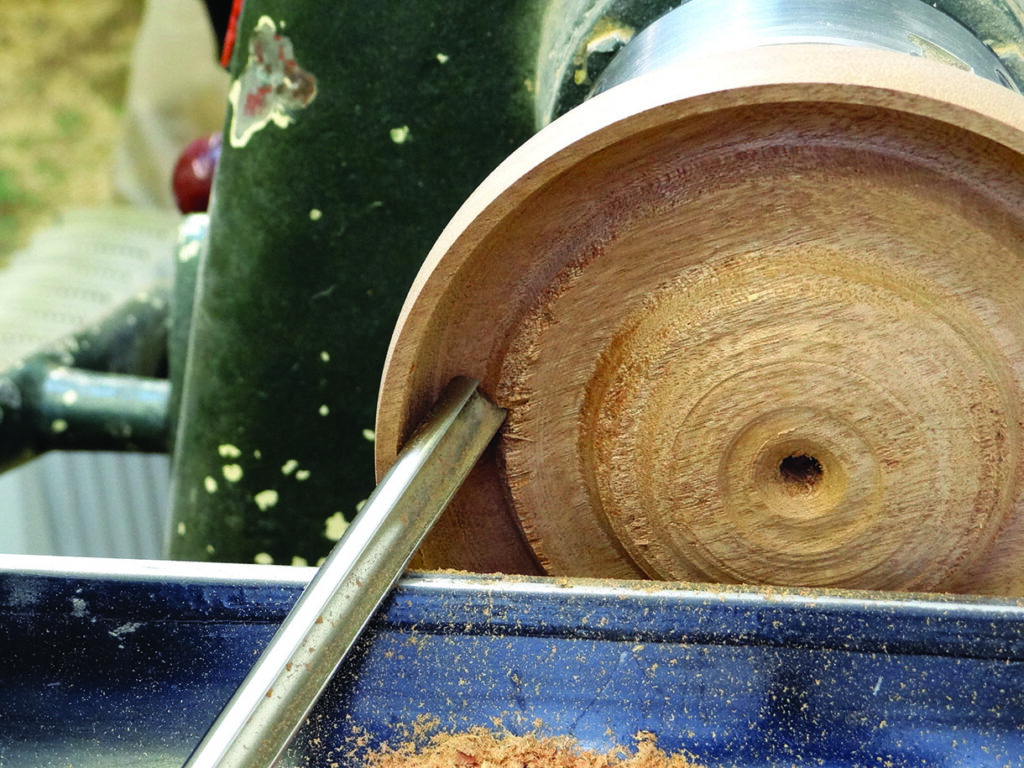
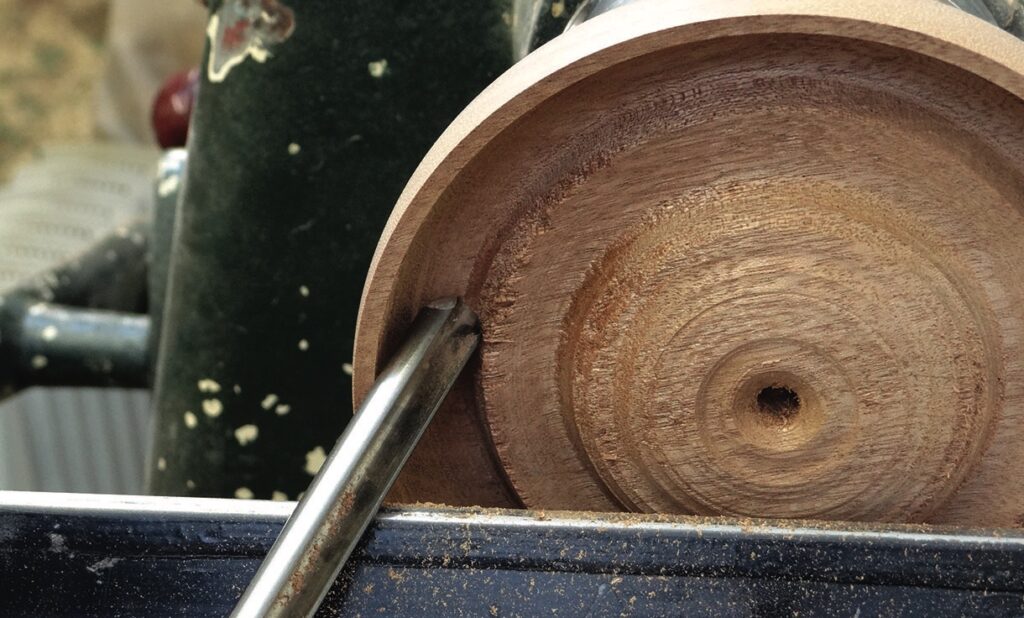
With the grind profile fresh in mind, it makes sense to begin by looking at catches caused by the wing of the tool. One of the reasons I like the grind I use best is that the wings are big enough to be useful but swept back enough to be out of the way, without being so big as to invite a huge and catastrophic catch.
It could be argued that most wing catches can be avoided if you are paying full attention to what you are doing, as they usually occur because the cut is increasing in depth or is up to a raised detail and the wing simply takes a cut too big to control. By properly monitoring where the wing is and how the cut is progressing the cut can be stopped and adjusted to avoid the catch, but, in reality, we have all found ourselves carried away by a smooth cut and flying shavings, perhaps a moment’s inattention and BANG!
Because a traditional grind has its wings so square, they will quickly come into contact with a raised surface in front of the cut. With ground-back wings, this is much less of a problem, although a catch is still perfectly possible, it is just perhaps easier to see and so avoid.
This type of catch will grab the wing of the tool, violently lifting the handle upwards and pulling the tool’s tip into the bowl. The increased leverage that is caused is usually the reason a bowl is pulled from the chuck.
Forming details and wing catches
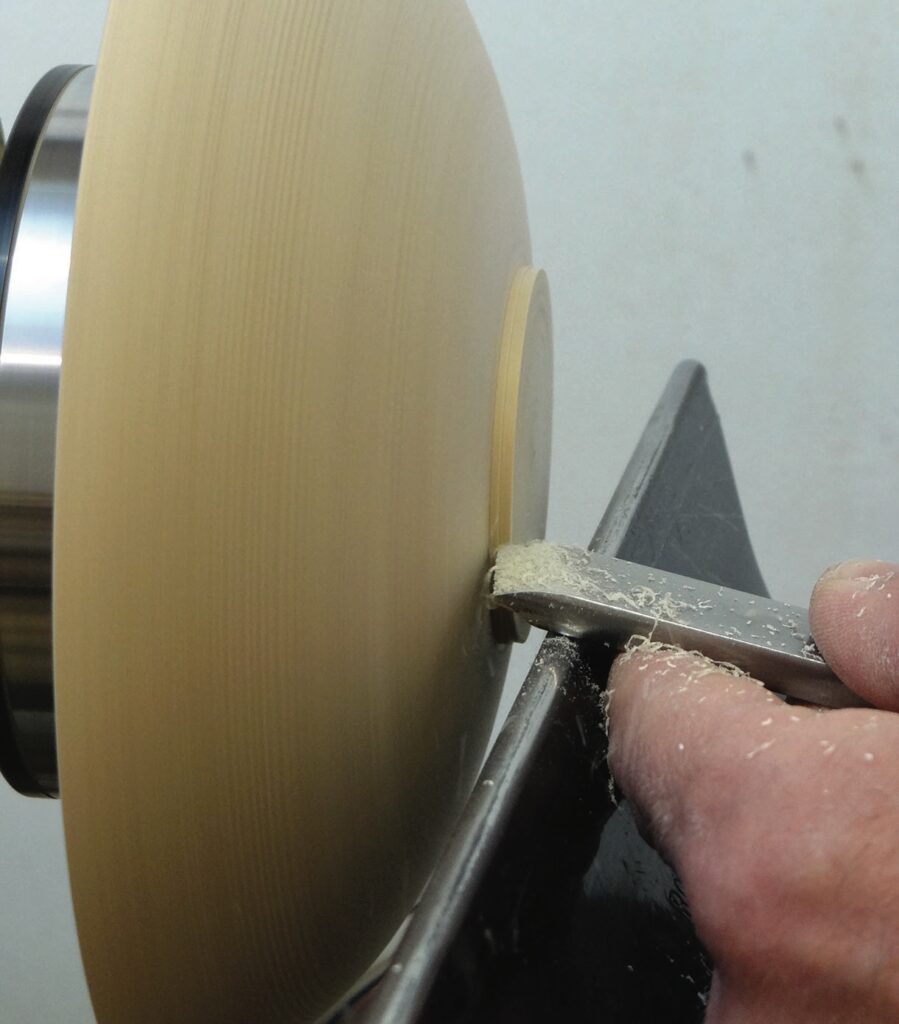
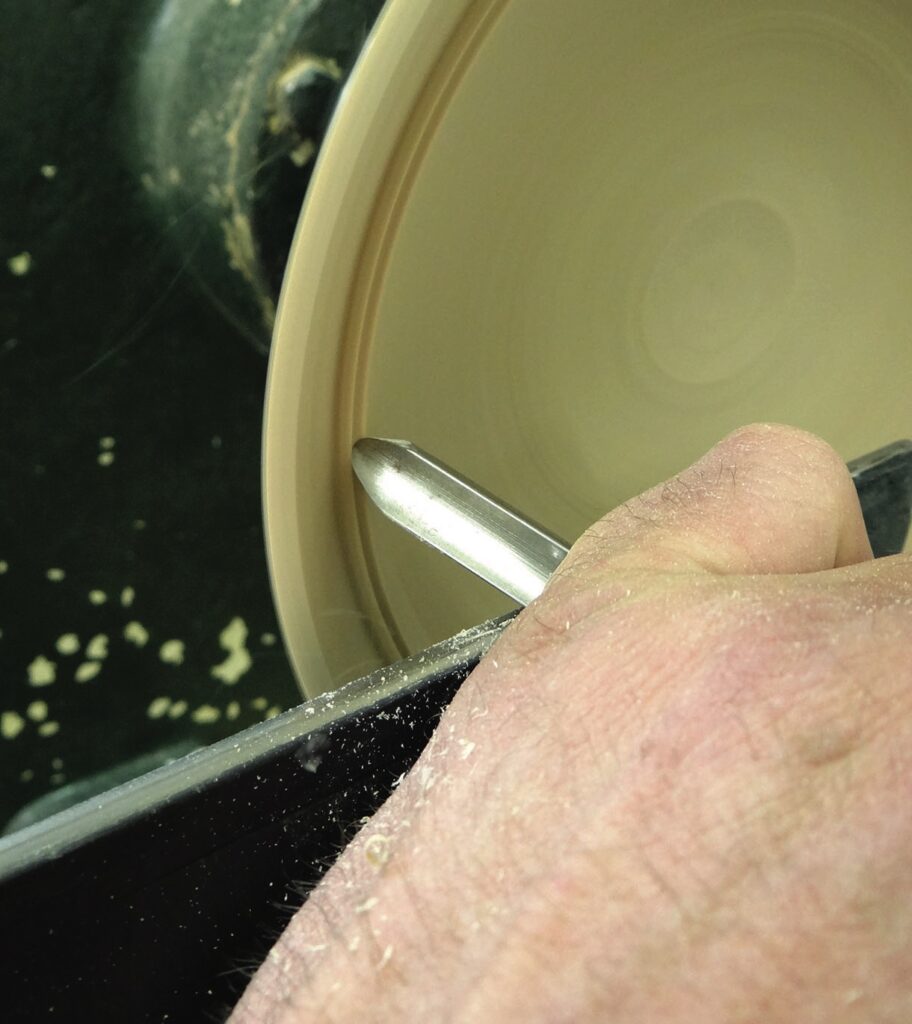
Cutting spigots and small stepped details with a bowl gouge means that the wing is put to use in a way similar to my previous description, but it is intentional. The difficulty is that when the wing is intentionally engaged in the cut, a full understanding of the limits is required. Unfortunately, as with so many things in turning and in life in general, the only way to find the limits of yourself and the tool is to push them. A catch when forming a chucking spigot is usually nothing more than annoying as it is early in the turning process and the blank will be securely held on a sturdy screw chuck or faceplate. Wing catches on details are often far further on in the turning process and can lead to much greater ‘design changes’.
My personal preference is to rough out these details with the bowl gouge but to cut and refine them with a skew in scraping mode or a suitable scraper. Some will maintain that these details should be cut and not scraped to give the best finish from the tool, in which case a spindle gouge might be worth considering, as long as the overhang from the toolrest isn’t too great. The grind and profile of a spindle gouge is far better for cutting and shaping fine detail than a bowl gouge, which, in my opinion, is generally better for bolder, sweeping curves.
Testing the limits of a push cut
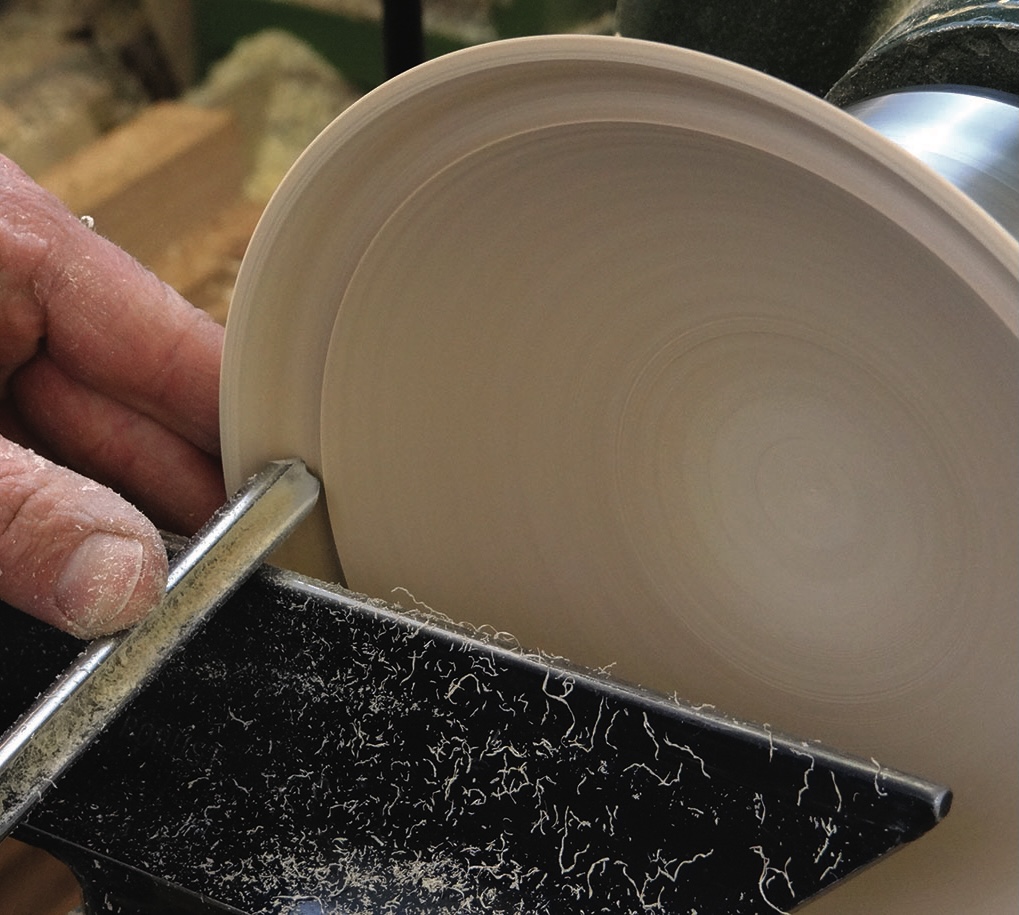
A push cut would be considered the traditional way of producing a clean finish on a bowl before sanding. With a traditional grind this cut is the only option, but with a long grind a shear cut can be employed on the outside
of a bowl.
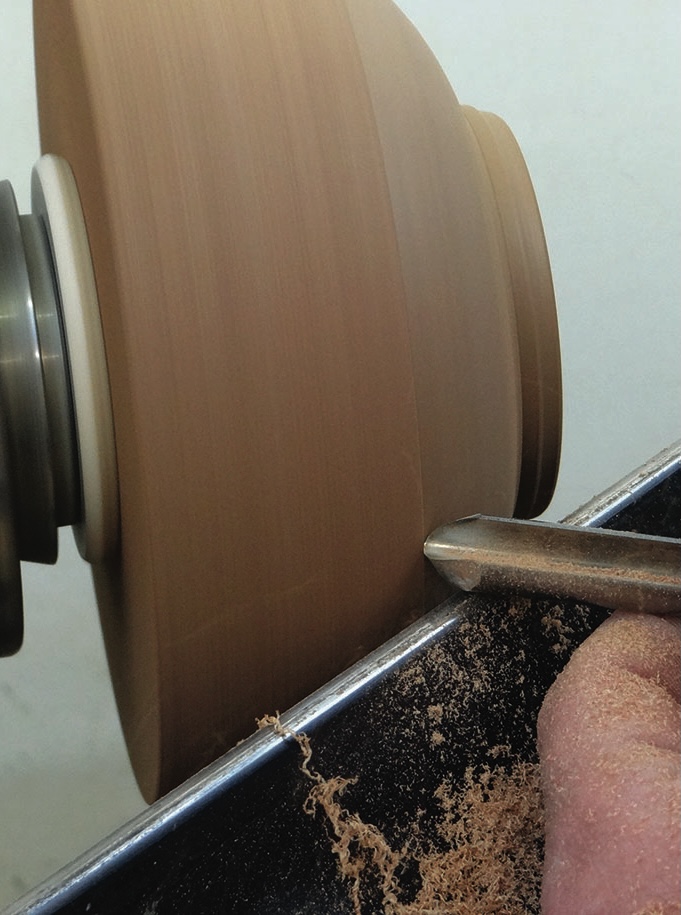
When taking a push cut, just like every other cut in turning, there is a ‘sweet spot’ on the tool where the shaving whistles cleanly from the edge with almost no effort. On the push cut around the outside of the bowl, when the flute is at around the 10 o’clock position, the cut should be working well. There is a range of variables that will mean the exact position will be slightly different for each turner, but generally speaking 10 o’clock is a good guide. Likewise, inside a bowl, 2 o’clock is a good flute position to aim for.
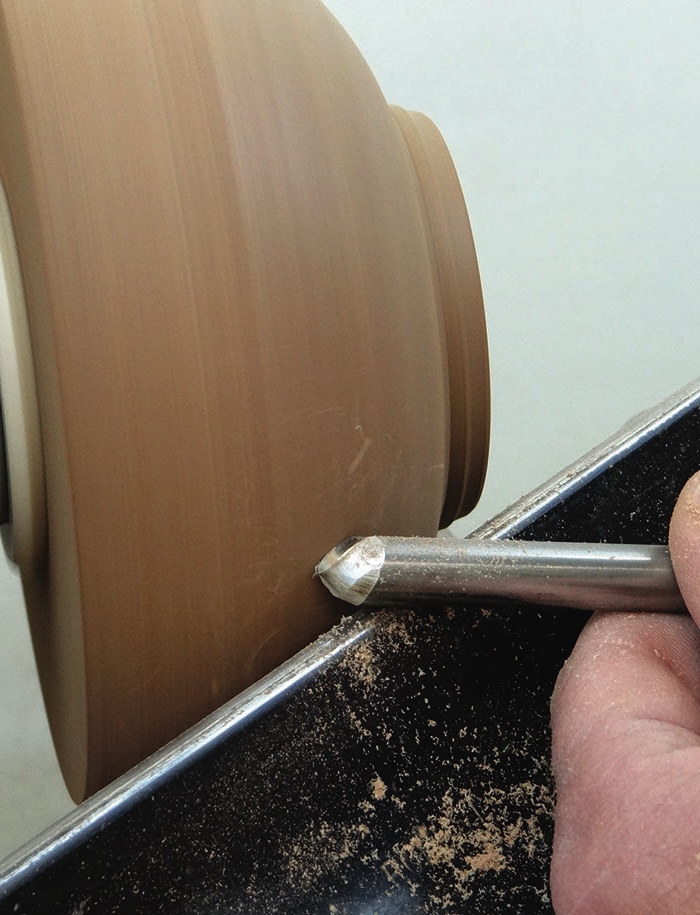
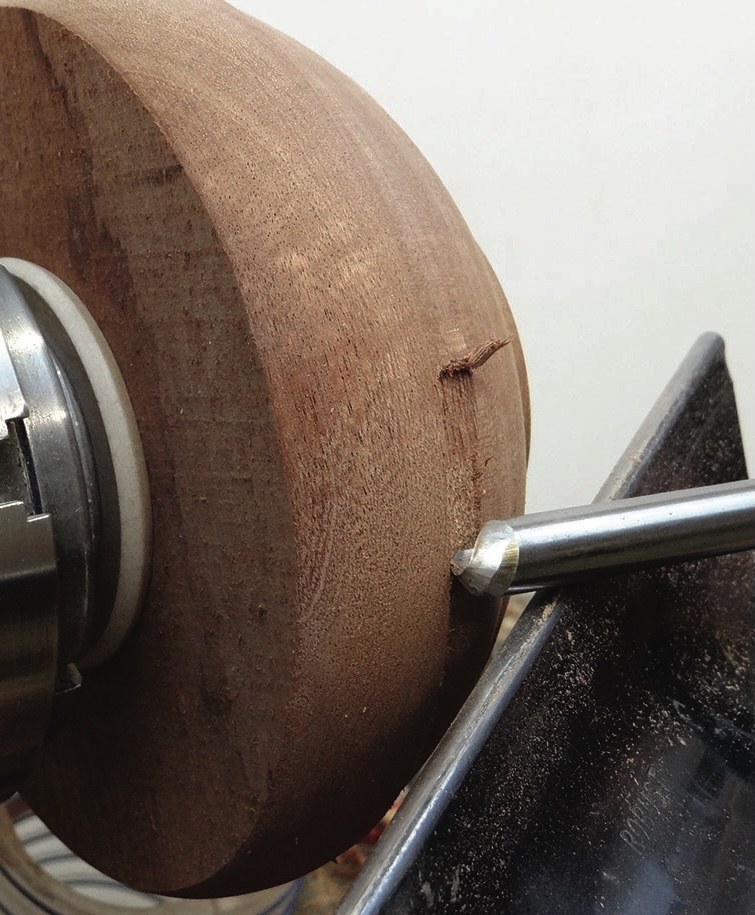
It seems obvious that if the tool is rotated too far around, so the flute points nearly vertically upwards to the 12 o’clock position, the wing is in danger of a catch. To see how real this danger actually is I gave it a try. I wouldn’t deliberately do this on the inside of a bowl as my instinct tells me the catch would be far worse, but on the outside I was reasonably comfortable with it – or at least as comfortable as one can be poking a bit
of spinning wood with a sharp piece of steel with the aim of getting a catch.
I was amazed at just how far round I managed to rotate the tool and still produce a shaving before the catch actually happened. When it did happen, it was quite deep and ugly, but not disastrous, either to the blank or the tool.
Rim catches
In my experience, catches on the rim of a bowl are some of the most frustrating and common catches that happen in bowl turning. These catches are not linked to the tool’s grind so much as the wing catches, but more to the presentation of the tool to the wood on the entry cut.
In both of my previous articles on catches I have written about the need to present sharp tools correctly to the wood to avoid catches, and this example is just the same. Bizarrely I tried various different presentations to the rim of a bowl and initially struggled to get a catch. It was only when I was really trying to cut a fine and crisp rim that I actually managed to achieve the catch I had been fishing for.
I relate this cut to the entry cut of a cove with a spindle gouge, as described in the last two articles. The action of simply pushing the tool into the wood is not the best approach. Instead the lifting action of the handle which makes the cutting edge arc into the wood produces a slicing motion which both delivers a clean cut and a controlled entry into the wood, giving the bevel something to rest against and so giving control.
The correct flute position is also important. I will usually begin with the flute rolled to around 3 o’clock on entry but, as soon as the bevel is comfortably in the wood, I will open it to the 2 o’clock position which achieves a much cleaner cut around the bowl.
Peter Child method
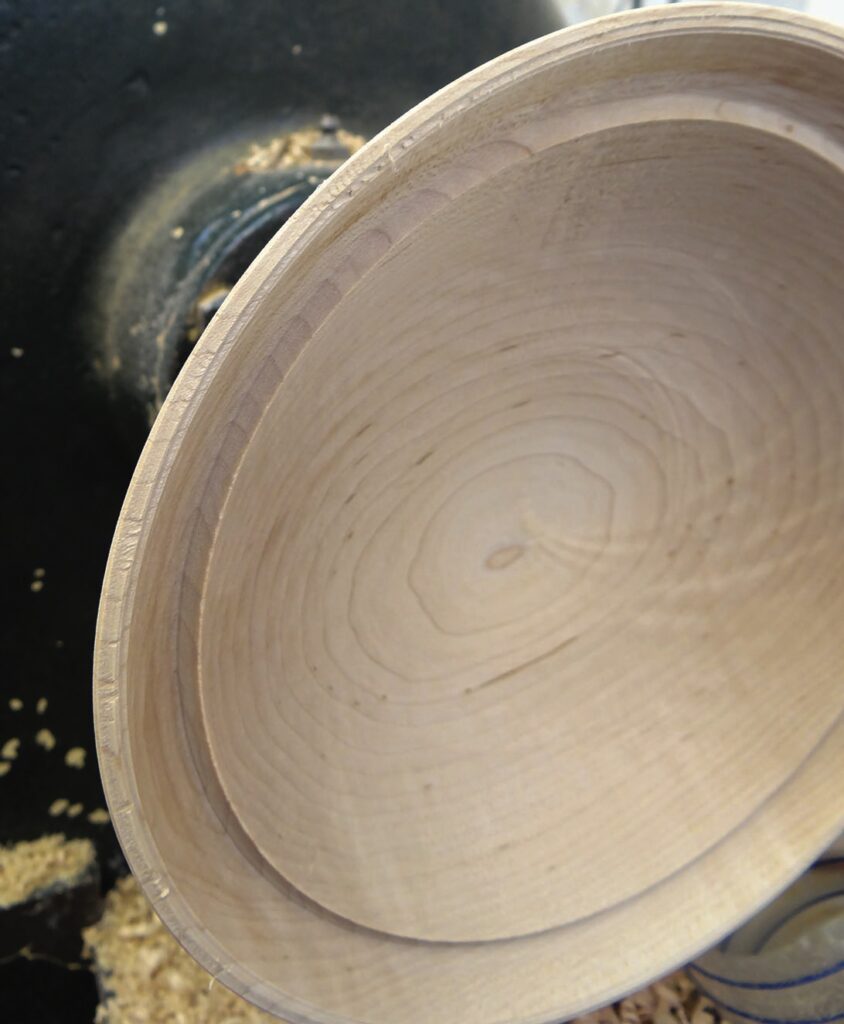
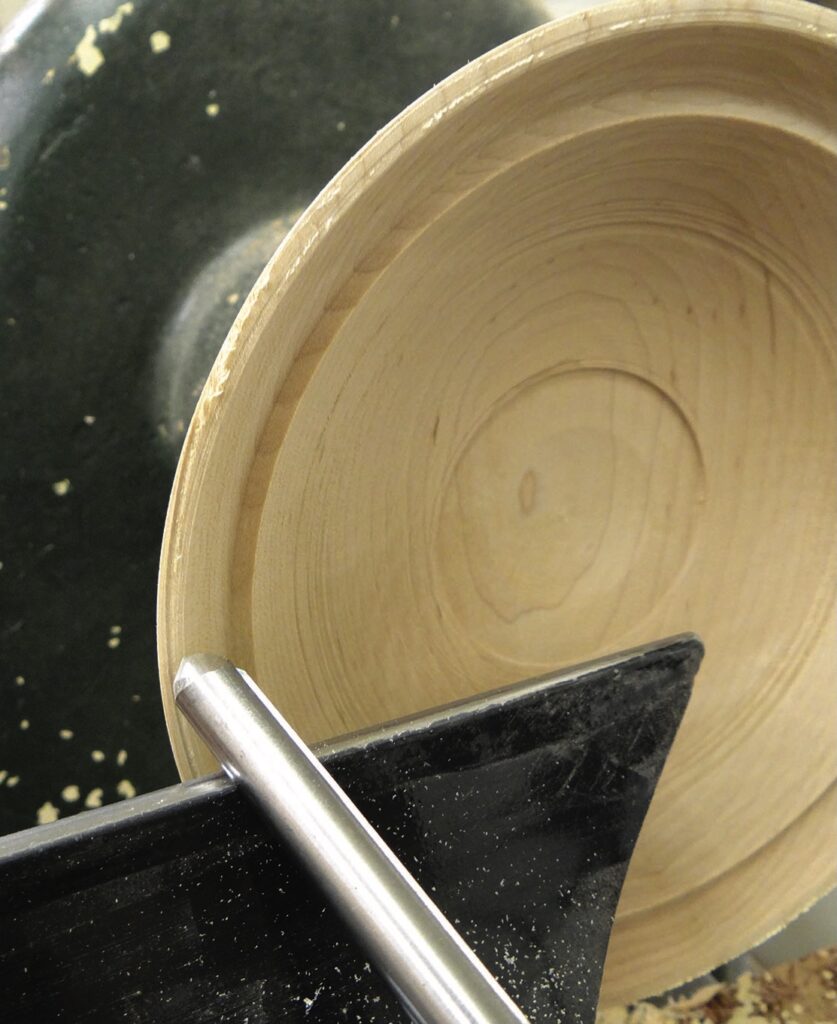
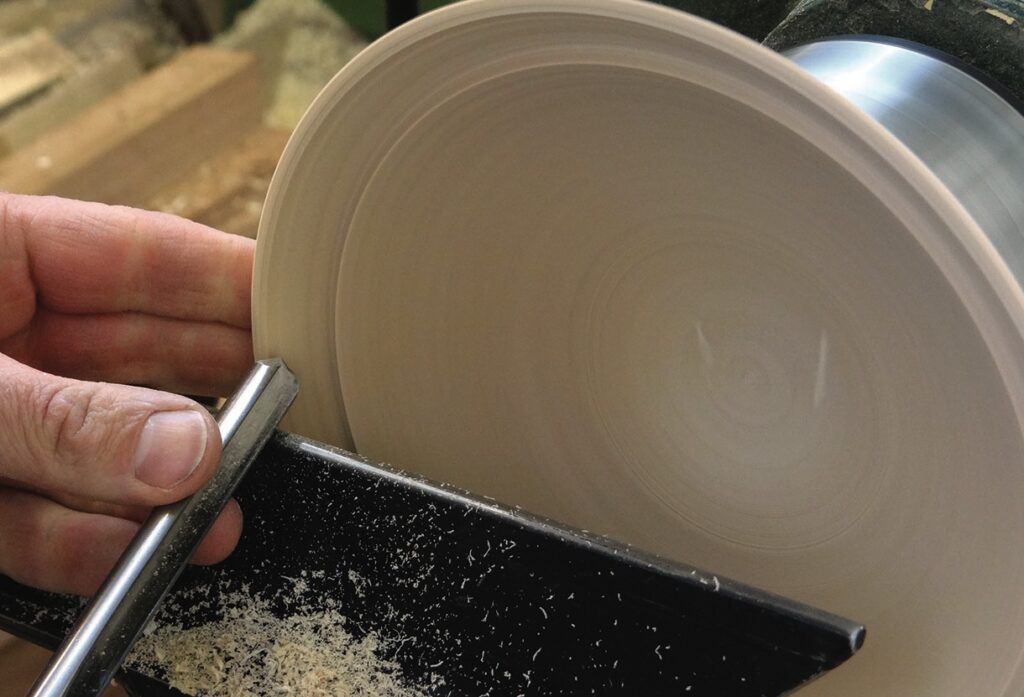
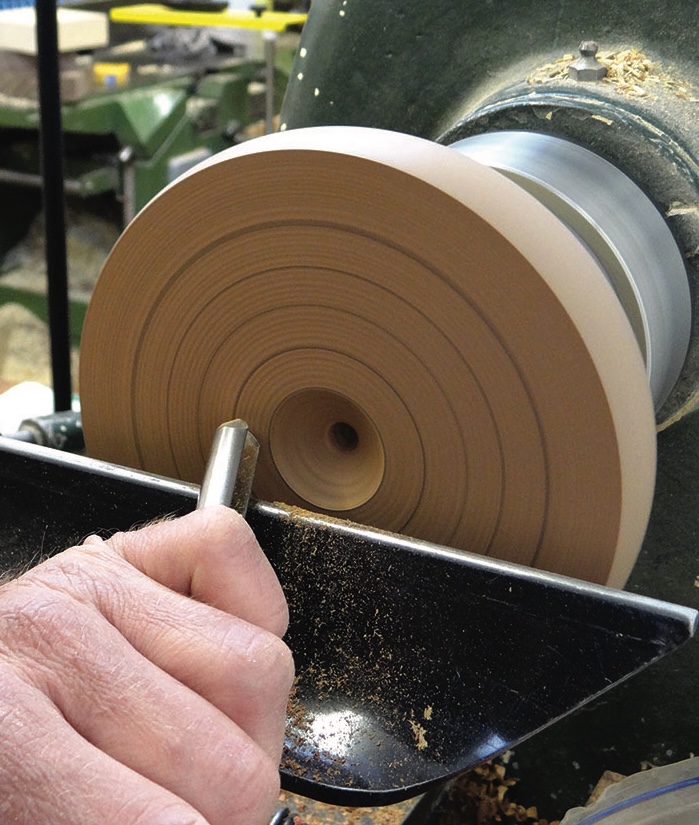
One of my favourite turning books, which is now a little out of date, but a good read all the same, is The Craftsman Woodturner by Peter Child. In it he describes a way to practise the entry cut into bowls by drawing a series of lines or rings on the face of a bowl blank and simply cutting on each until the method is perfected. The best thing about this suggestion, I feel, is that the cut will begin quite simply but become progressively more difficult as the forces on the tool increase, but by the time it does become more difficult you will have mastered the cut.
Over cutting the centre
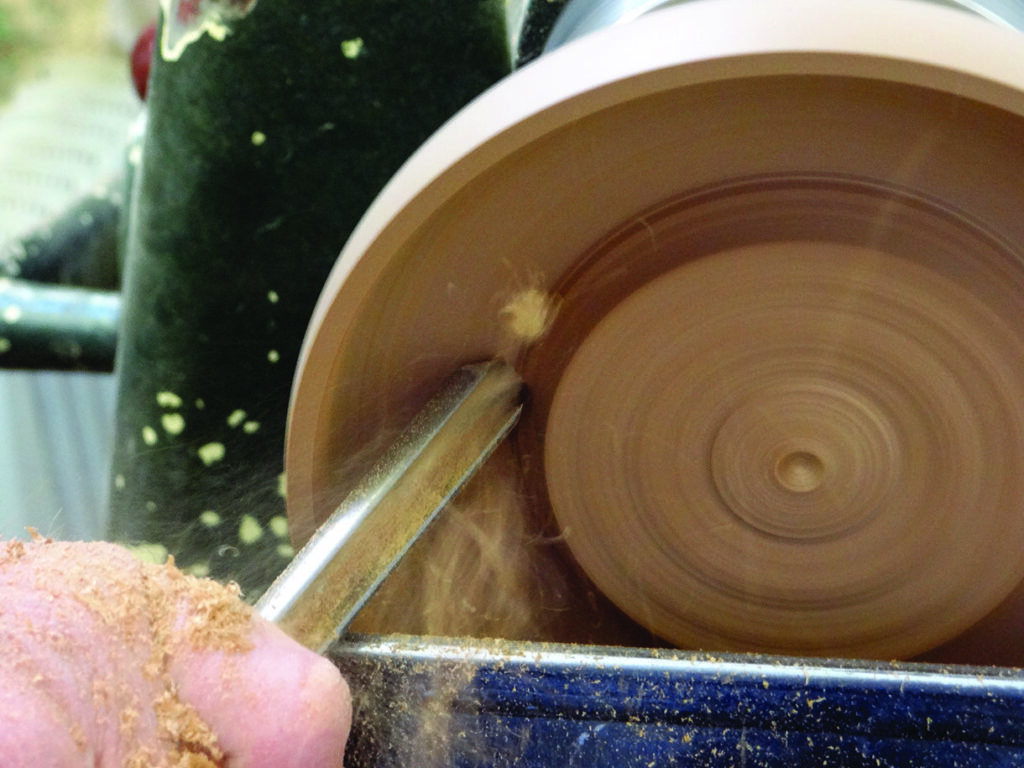
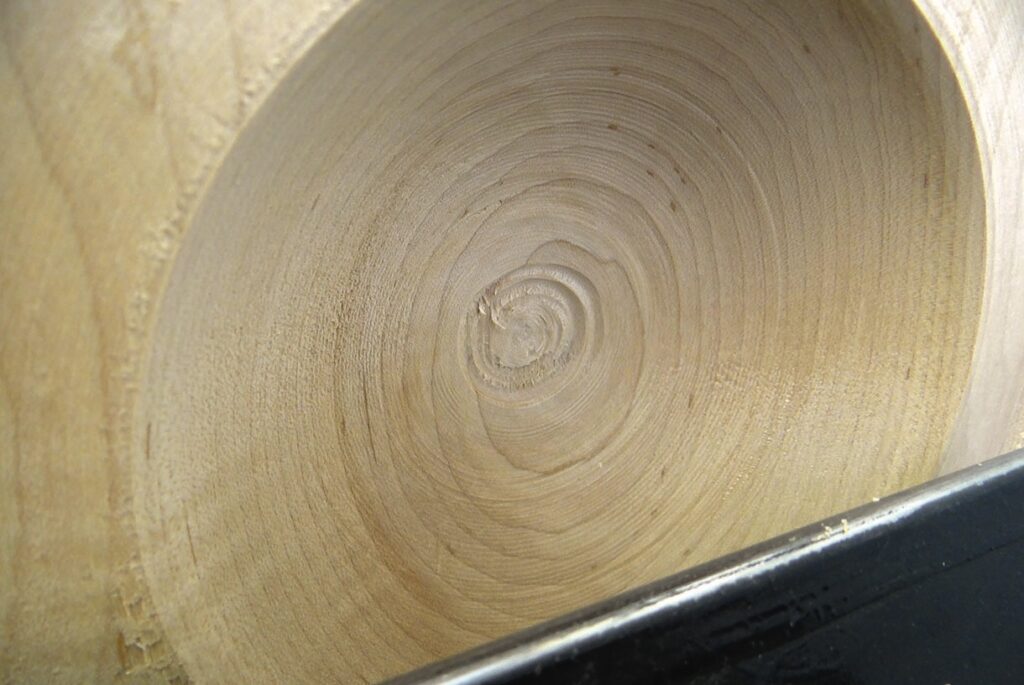
The last catch possible to get with the bowl gouge is as you approach the final cuts inside the bowl, usually too quickly, and the tool moves past the very centre of the bowl. The upward force of the right hand side of the bowl lifts the gouge up and back to the left side of centre, where the now downward force grabs the tool and slams it down onto the tool rest, producing a spiral-shaped catch in the bottom of the bowl. I’ve been there, done that and got the T-shirt yet, despite every possible approach I could think of, I couldn’t achieve the spiral catch I vividly remember from my early days at the lathe. The picture shows my best attempt at the catch.
The answer to avoiding the catch is to slow the speed of approach to the centre of the bowl. Although the whole thing is spinning at the same RPM, the centre will be moving more slowly than the outer rim of the bowl, because RPM is a measurement of angular speed rather than a measurement of actual speed, like mm per second would be. So, to maintain an even cut throughout, you need to slow the movement of the gouge as it gets closer to the centre.
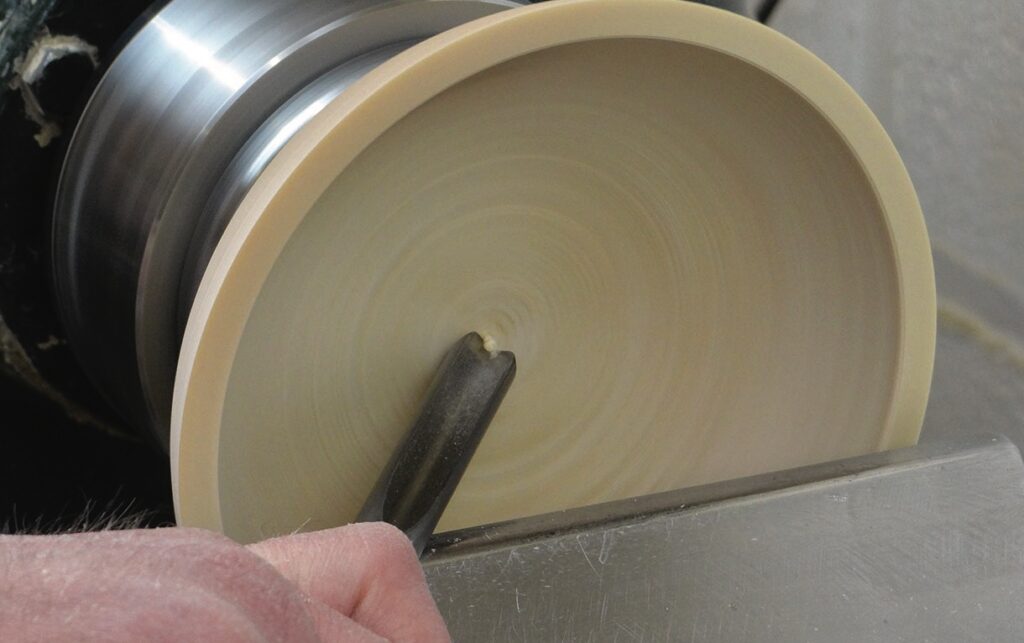
The tip of the gouge needs to be very slightly below the centre of the bowl so that the tiny pip that remains right at the heart of the bowl will simply drop off into the flute of the bowl gouge. As soon as this happens the tool can be removed from the wood, avoiding any chance of a catch.
My personal bowl gouge preference is for a 10mm (13mm diameter bar) tool, which I find ideal for most of my bowl work. Larger deeper bowls can need a more rigid, sturdy tool, in which case I move up to a 12mm (16mm diameter bar) tool. Both tools are ground to my preferred 60 degree short-long grind, but I will occasionally adapt that versatile grind if the need arises.
Final thoughts
Writing this short series has been interesting for me and very counterintuitive. I’ve spent the entirety of my turning career trying my best to avoid catches, and yet here I am doing the very opposite.
The one thing that struck me throughout the process, though, was how difficult it was to get some cacthes. This revelation thoroughly confused me because I am not so far removed from the enthusiastic raw beginner I once was that I can’t remember every single one of the bone-shaking catches I have experienced – and occasionally, still do – yet here I was, prodding the wood in ways that really shouldn’t be possible but a catch often didn’t happen.
The only conclusion I can draw from this is that, as vitally important as sharp tools, perfect profiles and precise presentation are, there is something else that can cause and increase the chances of a catch. A variable that is almost impossible to account for: being human.
I’m no scientist but I know that we are emotional creatures and no matter how much control we feel we have of our minds and bodies, we have natural responses to events. In this case the event is turning and the emotion might be excitement, nerves, fear or relief, but in each of these cases muscles tense and relax, frame of mind alters and an action that has been done a hundred times before perfectly, can become hesitant or shaky. How many times have you thought ‘just one more cut…’ and got a catch, despite getting to that point without one? How many times have you thought ‘I need to be careful here because…’ and been rewarded with a catch? It’s not that you have suddenly forgotten how to turn, but more likely because your natural emotional response has been to tense muscles that are normally relaxed, or perhaps something more subconscious that I don’t understand.
So what is the solution? I’m not entirely certain, but once everything practical has been done and you have practised and practised and practised some more, perhaps the answer is that, sometimes, we, as turners, just have to accept catches sometimes happen.