The Woodworkers Institute

We bring you the very best of woodworking!

“Make it with us”

Chair mortises 

Peter Wood looks at using mortises to make chairs

Woodworking tools on messy workshop table

Making slab and stick seating, as found in Windsor chairs for example, involves drilling a large number of round holes (mortices) to complement round tenons, so in this article I’m going to examine a selection of drill bits that can be used to achieve good results.

Vintage hand drills with auger bits on wood
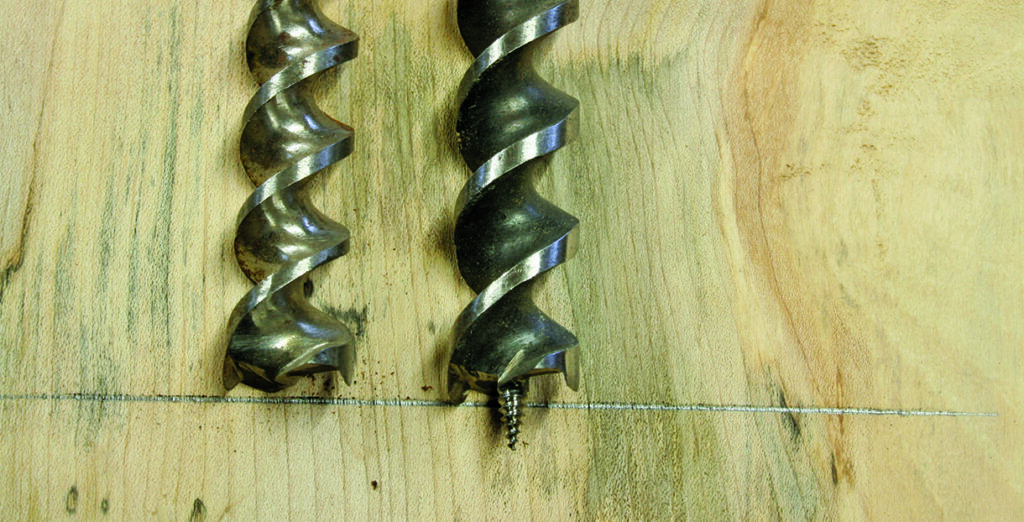
1. I use hand/power tools to drill my holes. You can use a drillpress and I’d recommend this if batch producing, but as most of my chairs are one-offs it’s not a tool I use regularly, so we’ll focus on drilling by hand and the bits I use. The first selection are a series of auger bits. Traditionally, they’re used with a brace (hence brace and bit), but you can use some of these in a power drill if they have the correct shank. Pictured are mainly Jennings pattern augers with an Irwin pattern that has a solid centre (third from the right). I find in hardwoods the Irwin pattern clogs less but the Jennings gives a cleaner hole. As with most woodworking tools either will work best when sharp!
Drill bit creating hole in wooden plank.
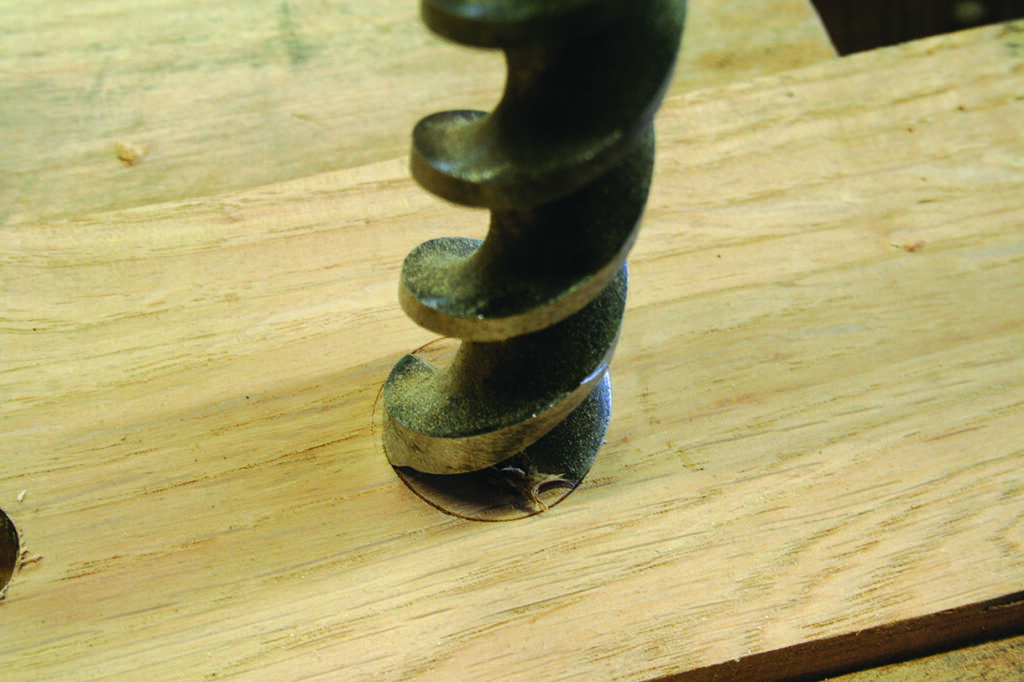
2. Both bits have a spur which can be easily damaged; this cuts the fibres of the wood before the drilling area starts cutting. This gives a clean hole. The lead screw has a specific pitch which means you can work out how many turns will give you a defined depth of cut (e.g. 20 turns will give 25mm depth of hole). The lead screw is also useful when you are ‘eyeballing’ the angle of cut – twist the brace for a couple of turns, then before it actually starts cutting you can guide the angle
Man using hand drill in workshop.
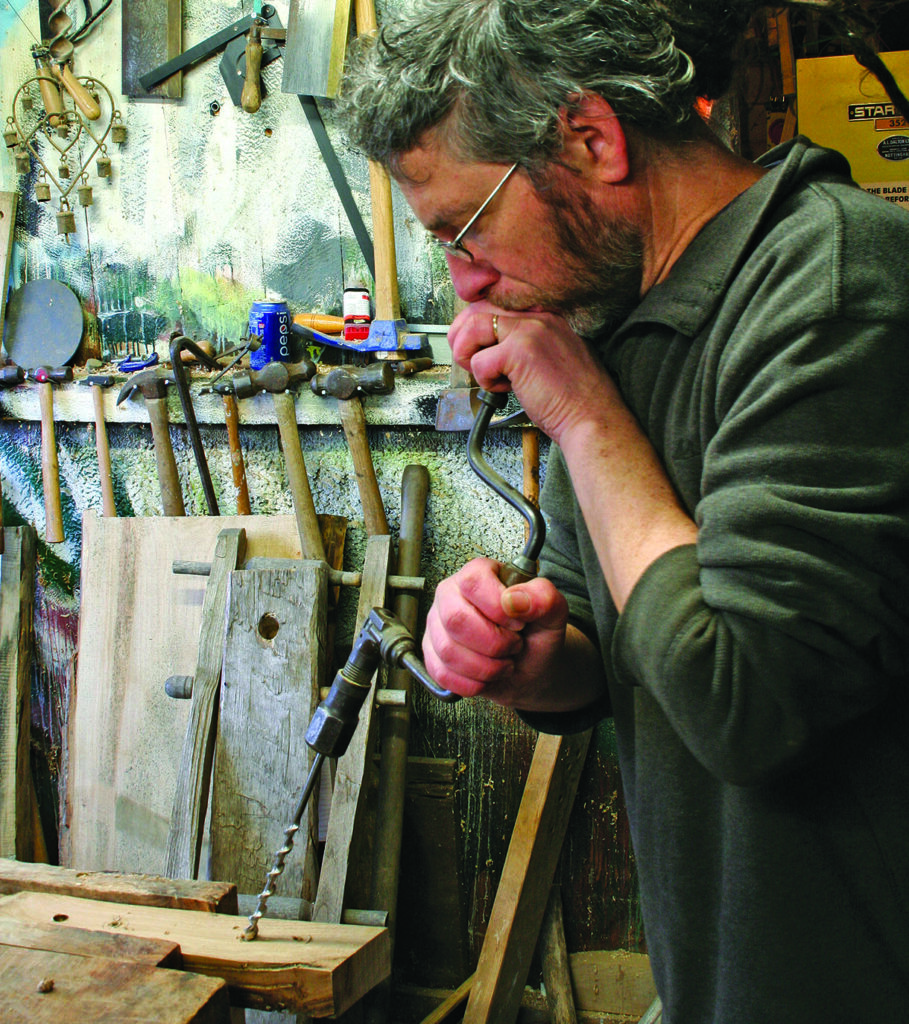
3. When drilling with a brace you need to keep the top wooden pad secure and not allow it to ‘wobble’. This gets harder as you increase the diameter of the bit, but I find my chin or chest the most secure place to brace against. As you twist the handle, counter its pull with equal pressure in the opposite direction on the top
of the brace. The auger bits have a lead screw which pulls the bit into the hole. You need to guide the bit but not ‘push it’ into the work
Four metal woodworking chisels on wooden workbench.
4. The second set of drills I use are spoon bits, which were one of the first drill bits manufactured. Still popular today for traditional chair-makers they do have some advantages; with no lead point you can drill a hole to its maximum depth without breaking though (when drilling you can feel the wood moving before they break through), they cut extremely quickly and cut at any angle so are excellent for using on the curved backs of chairs. The round bottomed hole created is strong and if you dome the end of your tenon you gain an extra 6mm depth, creating a much stronger joint
Chisel carving into a wooden plank.
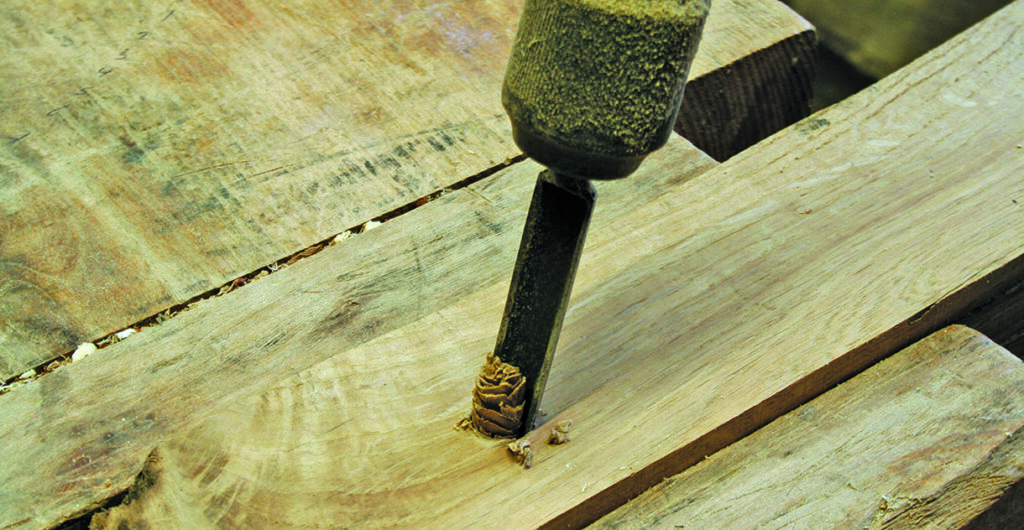
5. The spoon bit is started perpendicular to the work then as the bit bites, while still turning the brace, you gradually change the angle of the cut
Wooden surface with a chisel and wood shavings.
6. With a sharp bit you should produce some lovely spiral shavings
Five Forstner bits on a wooden surface
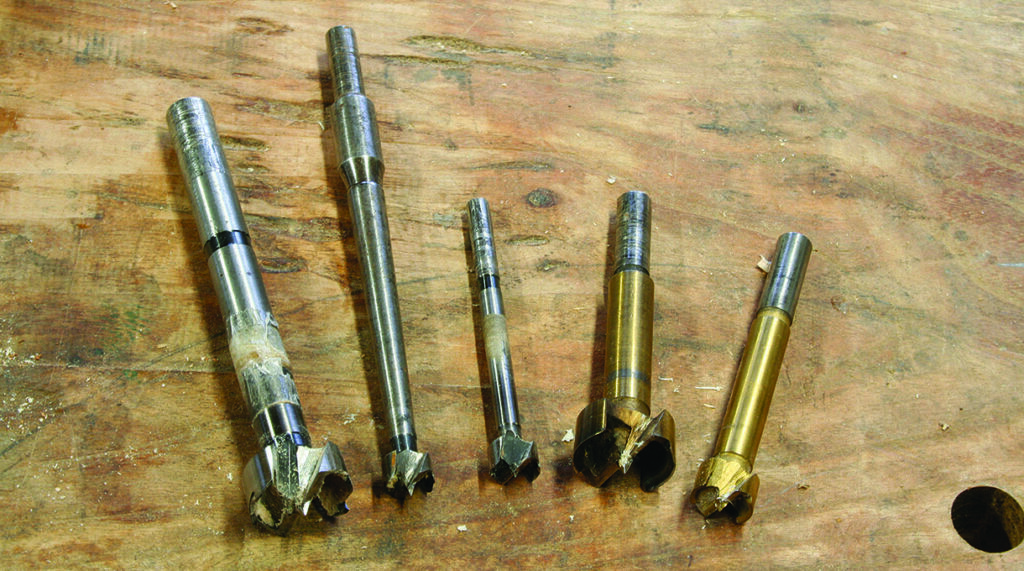
7. I use flat bottomed saw-tooth (left) and Forstner bits (right). They are designed to be used in a drillpress but I find them extremely useful in chair-making using a cordless drill. They cut cleanly when sharp and have a short lead point giving deep holes
Woodworking drill bit on wooden plank
8. When you use these drill bits to drill angled holes, as you move the bit to the desired angle it can slip forwards creating an enlarged hole. To eliminate this start your hole with the bit vertical. When you have cut the initial circle 2mm deep there is a ridge all around supporting the bit, then slowly (with the bit still cutting) bring the bit to the desired angle. The front of the hole will support the cut and stop the drill bit dragging forward
Four vintage woodworking tools on wooden surface.
9. A less useful bit historically used for chair-making is the centre bit. It does have a tendency to wander while drilling but a slow feed (dependent on pressure from you) means you can feed until you can feel the tip of the bit just protruding. This will give you the deepest tenon and the tiny hole created won’t be noticed
Assorted spade drill bits on wooden surface.
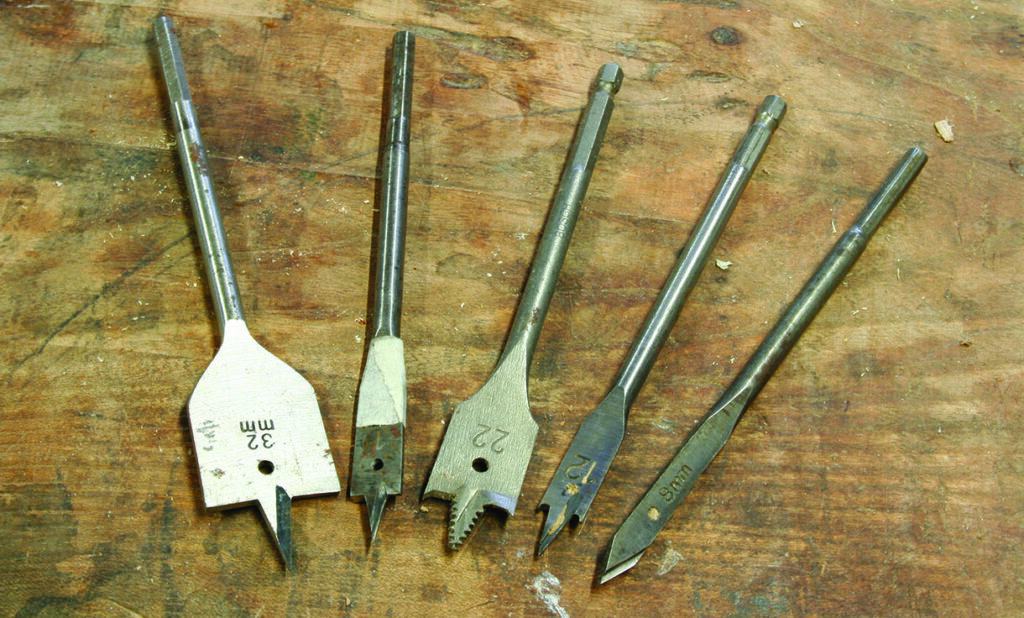
10. The modern flat bits can be useful but do have many limitations. They have a long lead point which reduces the available depth of tenon but they cut quick and accurate holes
Long and short drill bits on wooden table.
11. The long lead point does make it easier to start at an angle and when used in conjunction with an extension will increase accuracy in drilling
Woodworking tools creating grooves in wood
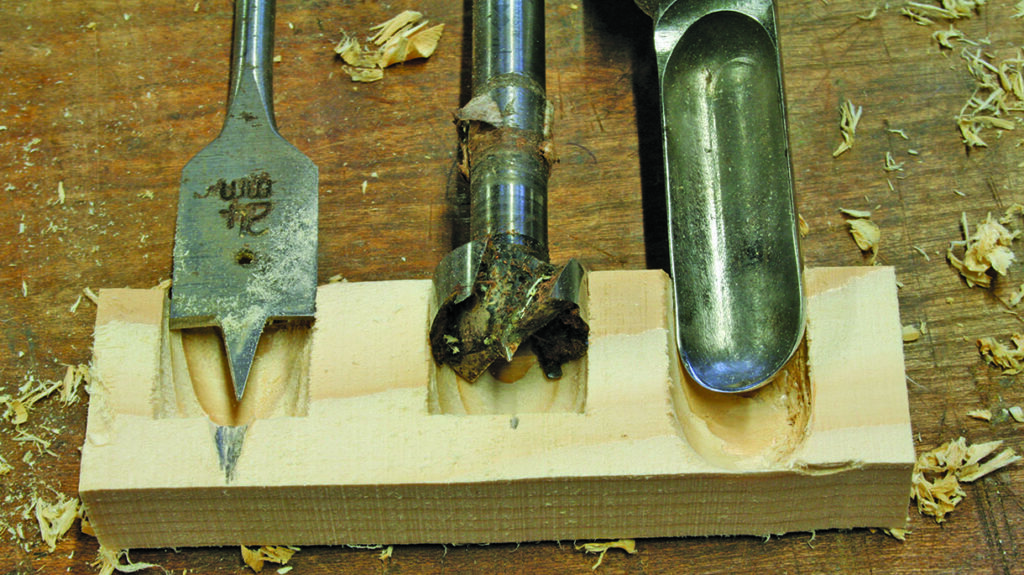
12. In this picture you can see the relative merits of different drill bits when trying to form the deepest hole without breaking through. Note the flat bit has a long lead point giving a shallow hole, while the sawtooth and spoon bit with little or no lead point will give the deepest holes
Two drill bits on wooden surface
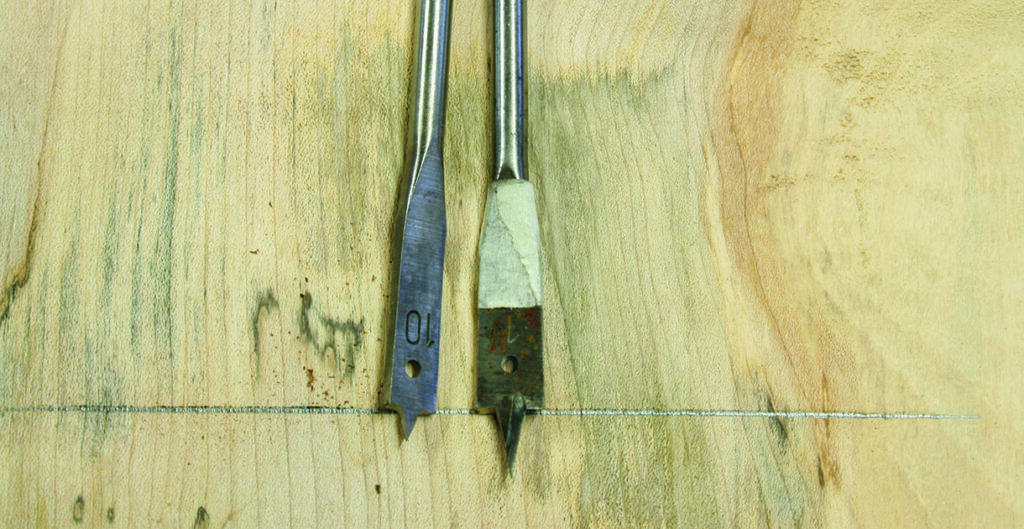
13. You can of course adapt your drill bits to the job; here I’ve ground down the lead point of a flat bit reducing the chance of breakthrough
Two drill bits on wooden surface
14. Here, just to finish off a hole and increase its depth, I tried filing off the lead screw – with lots of pressure you can increase the hole depth, but in practice it isn’t an ideal solution. I now deepen the hole using a sawtooth bit after the initial auger work
Assorted drill bits on wooden surface.
15. Standard metal and wood twist bits work well. The lip and spur bit enables accurate placement, cutting a quick clean hole. The diameter is accurate and easily matched to a tenoning tool
Drilling holes in wood on workbench
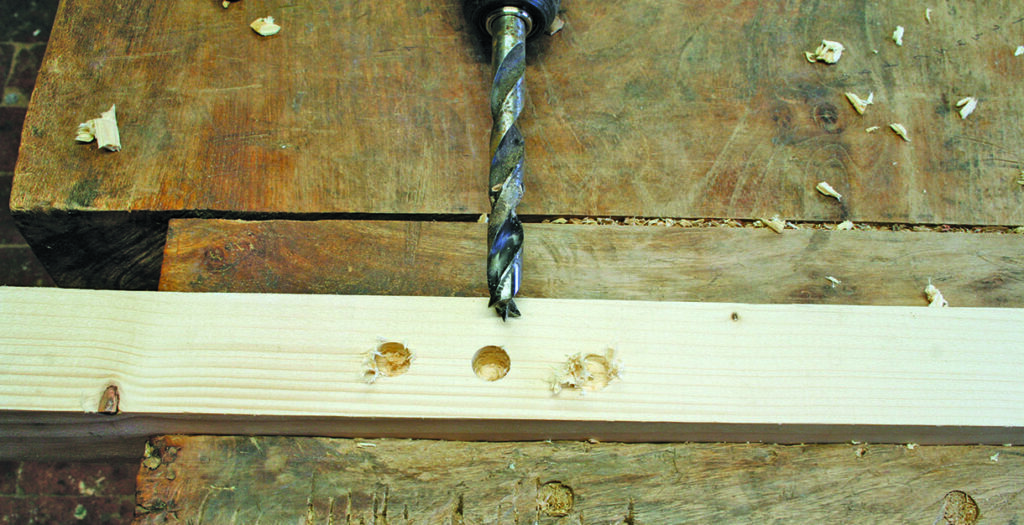
16. There is a correct way to use twist bits; if used incorrectly you will be left with ragged holes. Always start the hole with a high speed and a slow feed rate. Pictured you can see holes drilled with (L–R) slow speed/slow feed, high speed/slow feed, high speed/high feed

Leave a Reply

Your email address will not be published. Required fields are marked *