Derek Jones assesses the risks
Based on information collected by the HSE in relation to industrial accidents in woodworking workshops, circular saw tables account for more accidents than any other machine. Fact. As nearly every scrap of wood that enters the workshop is likely to pass over this piece of equipment you could argue that it’s hardly surprising. Or on the other hand you might wonder why that should be, when generally speaking the more often you complete a task, like throwing darts or cutting dovetails, the better you’ll get at it. Trouble is, fail to perform at your best at either of those tasks and the worst you can expect is a low score or a gappy joint. It’s no big deal I guess, there’s always next time. An error of judgement while operating a tablesaw, however, could mean there won’t be a next time.
The words risk assessment will either scare the pants off you or bore you to tears and although they’re the essence of this article I’m hoping we’ll get to the end with everybody wide awake, suitably attired and better informed. For the most part, most injuries sustained while operating a tablesaw are as a result of inadequate or missing guards. The very same guards in fact that if you bought your machine from a reputable dealer will have been supplied and perhaps even fitted for you, which raises the question why do so many users prefer to operate their machines without them? I have a theory based along the lines of a shared ignorance being endorsed by influential role models with a fixation for convenience, but it’s more complicated than that. And as even the most rudimentary studies into human behaviour suggest that a high proportion of what we learn comes from observing and repeating the actions of others, it’s no wonder the habit is of endemic proportions.
There’s an interesting line on the HSE Woodworking Information Sheet for circular saw benches stating: ‘Inaccurate or lack of training for the operator was also found to be a major cause [of accidents]’. Although this version was only published in November 2011 it already looks a tad dated and is perhaps missing one important piece of advice relating to the quality of online instruction where, if the numbers are accurate, millions of people acquire knowledge of the subject. My concern is more of a rhetorical question about who might be held responsible for an accident resulting from watching and repeating another person’s bad habits. So, in an attempt to encourage more woodworkers to adopt examples of good practice what follows is some advice to help you avoid some of the most common unsafe practices.
Assessing the risk
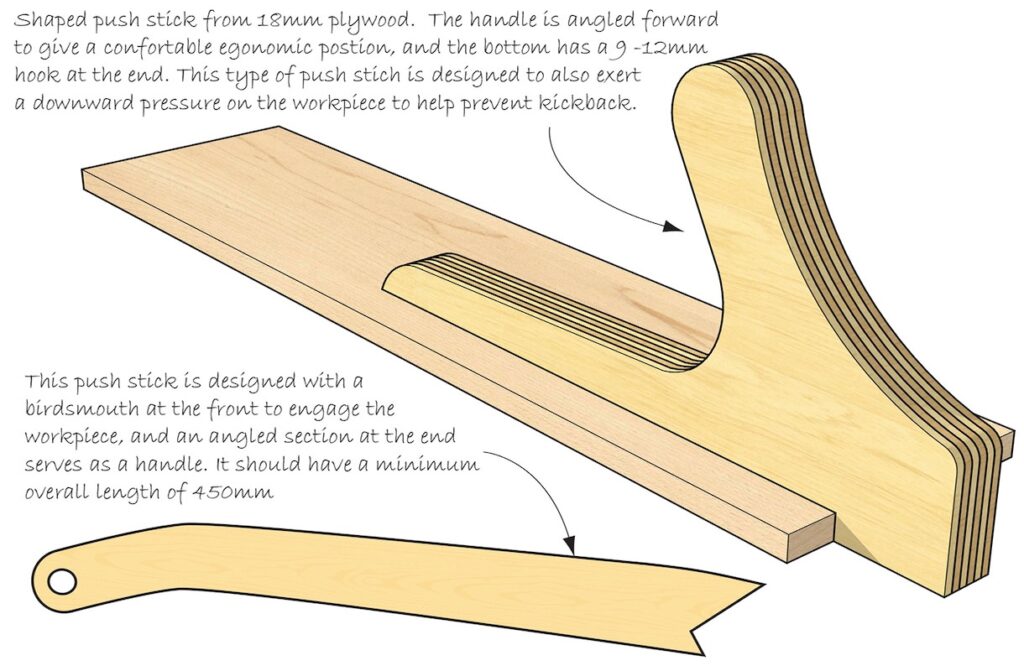
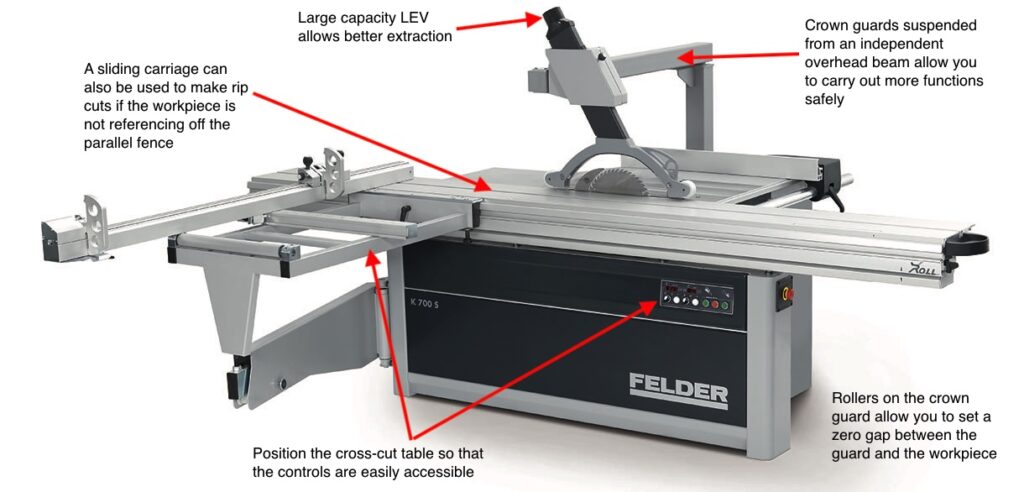
Perhaps it’s no small coincidence that the safest methods of working are also the most efficient and accurate. The same holds true for the majority of hand tool work as well as machine work with some very obvious examples. One of the first things you learn when you start to shape wood using hand tools are the benefits of developing a range of effective work-holding solutions. Simple devices like a bench hook, a vice, clamps and even a workbench are things we readily employ to make life easier. The basic principle of holding work securely is no different when applied to machine work. When it comes to assessing the suitability of a process to be carried out on a tablesaw, things to consider are, how the workpiece is supported and what method will be used to propel the component during the cut? On a tablesaw the former is likely to be either a parallel fence or cross cut attachment unless the machine is equipped with a sliding carriage, which also allows more options for ripping. As manpower is the most convenient method of propulsion, consideration should be given to the precise nature of any work-holding apparatus. If after much deliberation the best you can come up with is your hand, you may need to either rethink the process entirely or reach for a suitable push stick. Push sticks may look and feel a little cumbersome at first but with practice afford tremendous control over feed rate and pressure and are infinitely replaceable in a way that your digits are not.
Consider alternatives
It’s possible to perform operations like grooving, trench cutting and rebating on a tablesaw but there are other machines that are better equipped to do so, such as a router or spindle moulder. In fact the results from using either of these alternatives are often better than those obtained from a tablesaw. Stopped grooving should not
be carried out on a circular saw.
Riving knives, what are they and what are they good for?
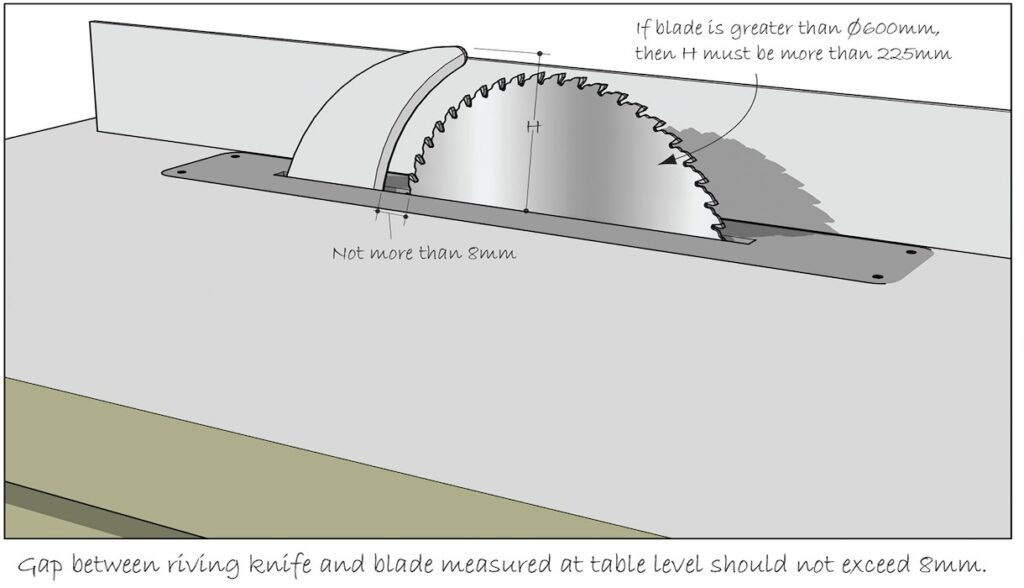
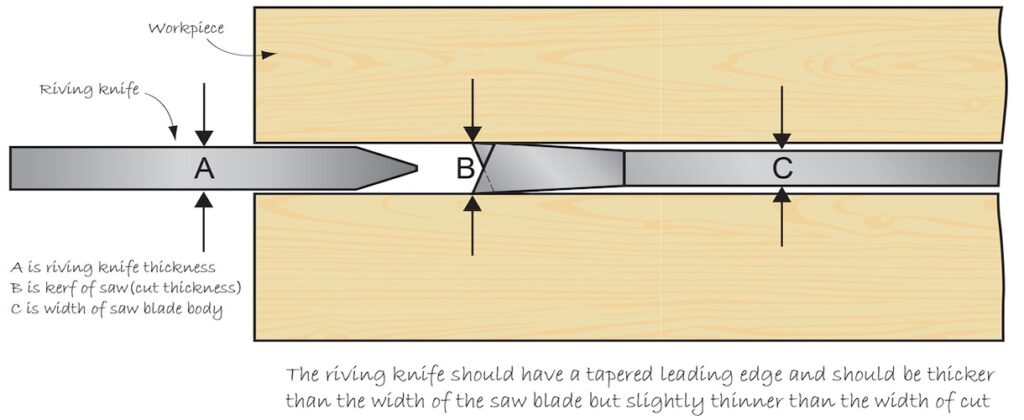
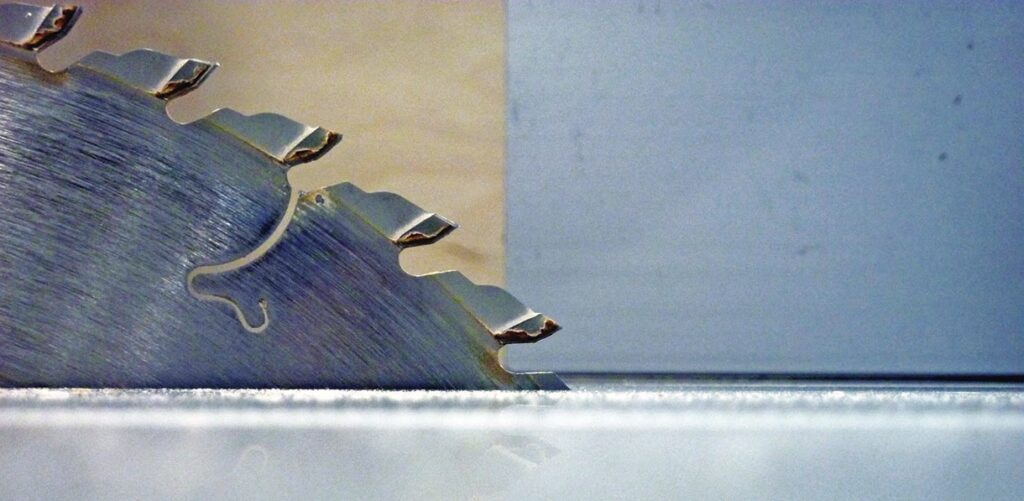
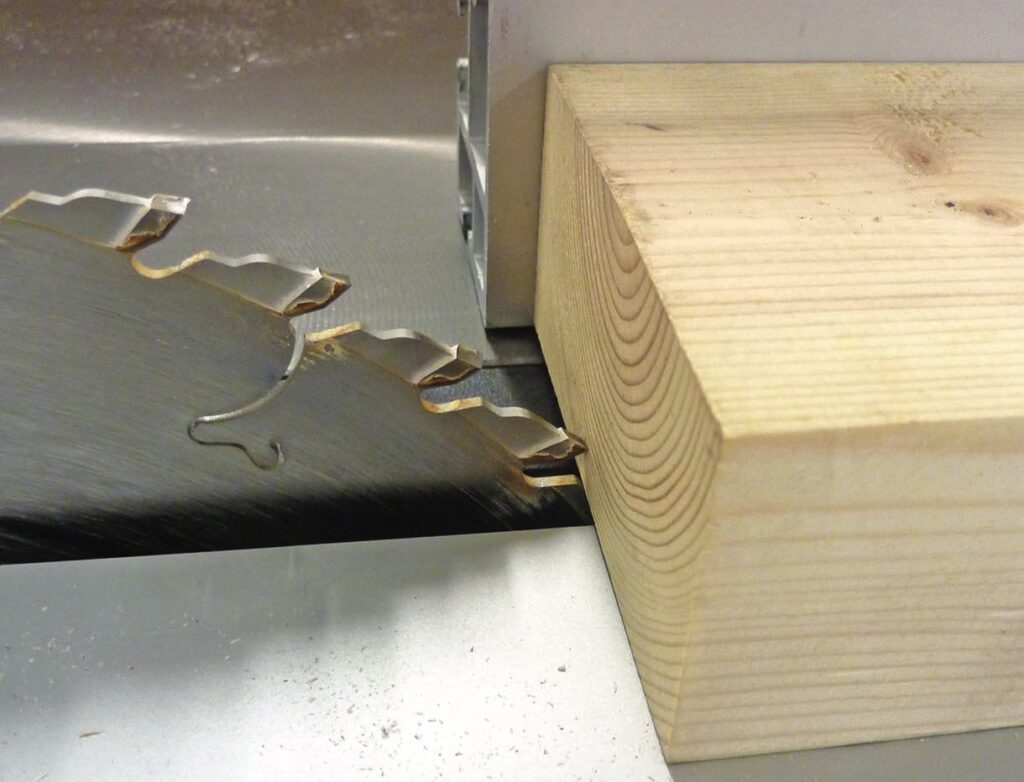
The riving knife is that crescent-shaped piece of metal that’s attached to the machine below the surface of the table directly behind the blade. The curve may not be identical to that of the blade and it may feature holes designed to accept a top-mounted guard. The purpose of the knife is to prevent material from closing in on the blade after it has been cut as it passes beyond the back of the blade. The blade at this point is rising up towards the material and when combined with a slowing down of the blade is one of the causes of kickback. Kickback is the term used to describe what happens when a piece of material is suddenly ejected from the path of the blade often without prior warning and sometimes with devastating results. A riving knife needs to be thicker than the plate of the saw blade but thinner than the kerf. The kerf being the thickness of the cut which is determined by the combined offset of the teeth. The HSE don’t recommend an optimum measurement on their worksheet for the difference in thickness between knife, kerf and saw plate but do have guidelines for setting the gap between the front edge of the knife and the back of the saw blade. At table level the optimum gap should be no more than 8mm.
A riving knife needs to be set in line with the blade, which is why they are fitted to the saw arbor on tilt arbor saws. As the blade is tilted the knife follows. On fixed arbor saws the knife can be mounted differently, these are often referred to as splitters and depending on where you come from the names are interchangeable.
Saw blades in general
In much the same way that a hand saw filed with a rip tooth pattern can be used to make a cross cut, it won’t do it very efficiently. You’ll get breakout on nearly every edge and the cut surface will be rough. Circular saw blades are no different so you need to select a blade that’s suitable for the task at hand. Some coated sheet materials do respond better to specific tooth geometry but as the choice is too vast to cover in this article, a general-purpose blade plus a dedicated rip is a good place to start. These will cope with the majority of sheet material and solid timber.
The diameter of the blade is also an important factor in determining safe practice. Manufacturers will provide information about the smallest diameter blade that can be used on the machine and this should be clearly marked on the machine or the blade cabinet so operatives are aware of the limits. Smaller blades have a low peripheral blade speed and under strain are more likely to stall and result in kickback. Generally it’s not physically possible to fit a blade that’s too big for the machine but again highlighting this information where operatives can see it is an excellent idea.
‘Sharpness fixes everything’
We can thank the influential hand tool woodworking expert Chris Schwarz for this little gem. It’s a user-friendly recommendation for achieving optimum performance from your hand planes instead of the numerical sudoku-like challenge of matching blade pitch and bevel angle.
Circular saw blades also work better when sharp as they require less effort to feed the work and are more able to maintain their optimum rotational speed. High buildup of resin and other deposits on or behind the teeth also affect the performance of the blade and should be removed before they build up.
Tip: Oven cleaner also works as an excellent cleaner for saw blades.
Workpiece support
Whether large or small, the workpiece needs to be supported for the entire duration of the cut, that’s before, during and after. Large pieces can be supported by either roller supports or extension tables and smaller pieces by guides or jigs. Infeed tables are just as important as outfeed tables and both should be checked and adjusted regularly as part of your regular maintenance regime. If a second operator is working at the outfeed end to remove cut pieces the distance from the edge of the table to the saw spindle needs to be 1200mm. The second operator should under no circumstances reach forward to retrieve pieces and should at all times remain at the back of the saw while it’s in operation. In this instance communication is the key to safe working and both operators need to be aware of the limits with which each are working before the process
begins. Appropriate PPE (ear defenders and goggles for example) should be worn by both operatives.
Ripping
Ripping is the term most often used to describe a cut along the length of the workpiece. It is also used to describe a cut that runs with or in close proximity to the direction of the grain on solid timber. There are a number of ways in which you can carry out a rip cut on a circular saw. Running the workpiece against a parallel fence is the most common method for both sheet material and solid timber. On saws that feature a sliding carriage it may be possible to use a jam stop to secure the workpiece to the carriage and complete the cut without the use of a parallel fence. It is not recommended to use both. There can be tension in dry seasoned wood as well as unseasoned timber causing it to open up further than the width of the kerf behind the blade directly after the cut. To allow the material to expand freely the fence needs to be adjusted accordingly so that it doesn’t force the material back into the path of the blade. The correct setup should be to slide the fence forward towards the operator so that the back edge of the fence is in line with the bottom of the gullet at table height at the front of the blade.
Guards
As this magazine is read on several continents, with often different opinions regarding the safe use of saws, it’s impossible to give a definitive guide to what is required by law in your region regarding guards. Guards come in various shapes and sizes and some allow you to perform some processes more efficiently than others.
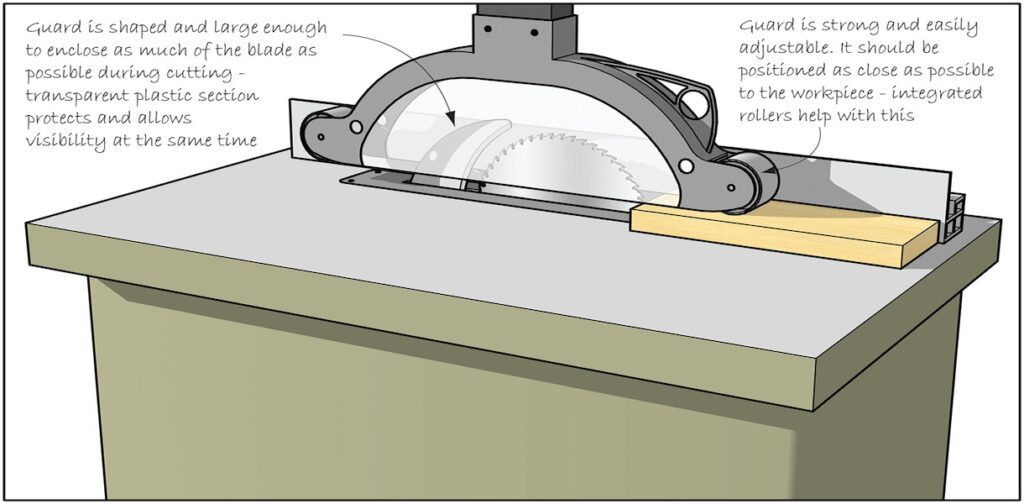
By far the most common type of guard found on a tablesaw will be the crown or top guard. It is designed to prevent access to the blade by creating a physical barrier between the operator and the blade. For crown guards to be effective it’s important to have them set up and adjusted for the type of cut you are about to perform. The correct setup is to have the guard as close to the workpiece as possible without interfering with it. Some guards feature rollers at the front and back that allow the guard to be lowered directly on top of the workpiece thus creating a zero gap between both items while the cut is being made.
Crown guards also perform another very important function as one of the local exhaust ventilation (LEV) features of the machine. The closer it is placed to the workpiece the more effective the extraction.
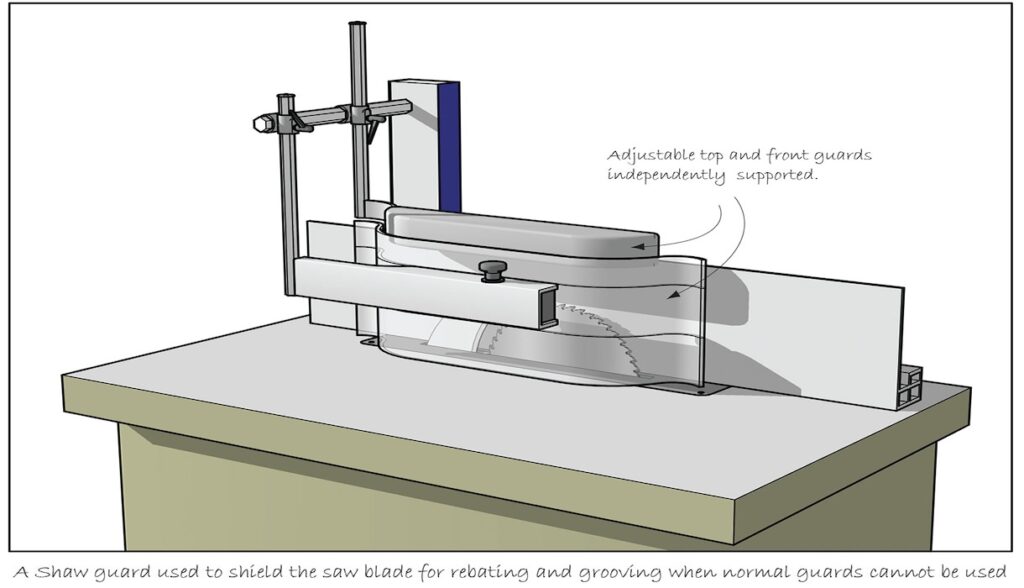
Shaw guards are another acceptable means of guard but do not cater for dust extraction. They are designed with sprung pressure pads that not only prevent access to the blade but also support the workpiece. They operate like a tunnel completely covering the blade from the side and top and are one option that means you can cut rebates and grooves safely on a tablesaw.
A word of warning
If you asked the millions of professional woodworkers using social media to promote their work if they considered their techniques to be promoting un-safe working practices, I think I know what the answer would be. If you asked them if their techniques could be altered to demonstrate a safer method for the benefit of those who perhaps don’t have years of experience in the field, I reckon a fair few would struggle. Being ignorant of the facts in most cases is not a defence so I wonder where we stand when it comes to broadcasting less than safe working practices. Is a ‘don’t try this at home’ hashtag sufficient advice? If my experiences are anything to go by, be warned, some folk don’t take too kindly to good advice. The next time you suggest that a guard might be a good idea and the response is a two finger salute, spare a thought, it might just be all they can manage.
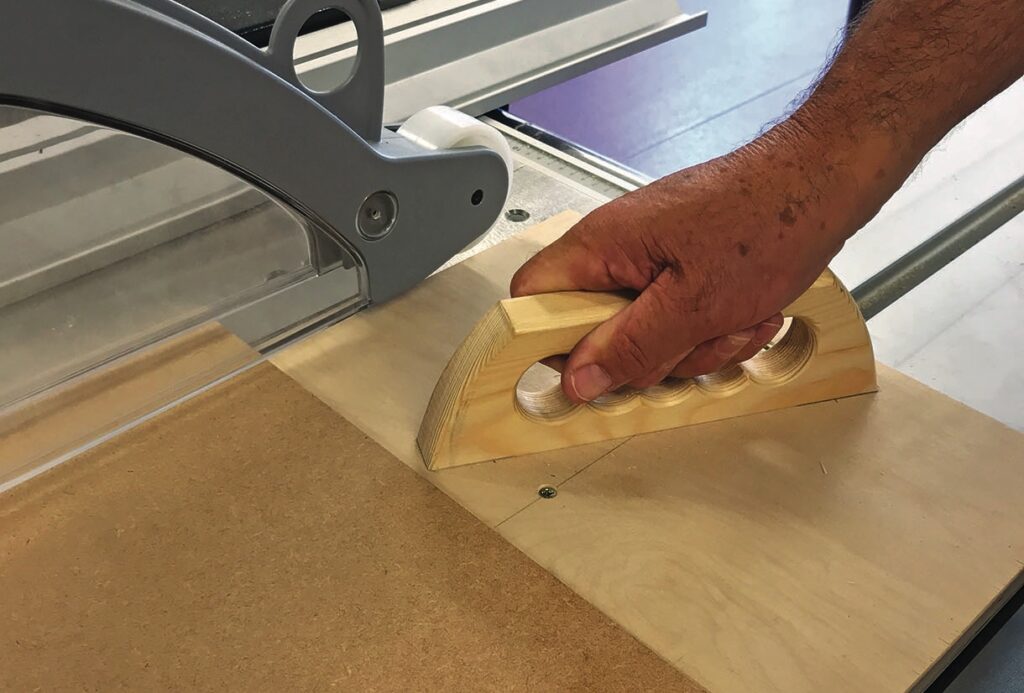
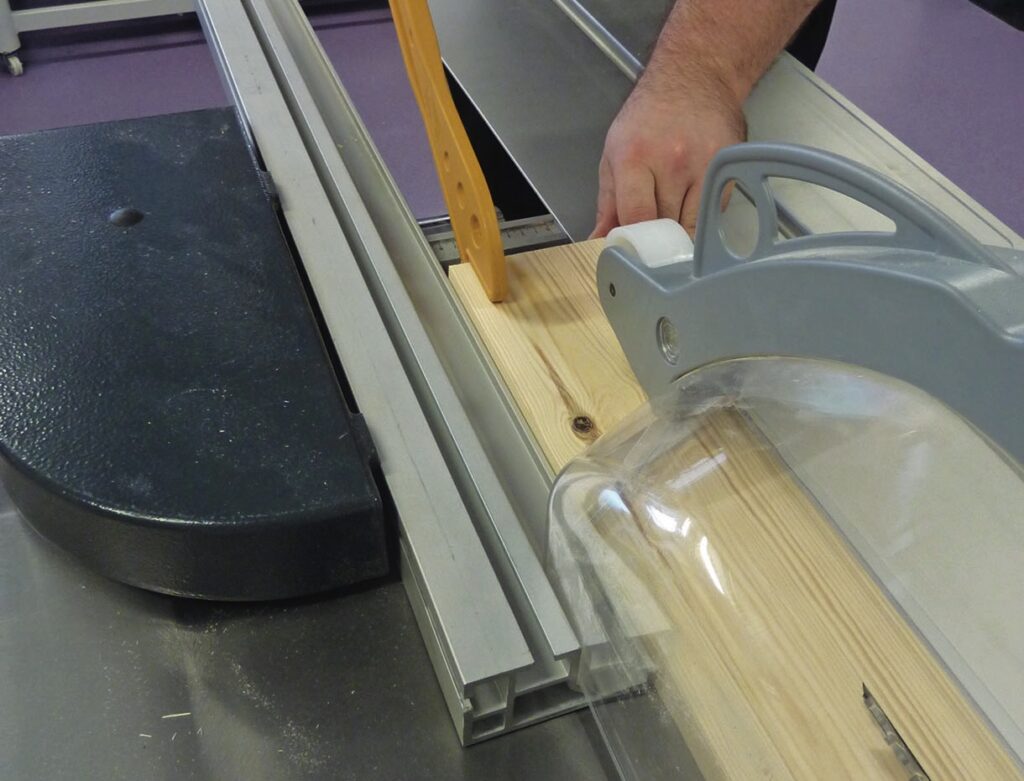
Stand up for push sticks