
Colin Sullivan looks at the power drill’s manual predecessors
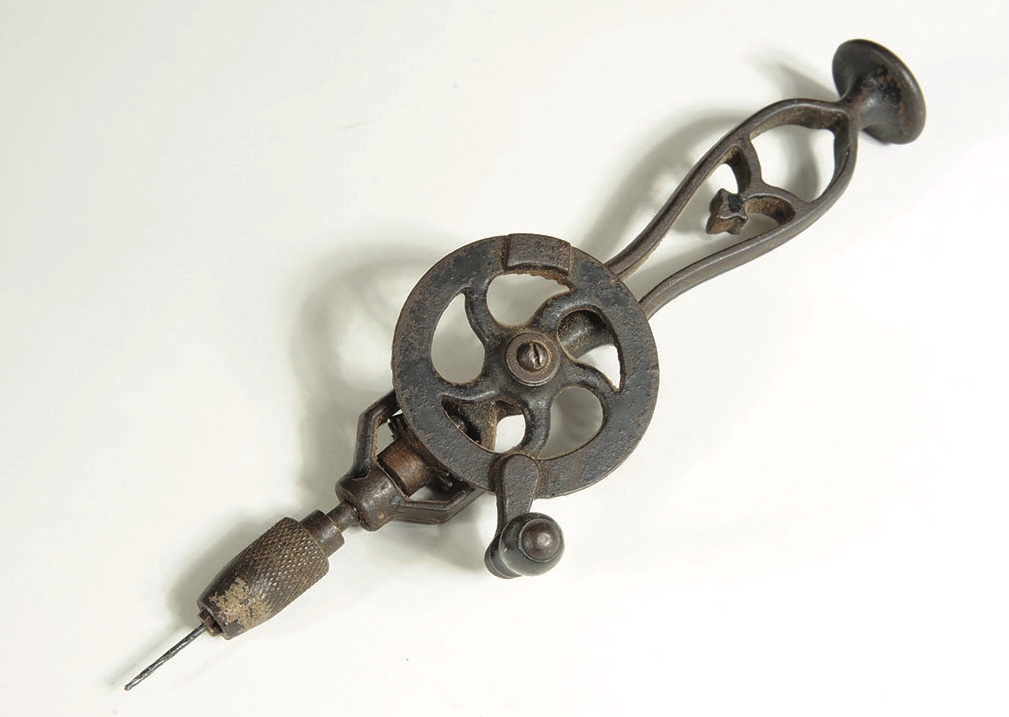
The wheel brace or hand drill relies on a bevel gear to make it work, transferring the rotary motion of the hand to a vertical or horizontal rotary motion of the chuck. By the 1850s bevel gears could be machine made accurately and were soon used on drills to improve their performance over the age-old brace and bit. The Americans in particular saw the advantages they gave and went into large-scale production; Millers Falls feature in their 1887 catalogue a full range of drills that were to set the pattern for the next 100 years. Close copies of these drills were later made in England but in my opinion few could claim to be as good and ingenious as the American imports.


At the beginning of the 20th century hand drills were offered in all shapes and sizes from 8in to 18in long, some with two gear ratios and with improved three-jaw chucks. They were given a variety of different names by tradesmen: egg beater drill, angle drill, gearing brace, corner brace and, my favourite, the twirly.
By 1816 there were simple hand drills made in either France or Germany with a forged iron frame and two gear wheels of the same size giving a one-to-one gearing. The bit holder was similar to the normal brace, using square tapered tangs.
Millers Falls was not the only company to make great hand drills; Goodell-Pratt and the famous Yankee company also made various ingenious designs. Record tools also offered a range of drills in England.
The three-jaw chuck we use today was developed by Millers Falls – as far as I can find out – from a simple two-jaw chuck around the early 1900s, making it possible to hold drills up to ½in securely, easy to open and close with a twist. Another nice detail was to have the handles hollow with screw tops to contain a set of drills, some had removable handles for the same purpose. Only the best materials were used on these drills up to about 1940, cocobolo handles – often mistaken for rosewood – with nickel-plated brass ferrules; attractive, functional designs that still work today just as they did originally. In fact, restoration of these old drills is usually no more than a case of removing the rust, repainting the metal parts and maybe taking up some of the wear by filing various parts.



I think these drills certainly deserve a place in any workshop alongside the power and cordless drills, holding a countersink bit or a regularly used pilot or clearance drill – remember, they even work when the mains power is cut off!


Drilling dead upright holes is not easy by hand with any sort of drill, unless you can see both ways at once and still turn the handle, and so I hit upon the idea of sinking a round spirit level into the top of the handle as shown above. The result is great, upright holes every time – how simple.
One Response
Hi I’ve recently purchased an early iron wheel type style breast drill but it has a 4 jaw chuck with a tightening wing nut, uncommon so I assume its a hybrid ,the chuck has been added at a later date.Any info would be appreciated.