The Woodworkers Institute

We bring you the very best of woodworking!

“Make it with us”

Hens on a fence

Zoë Gertner shows how to have some fun by carving a delightful trio of hens
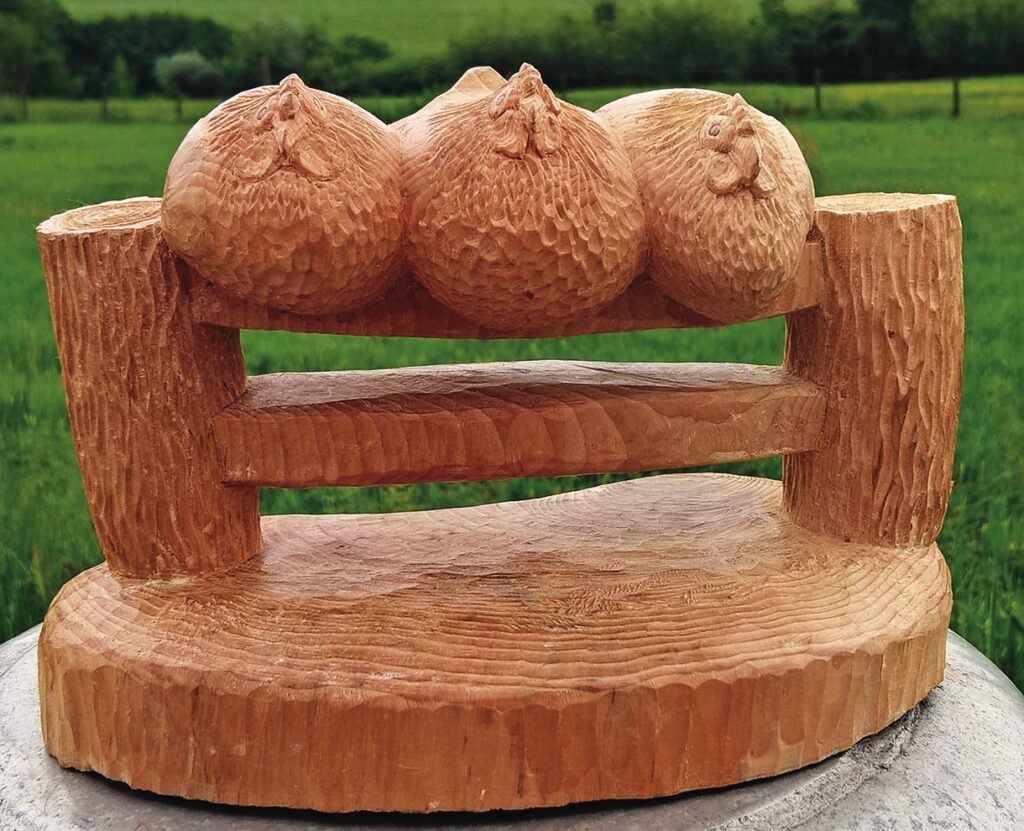
Wooden bench with hen-shaped details in countryside.

The inspiration for this carving came from my bantam hens. My hens are free-range and are very happy during the daytime, busily occupying themselves picking and scuffing the ground whilst hunting for ‘hen delicacies’. As dusk falls they will make their way into their hen house and with some shuffling around, they arrange themselves, fluff themselves up and sit tightly together on the perch for the night. When settled in place, heads are put under wings, sleep commences, and I close them up for the night in case of any predators.
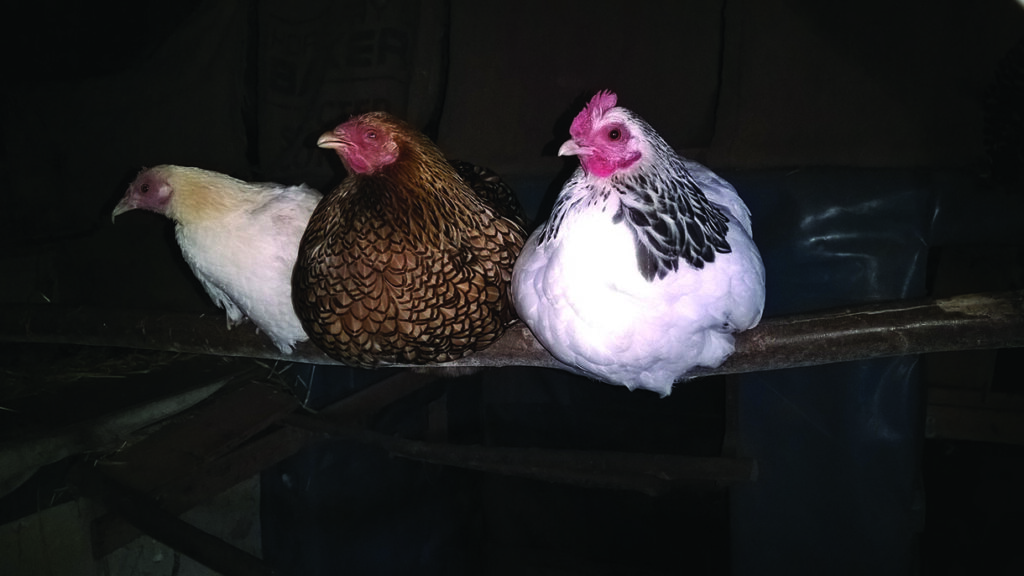
Three chickens perched on a branch at night.
Next morning, as daylight breaks, as I open up the house, they are bright and alert , ready to begin a new day again.

Things you will need

Tools:
• Personal and respiratory protective equipment
• No.9, 10 or 11, 3mm
• No.9, 6, 10, 12 and 13mm
• No.5, 6, 10 and 13mm 
• No.3, 3, 6, 10, 13 and 25mm 
• No.1, 6mm 
• 3mm and 6mm V-tool
• 6mm skew chisel
• Mallet
• Small microplanes/files/rifflers
• Hand drill 
• 6mm drill bit
• Handsaw and keyhole saw
• Nail punch
• Hammer

Materials:
• Timber of your choice to suit the size of project you intent to create
• Wax polish or finish of your choice

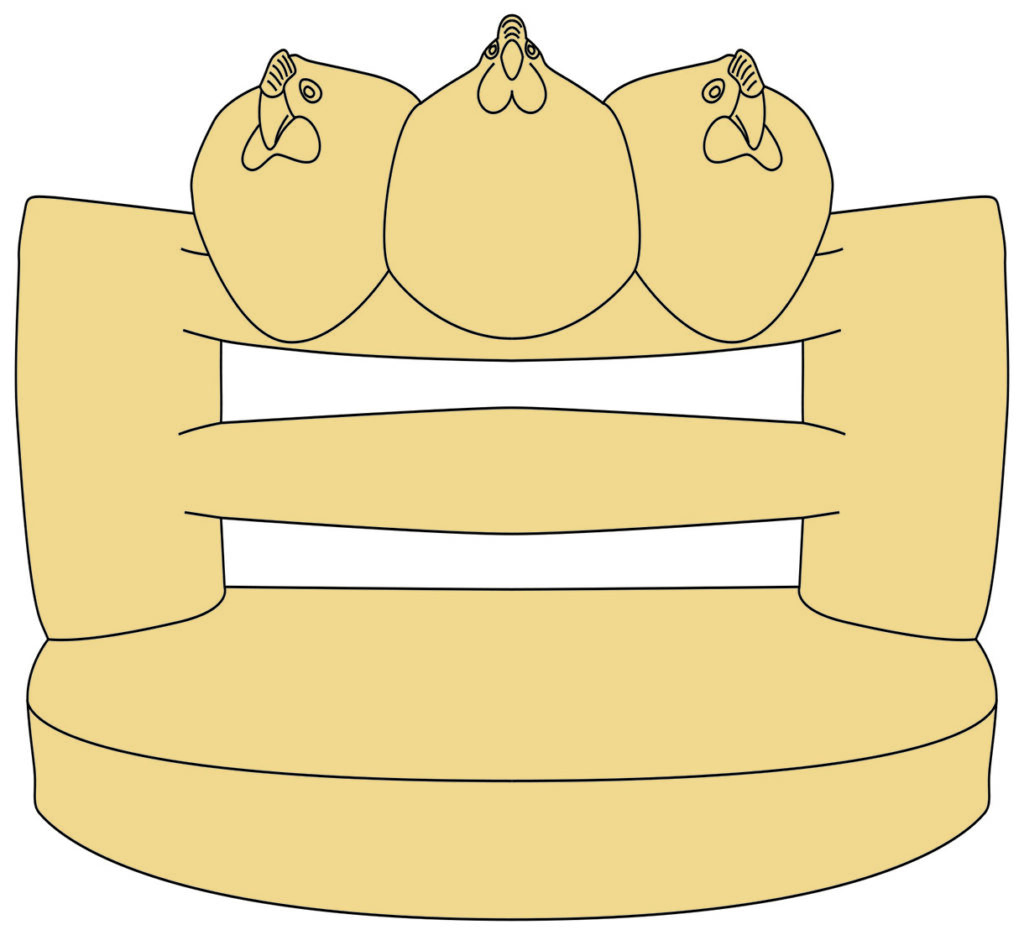
Drawings
Three wise monkeys illustration of sofa.
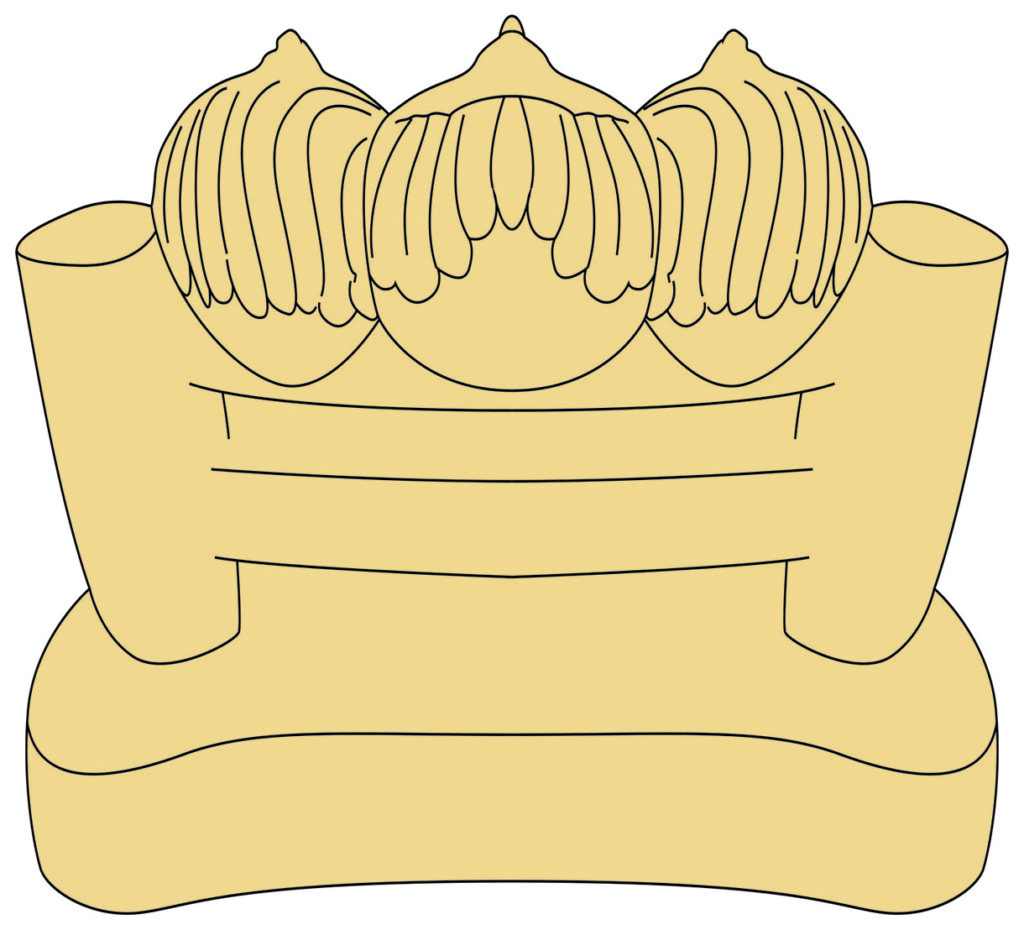
Front
Illustration of three seated lions on pedestal
Back
Illustration of mysterious ancient stone sculpture
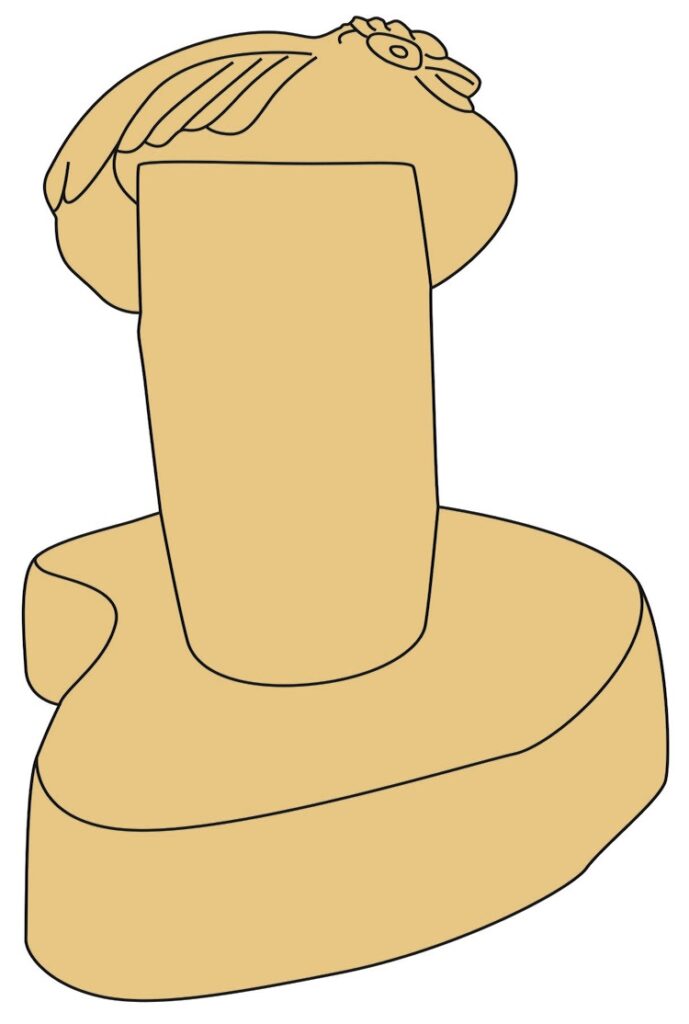
Side

Preparation

Tree cross-section with hen's eggs drawn.
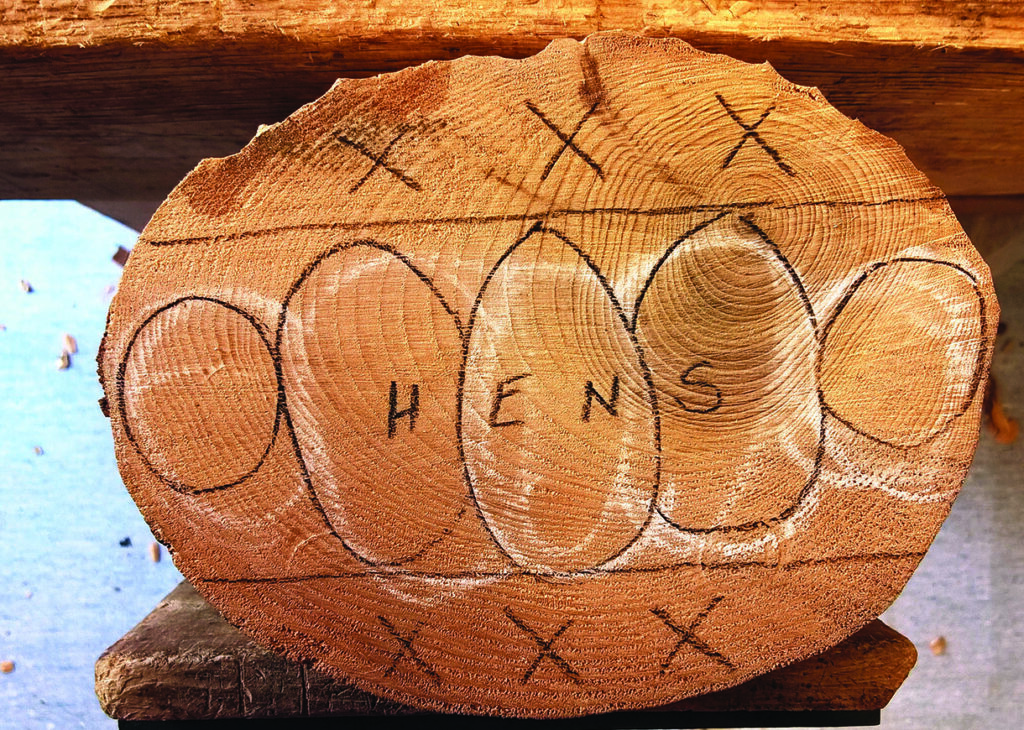
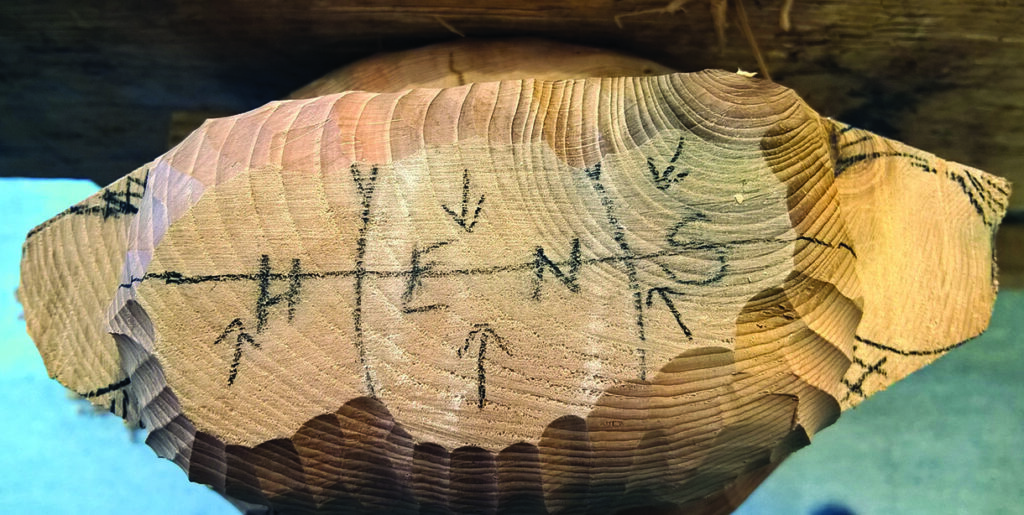
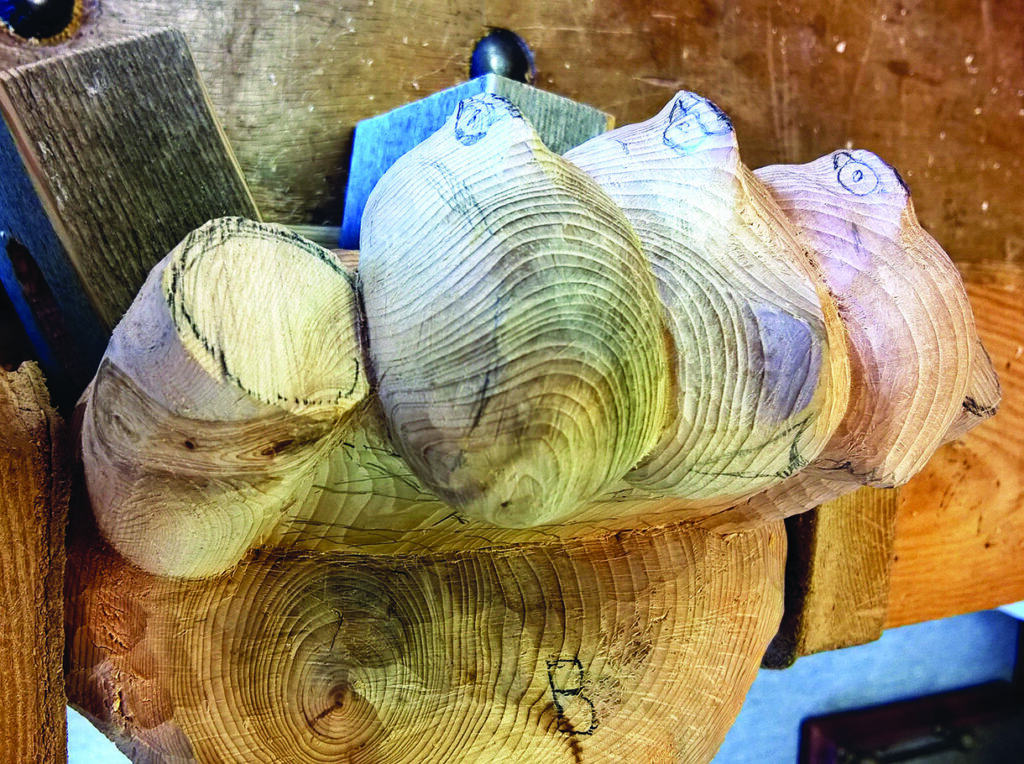
1. I chose to use a cedar (Cedrus spp.) log but you can use any timber of your choice. It needs to be about 200mm diameter x 120mm high. Since I used a log, the bark was removed and flattened beneath with a wide No.3 gouge and mallet. A V-channel was cut round it, marking the base of the carving. Draw the top view of hens perched on the fence between the posts on the upper surface with the areas in front and behind the hens to be removed marked with ‘X’ as shown
Saw cutting through marked wooden block.
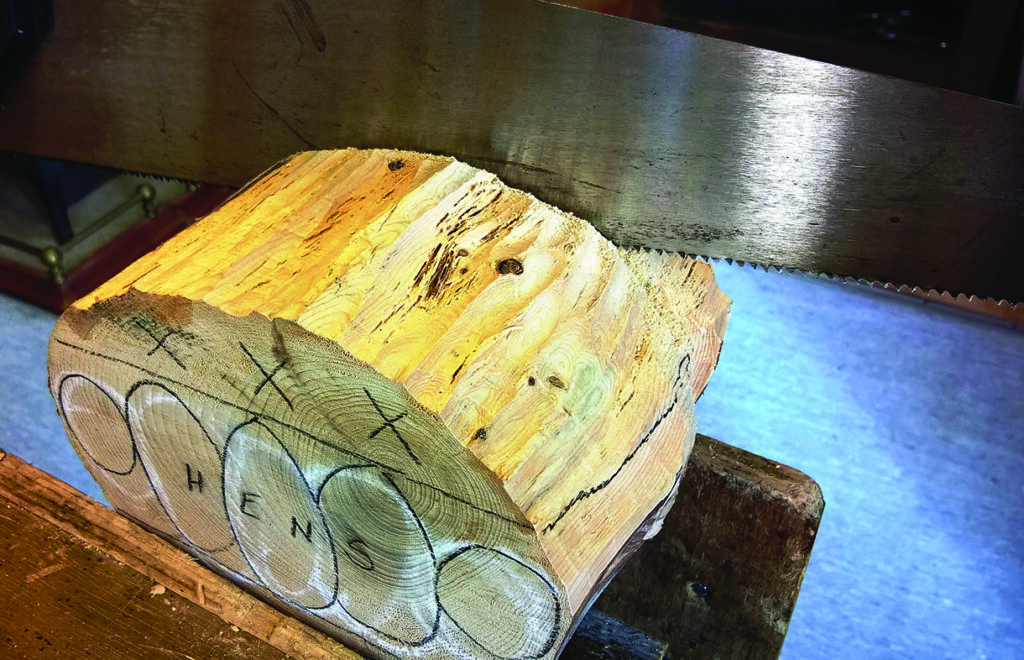
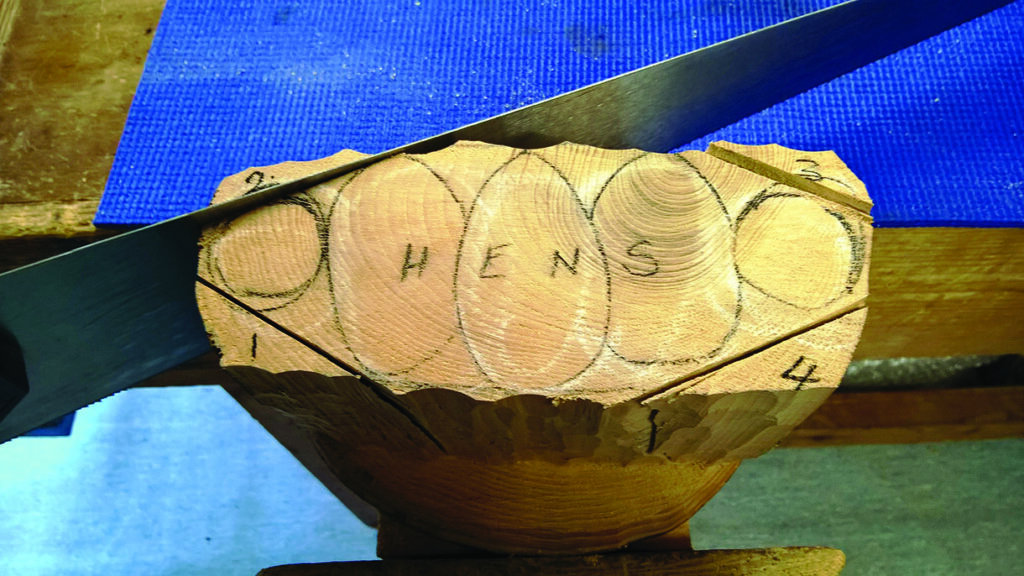
2. Place the handsaw in the previously cut V-channel and make a horizontal cut up to the base of the fence posts each side of the fence. Now  saw down vertically in front and behind the birds, meeting up your vertical and horizontal sawcuts and removing the areas marked ‘X’; alternatively, with a wide No.3 gouge and mallet split off narrow vertical slivers down to the initial horizontal sawcuts
Saw cutting round wood piece with numbers marked.
3. These areas removed, work in the same way across the corners in front and behind posts both ends of the fence
Wood carving plan with hen rail design.
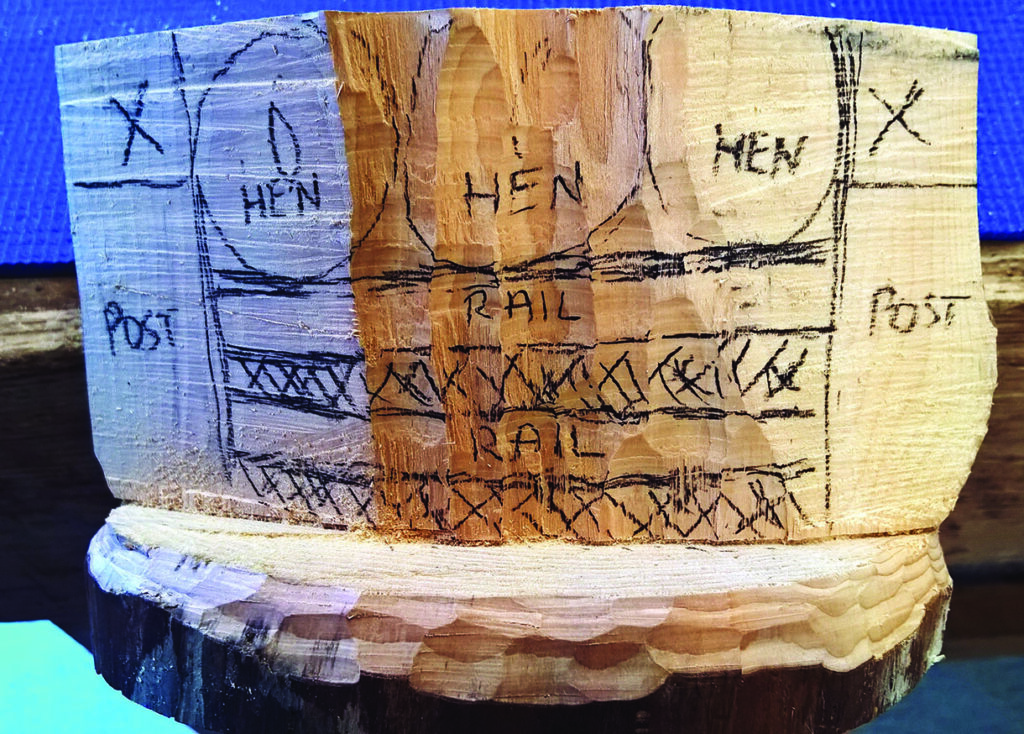
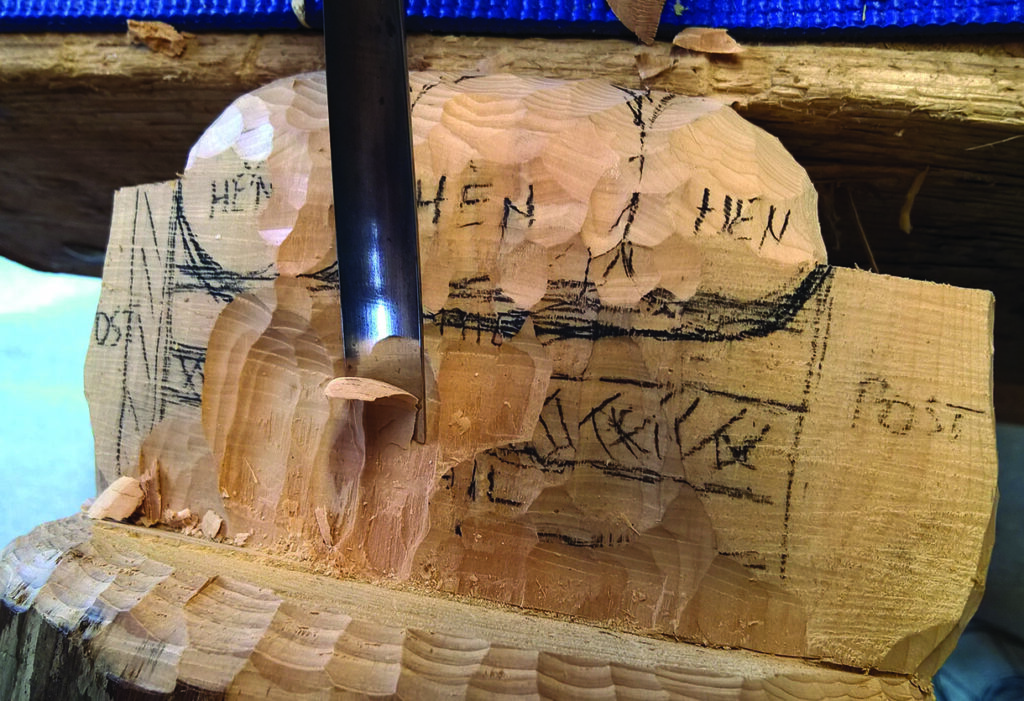
4. Draw hens, rails and posts on front face and mark areas to be removed above top of posts and between rails and the lower rail and base
Wood carving with labelled sections and blue background.
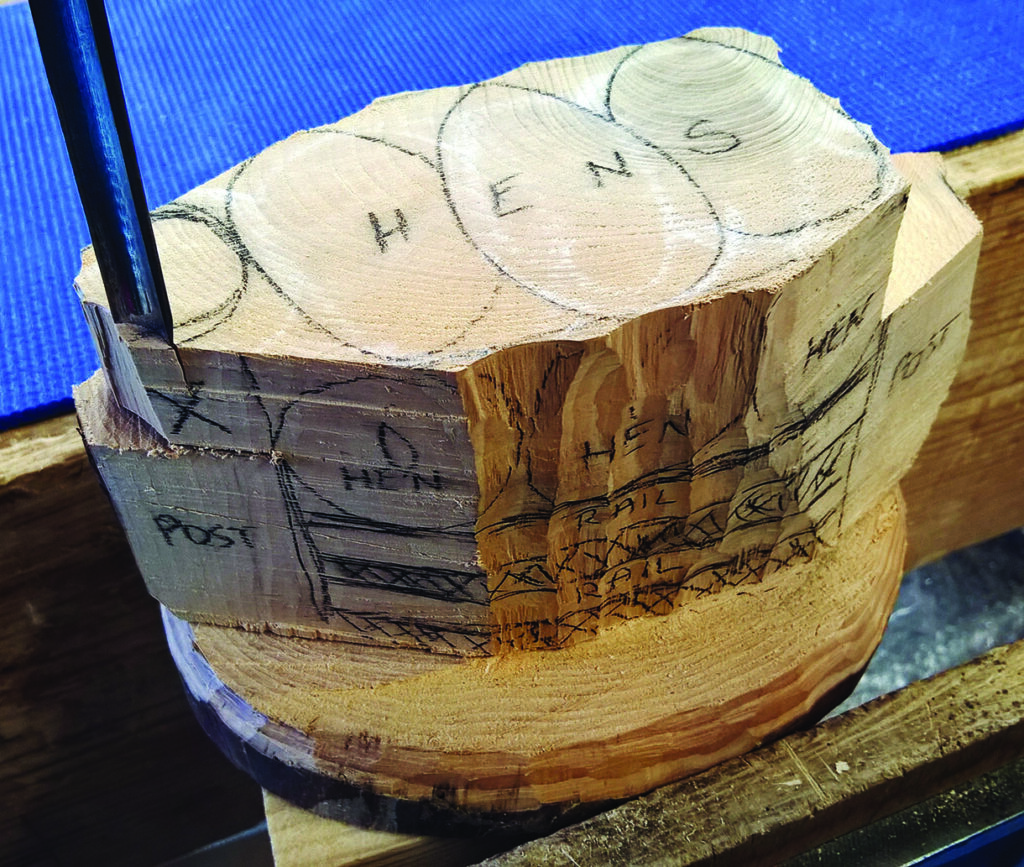
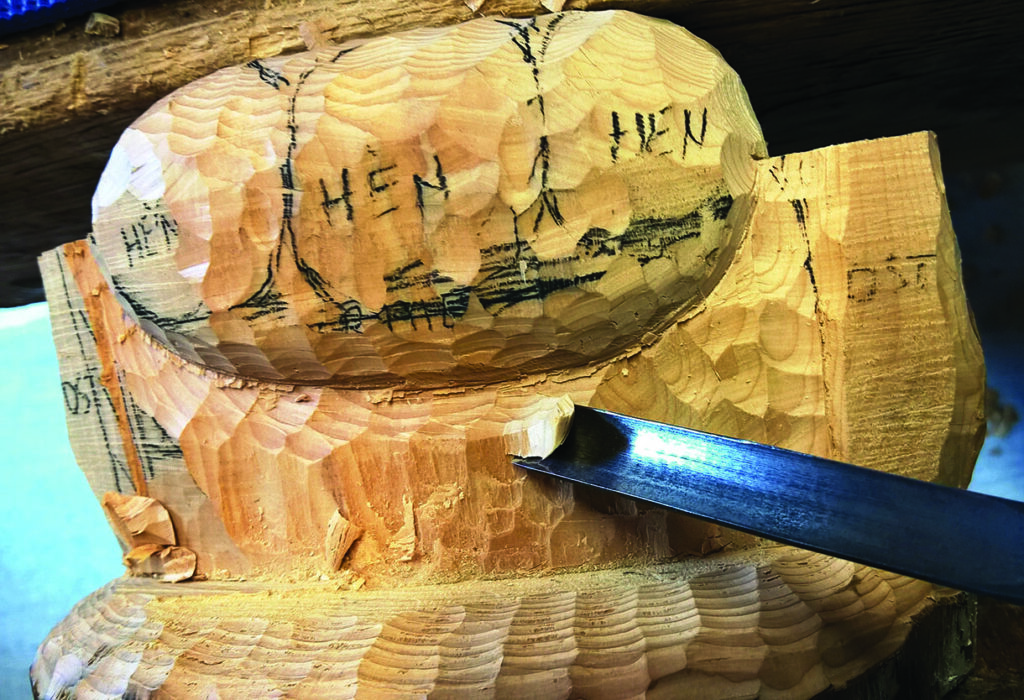
5a. Across top of each post make a horizontal sawcut. Now work downwards towards the sawcut, and remove slivers until the height of each post is reduced using a wide 13mm gouge. The birds should now be raised above both fence posts
Close-up of wood carving process with chisel.
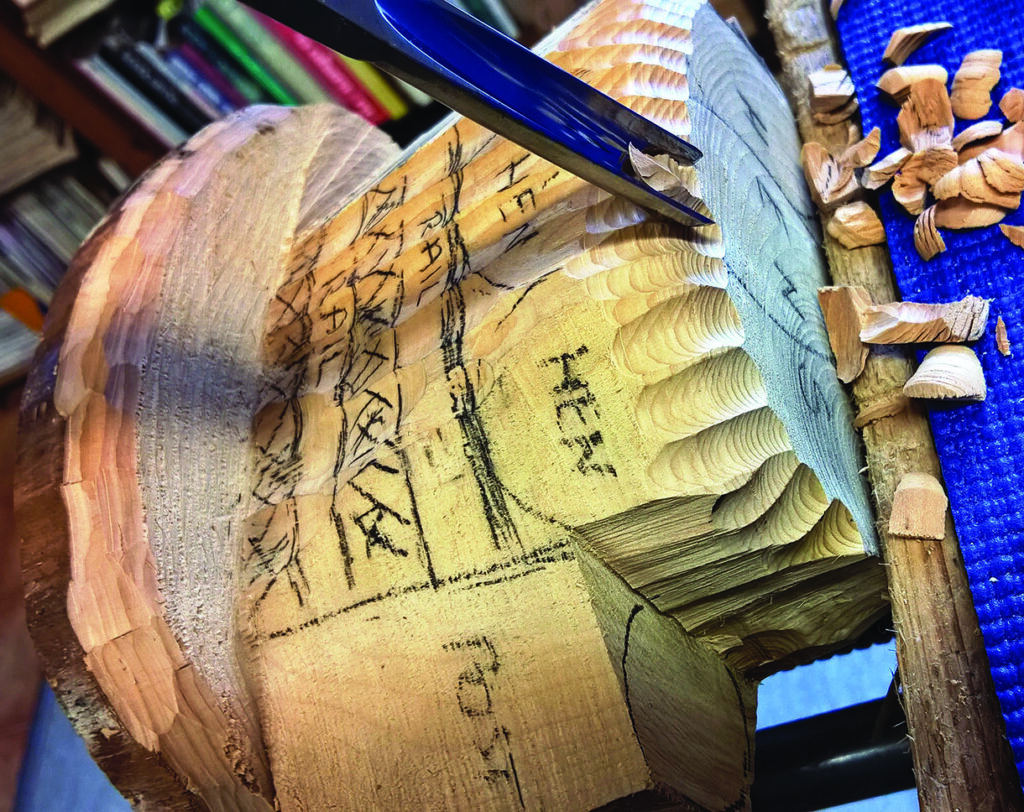
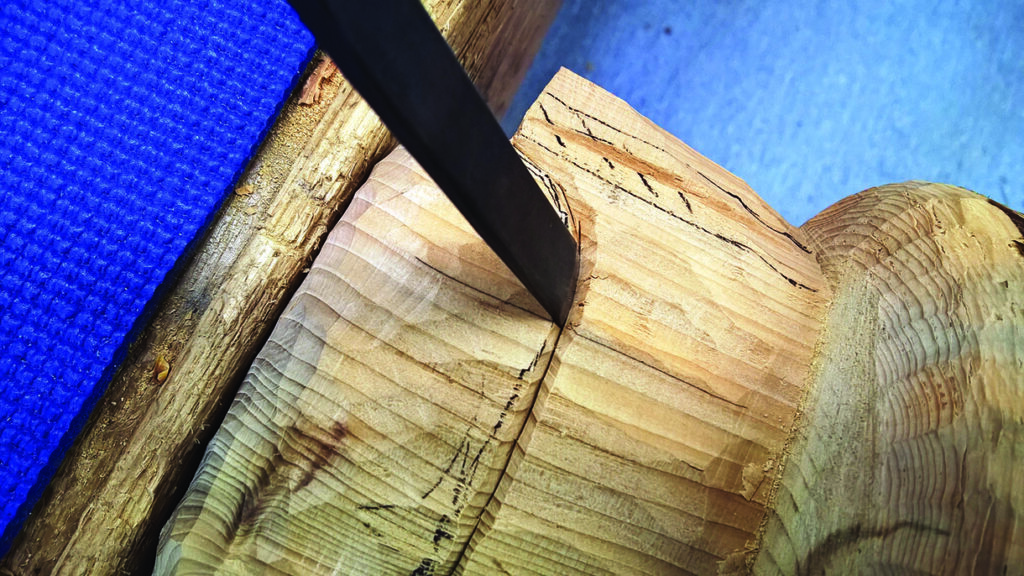
5b. Then, with the No.9, 13mm round over the top edges of the hens, remembering to lift your gouge hand as you cut across the edges front and back, and begin rounding the upper edges, front and back
Close-up of wood with carvings and markings.
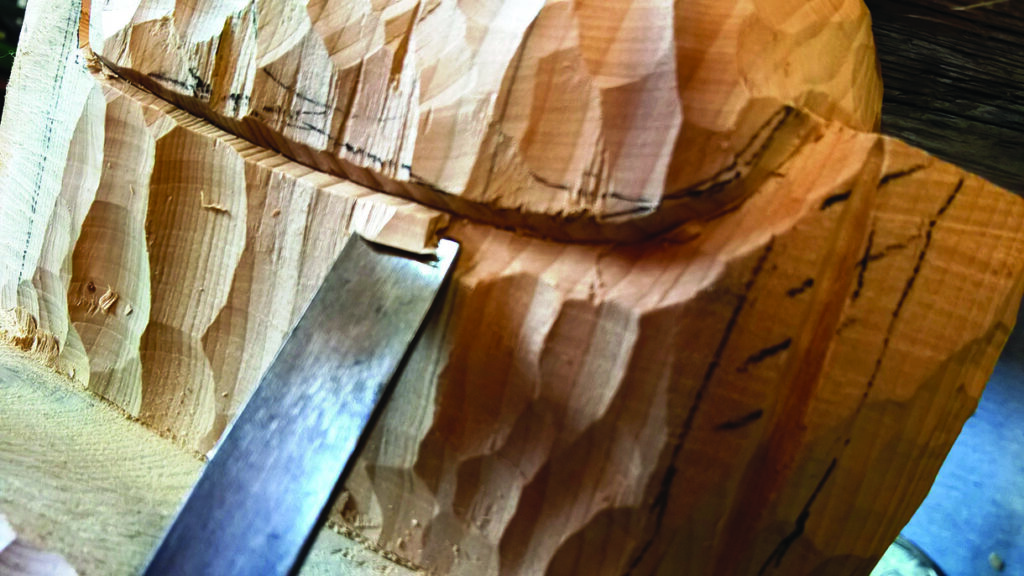
6. Across the width of the upper surface of the hens, draw a midline and continue working from both sides towards this until the original sawn surface is removed and the hens are rounded over between the posts. Then on both front and back, draw the line of lower edge of birds so they are perched and overhanging the upper rail of the fence
Wood carving with chisel, unearthing hidden design.
7. Below the hens and between the posts, scoop out down to the base both front and back to begin an indent beneath the hens. Work from each side with a No.3, 13mm to cut horizontally along the base between the posts, then scoop downwards with a No.5, 13mm

Starting carving the hens
Close-up of wood being carved with chisel
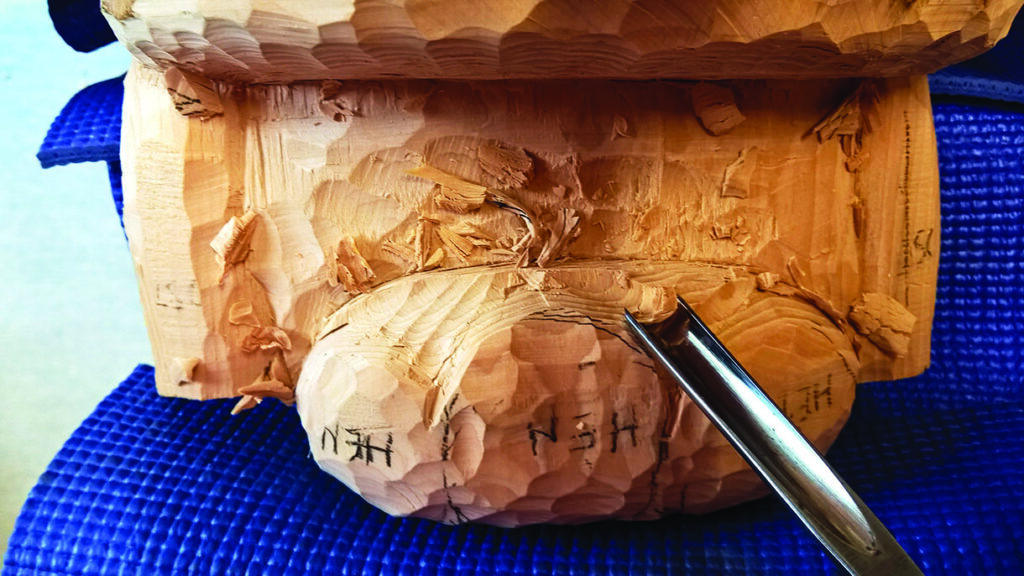
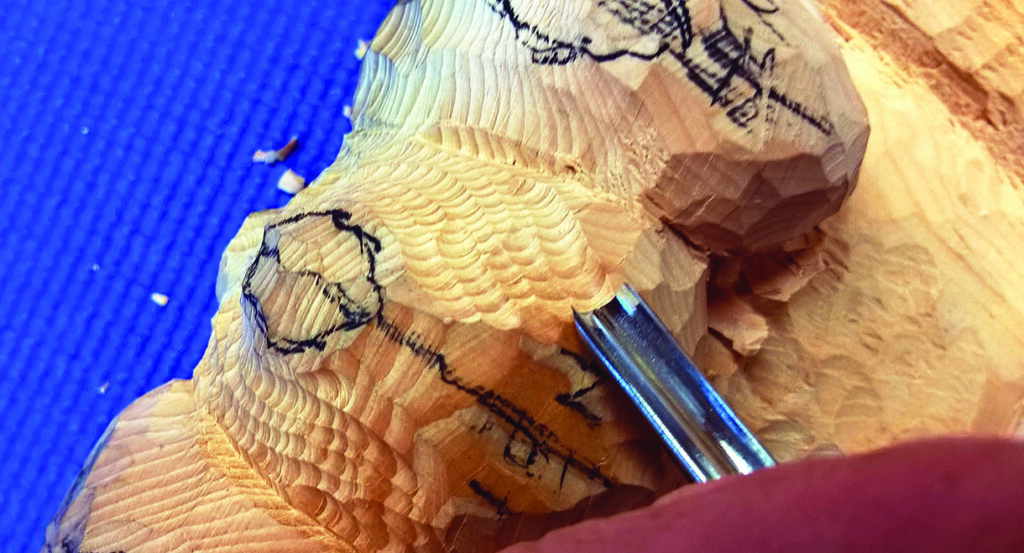
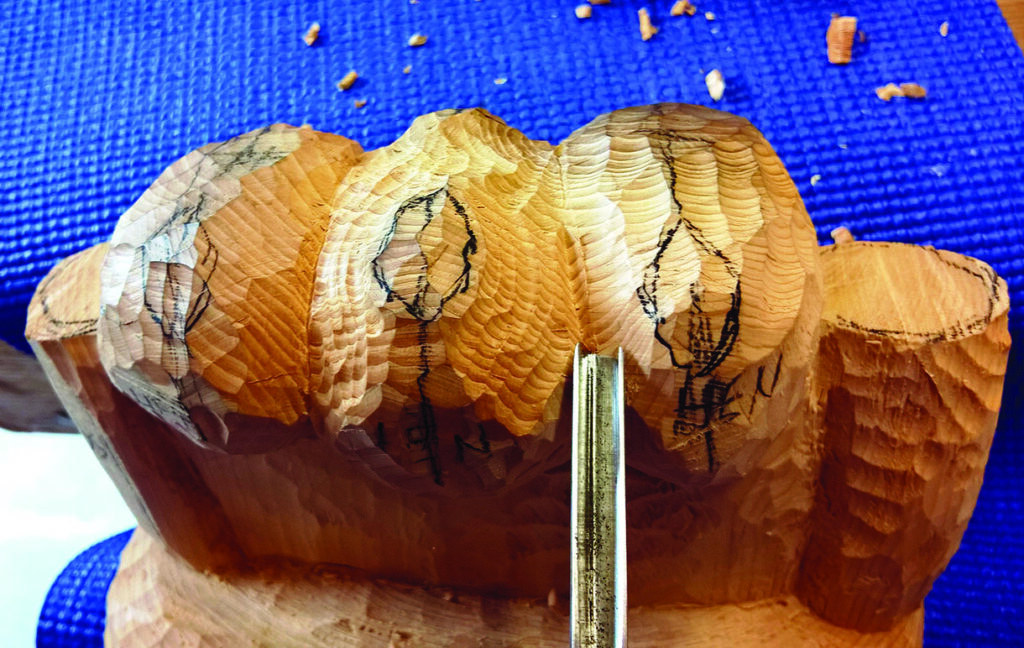
8a. With a V-tool, mark the inside edge of both posts and begin rounding the posts lengthwise. Mark the lower edge of the hens with a No.3, 13mm by using opposing cuts to make a V-channel to cut the line of them across from post to post. On approaching the posts each end, invert the gouge so the channel links up with the inner edges of the posts. Repeat on the opposite side of the fence. Cut towards the V-channel and remove the lower surface beneath the hens. Repeat the process by using opposing cuts to deepen and widen the channel, then removing below, until they project outwards
Wood carving with chisel in close-up view.
8b. Repeat this on the other side
Wood carving with chisel in progress
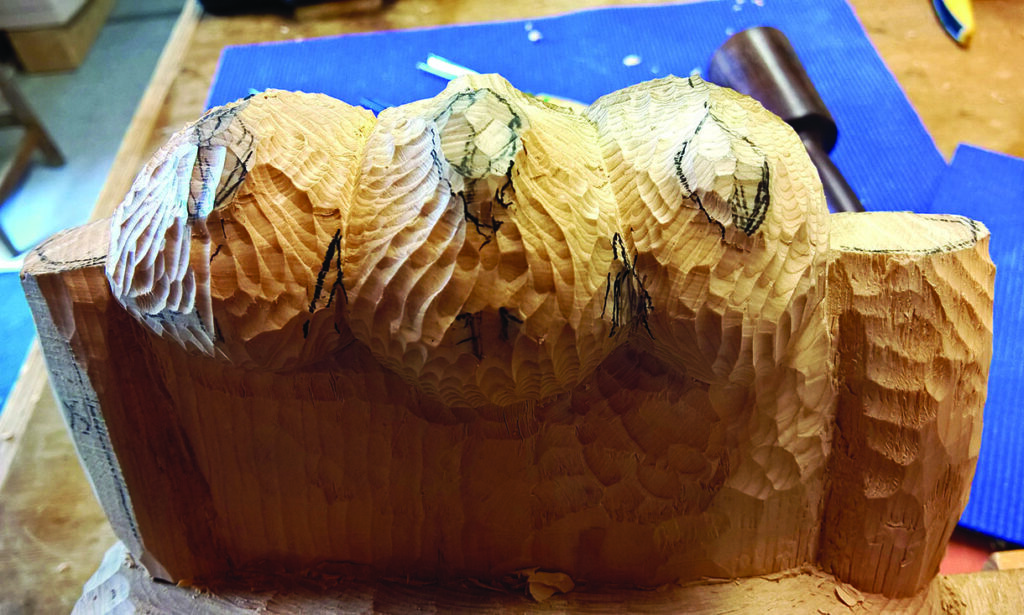
9. Round over their lower edges so that they overhang between the posts on both sides. Deepen adjacent to the inner edges of both posts and round each along its length. Repeat on the opposite side. Then on the rounded surface of the hens, draw their outlines resting on the upper rail between the posts
Wood carving in progress with chisel tool.
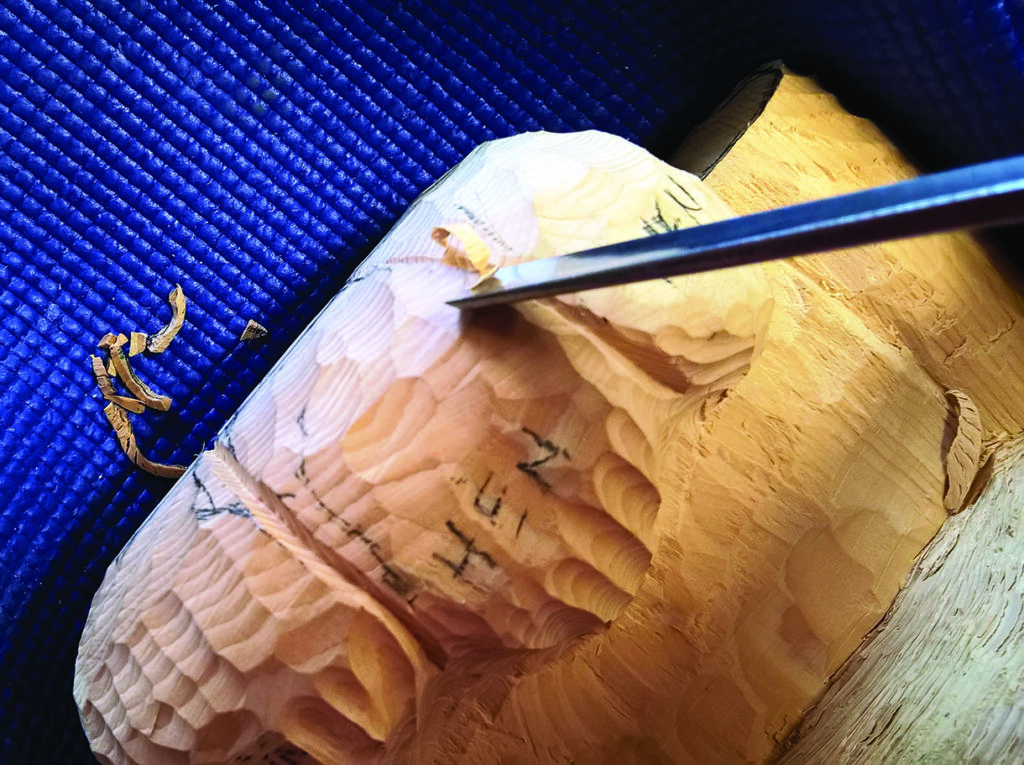
10. Begin separating the hens on their lower edge by scooping away a triangular area between them using a No.9, 10mm. Sweep the gouge round towards the midline of each hen as you cut the indents between them. On both back and front surfaces reduce the thickness of the area below the hens, to be the rails lying between the posts. Alternate re-cutting the V-channel beneath the hens and removing the lower edge of the V-channel and its adjacent surface, then as described previously, with using a No.3 gouge, cut horizontally across the base between the posts and remove the lower part of the rail area. The horizontal cuts act as stop cuts to lessen damage to the base between the posts. Now with the V-tool, mark the division between the hens, cutting downwards into the indent from the most convex area of the block (ie. with the grain)
Wood carving in progress with chisel
11. Turn the carving and continue marking the separations with the V-tool, starting from the most convex area upwards and towards the centre of the top surface of the birds from each side, so joining up on the uppermost surface and ready to start separating them
Wood carving in progress on blue mat.
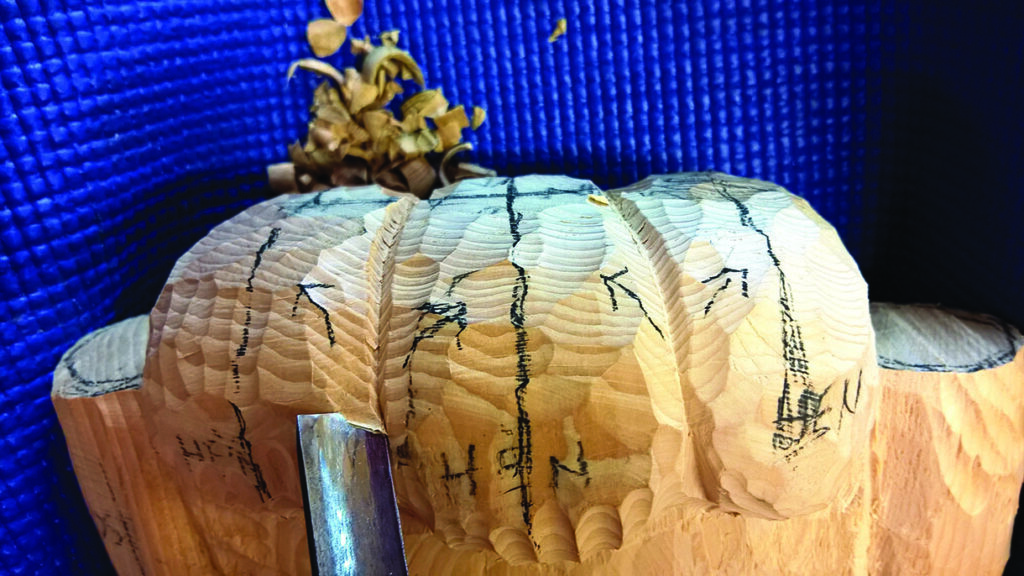
12a. Now use the corner of the No.5, 13mm and cut upwards along each side of the V-groove, removing its outer edge and widen the groove. Repeat this process working downwards towards the fence rail, then repeat on the other side of the fence
Wood carving with chisel and detailed markings.
12b. Continue thus until the divisions between are sufficiently deep to round over the edges of each side of each bird, then draw a centreline along the length of each hen and round over the body of each hen, cutting towards this centreline from both sides
Carving wood with chisel on blue background.
13. Draw the head area on each and taper the shape of each bird towards her head with the No.9, 6mm starting with the middle bird followed by the outer ones
Wood carving in progress with detailed textures.
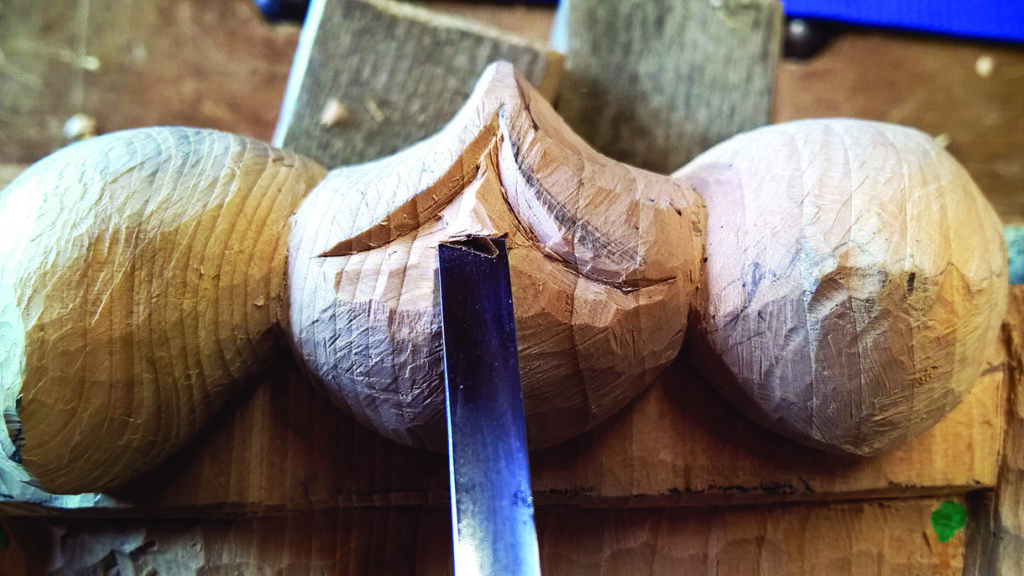
14. Continue shaping each bird by rounding her breast on to the face of the rail they are perched upon, then reduce the thickness of the heads, narrowing it to stand out from the body
Wooden carving with intricate patterns in progress.
15. Now modelling the rear ends, start with the middle hen and reduce the body in front of the tail, then alongside it, tapering it to a triangular shape so that the tail now stands up at an angle above the rest of her body
Wooden sculpture with twisting shapes on workbench.
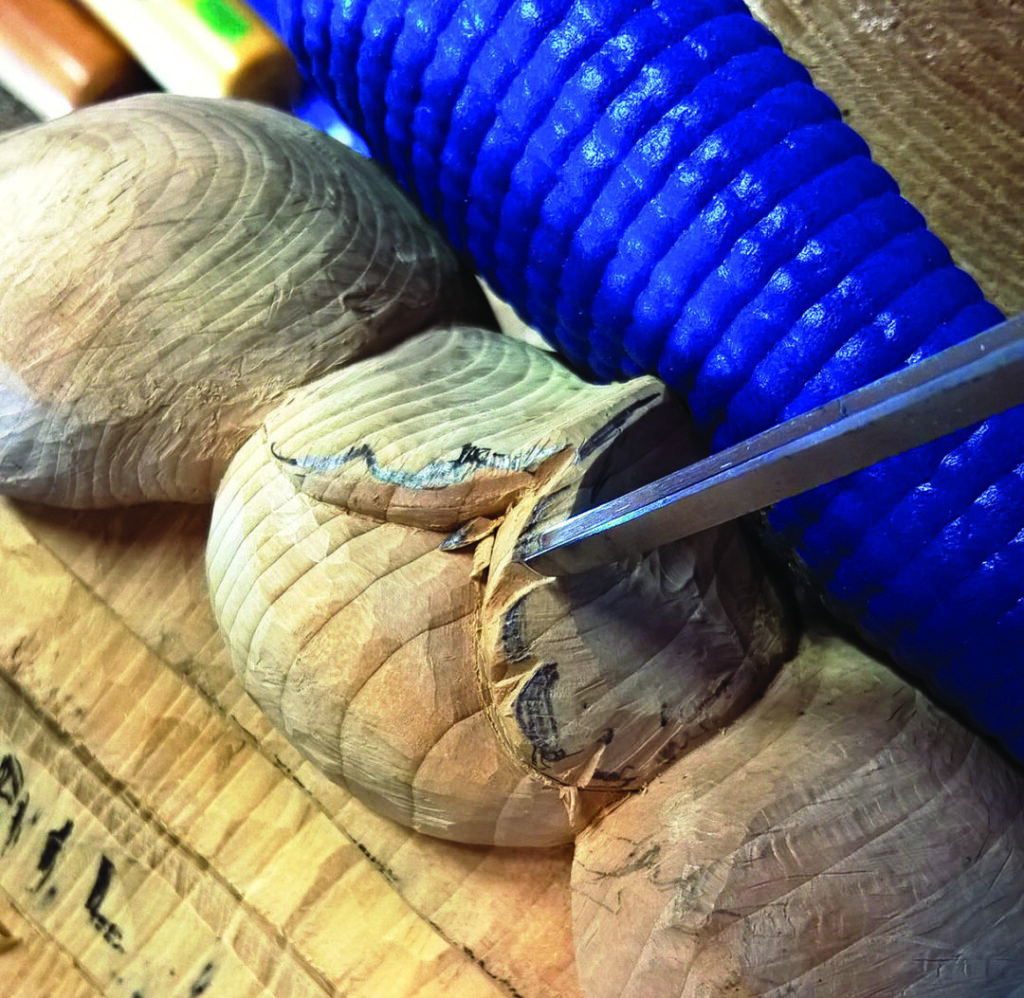
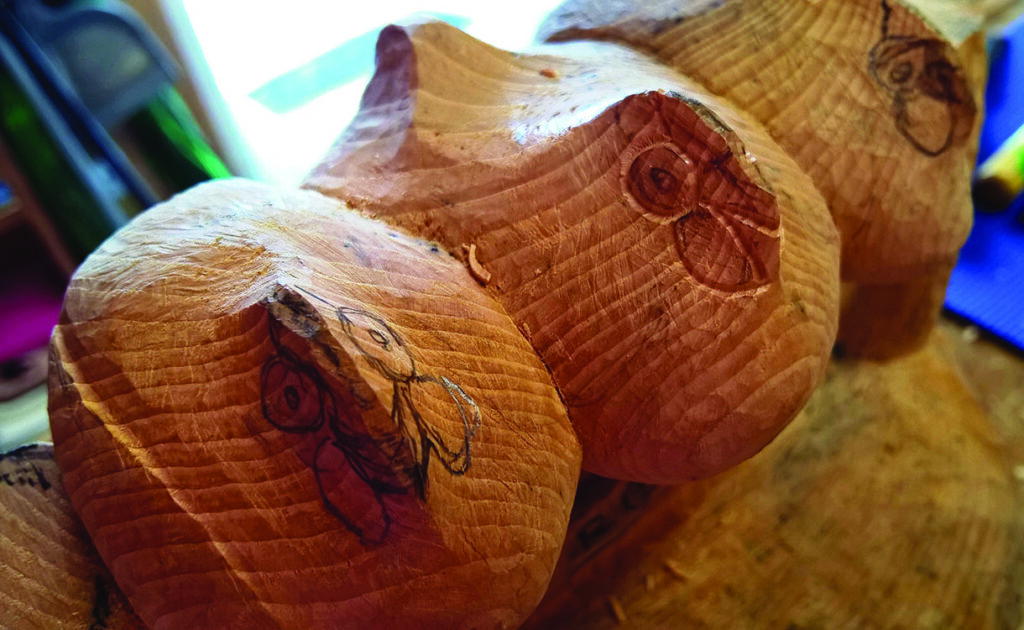
16. Taper and reduce the tails of the outer hens either side so that they droop downwards, then with the 10mm No.5 and No.3 gouges, refine and smooth the surfaces. When smoothing the heads, carefully pare upwards with the No.5 from either side, then on the fresh surface draw the face and eye each side, ready to detail later on. You may find a small Microplane useful for smoothing the upper and lower endgrain surfaces

The rails

Wood carving with three dome shapes and chisel.
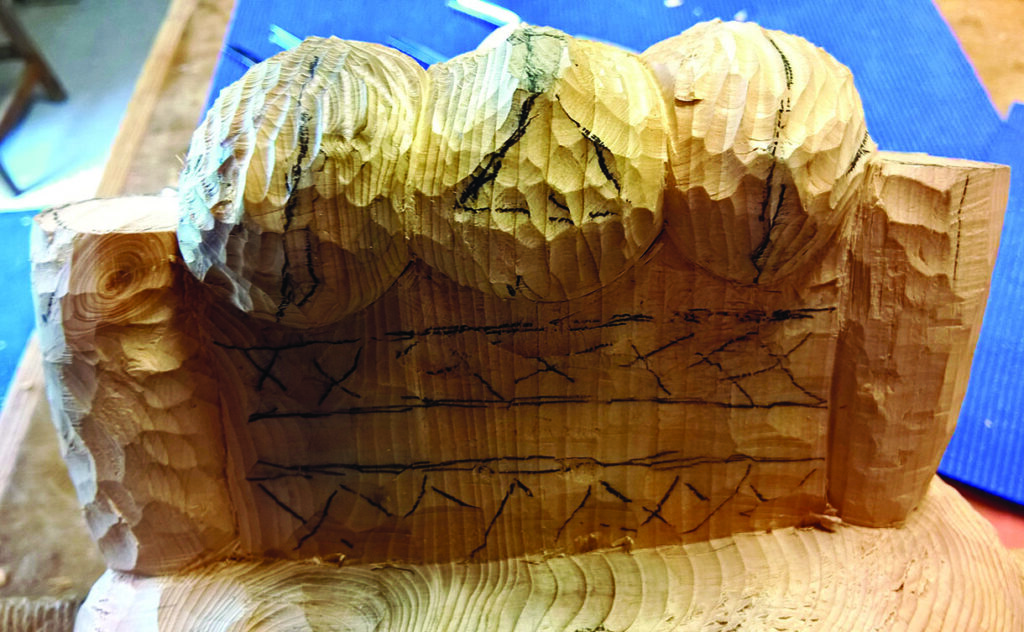
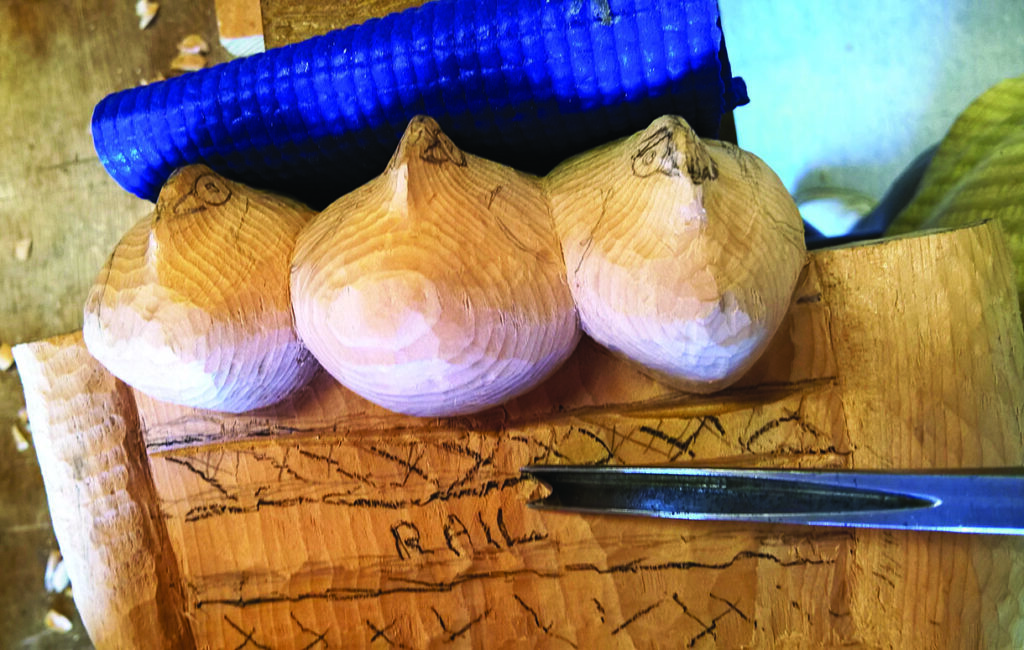
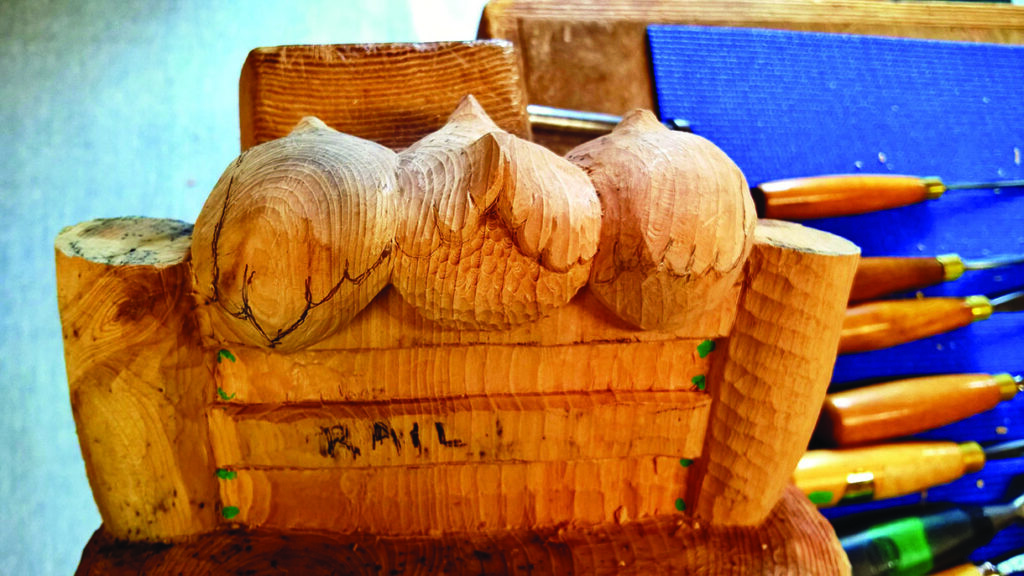
17. Further reduce the thickness of the wood beneath the birds to that of the rails and redraw them, back and front, between the posts below the hens. Mark the areas between them to be removed. Cut across from post to post along the upper and lower rail edges with a V-tool to mark them across the width
Carved wooden piece with circular shapes and tool
18. Now, reduce the hatched area between the rails. Cut away from the rail edge at a slight angle to chamfer it to minimise breakage
Wood carving of three acorns in progress
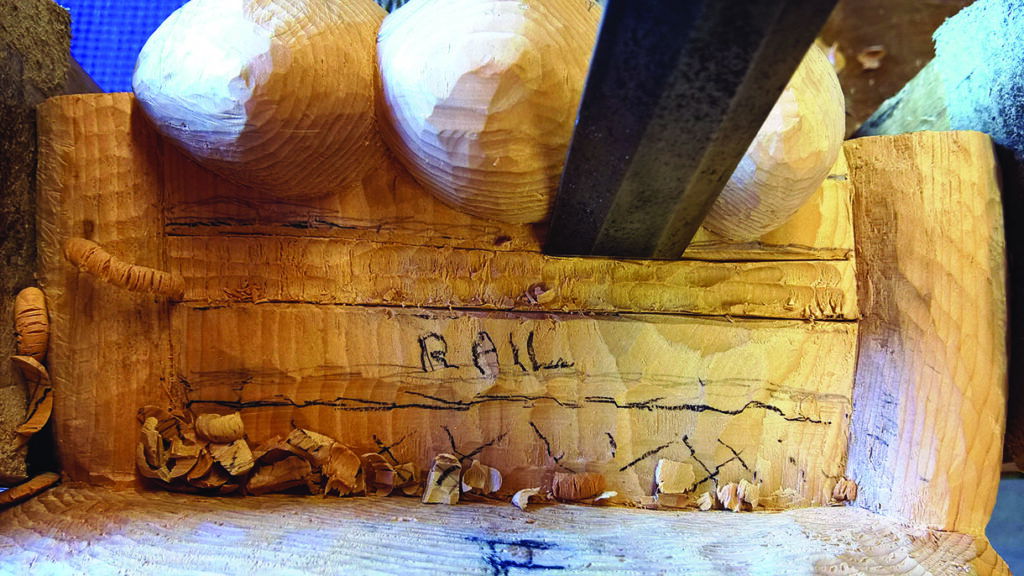
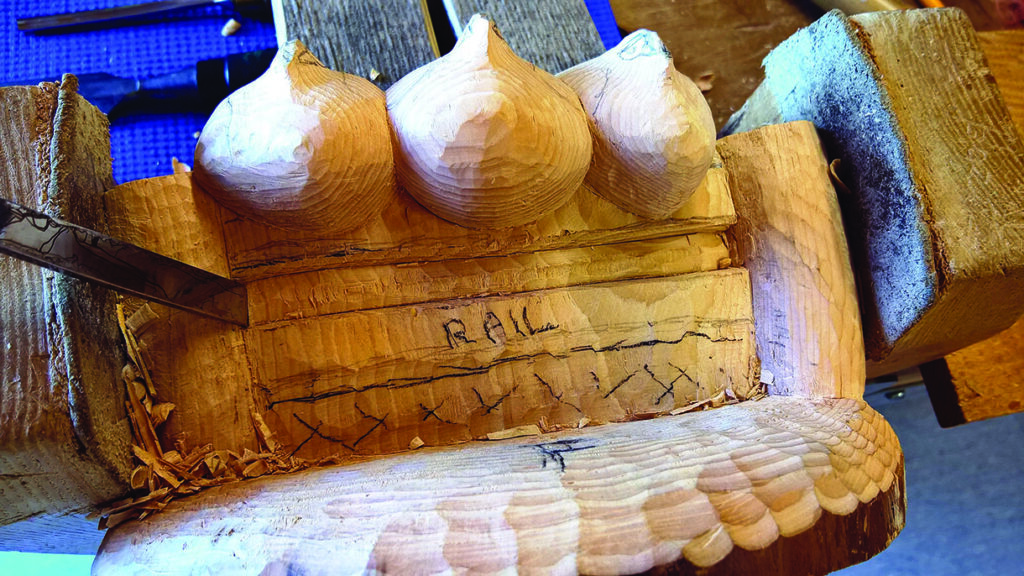
19. Adjacent to each post, use a narrow chisel and cut away from the post surface towards the void-to-be, so that the horizontal rounding of the post can be continued later on. Reduce the areas to be voided between the posts until the rails overhang these areas, then smooth off the surface. Repeat on the opposite face. Do not cut through yet because the support is needed when carving details on the hens – just reduce sufficiently to allow a drill to be inserted from each side later on
Close-up of textured carved wood face detail.
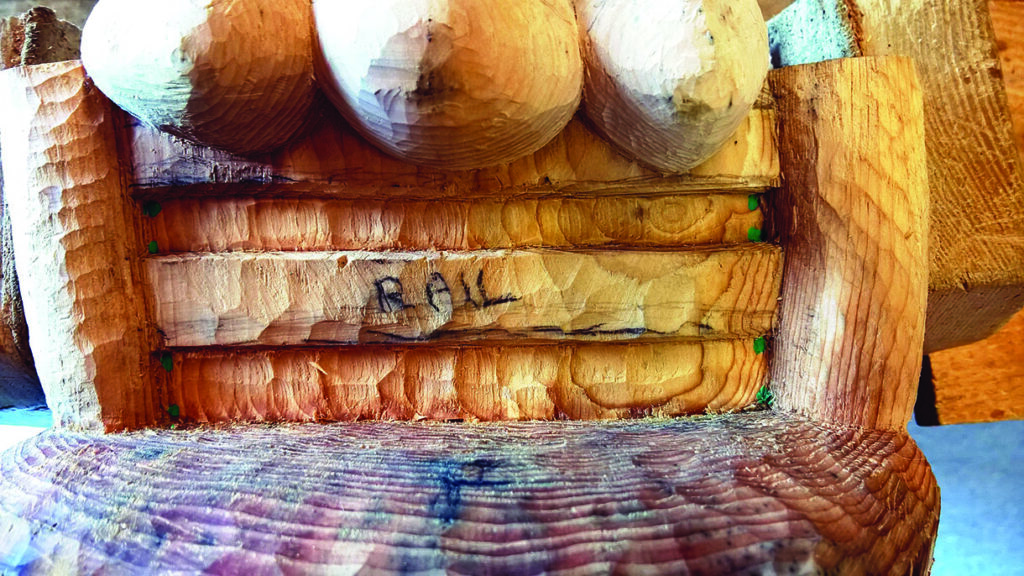
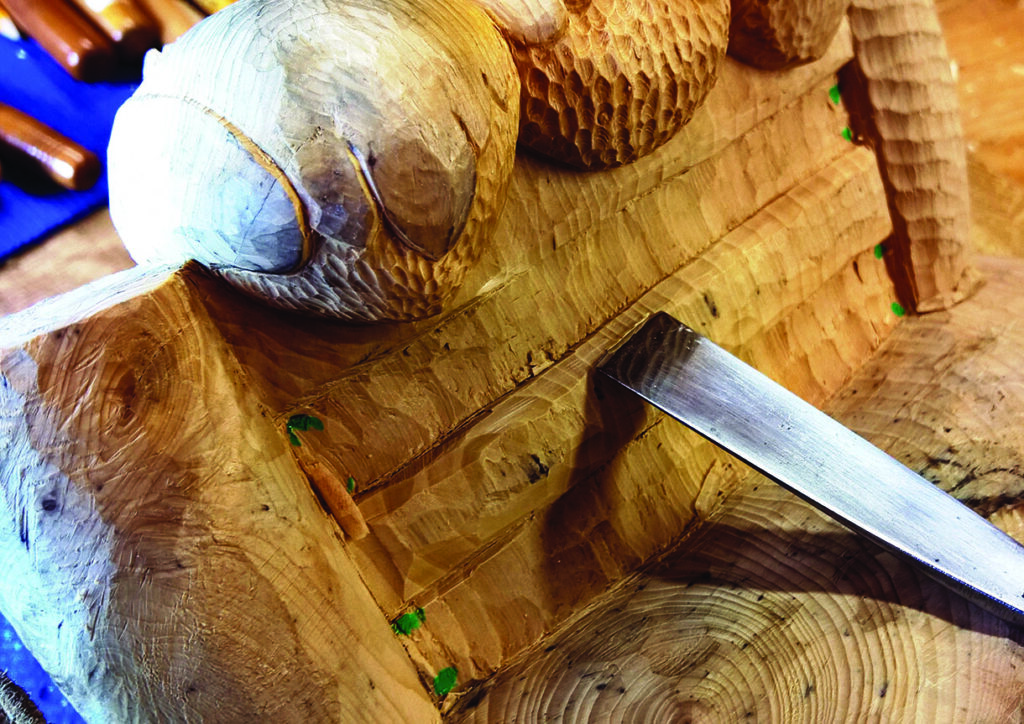
20. When the horizontal indents have been made, further reduce the thickness of the rails towards their final size, ensuring their ends lie within the posts. Deepen the indents above and below them again if necessary, then smooth off the faces of the rails each side, and now the detail on the hens can be completed

The tails and rear ends

Wood sculpture in progress with carving tools.
21. Start with the middle bird, on her triangular rear end, use the V-tool to cut upwards along each side, angling the two V-channels so they meet within the tip of the tail. Remove and deepen the triangular area within and round over the upper edge of her rear end into the newly formed triangular indent. Smooth the rounded surface ready to texture later on
Wood carving with chisel and blue grip tool.
22. Using a V-tool, cut outwards on the outer surface each side of the tail marking the tail feathers lying each side. Remove the triangular indent between each feather, then with the No.3, 6mm, round the ends of each feather into a scallop shape and tidy their meeting edges using the point of the 6mm skew chisel
Wooden owl sculpture with carving tools nearby.
23. On the tails of the two outer hens repeat the procedure as above, then mark in the primary wing feathering in the same way. Gently remove the lower edge of the V-channel so that the edges of upper feathers overlap those beneath. Now, create the appearance of the fluffy bottoms by cutting small indents using the No.9, 10mm, to texture the rounded rear ends of the three birds

The heads

Wooden carved owl sculpture in progress
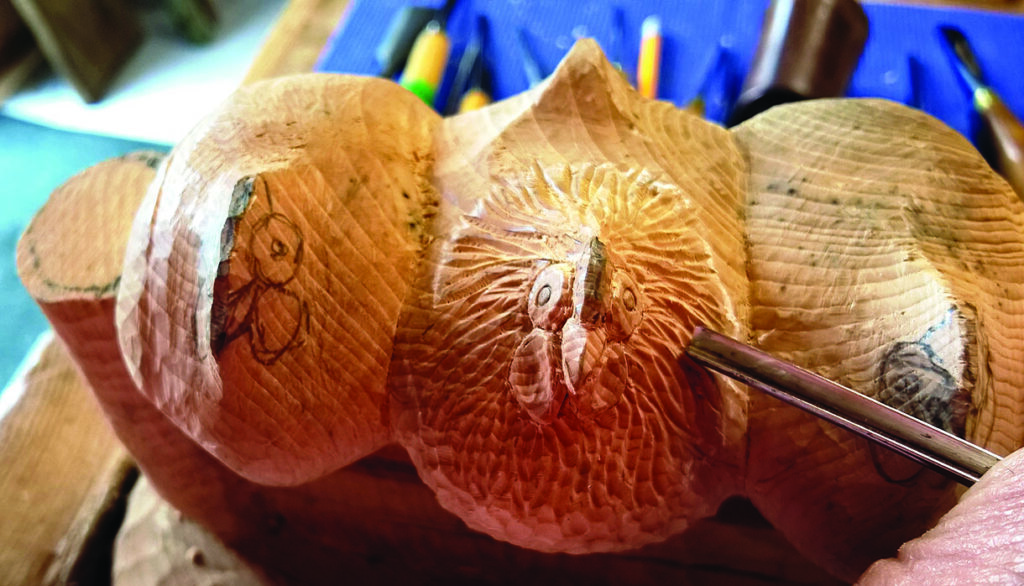
24. Starting with the middle hen, narrow and smooth the head and neck from each side, making sure it is symmetrical. Once symmetrical, draw both side views of the face, beak comb and wattles on each side and mark them out using the 3mm V-tool. With the No.3, 3 and 6mm, use opposing cuts around the features and then relieve them by removing the adjacent surfaces, leaving the comb indents until later. Refine the beak but leave it fairly substantial and don’t undercut it yet
Wood carving of owl in progress on workbench.
25. Texture the breasts with shallow indents as described for the rear ends with the No.9, 10 or 11 gouge. The feathering around the neck can then be marked using the 3mm V-tool
Wood carving detail with tool engraving.
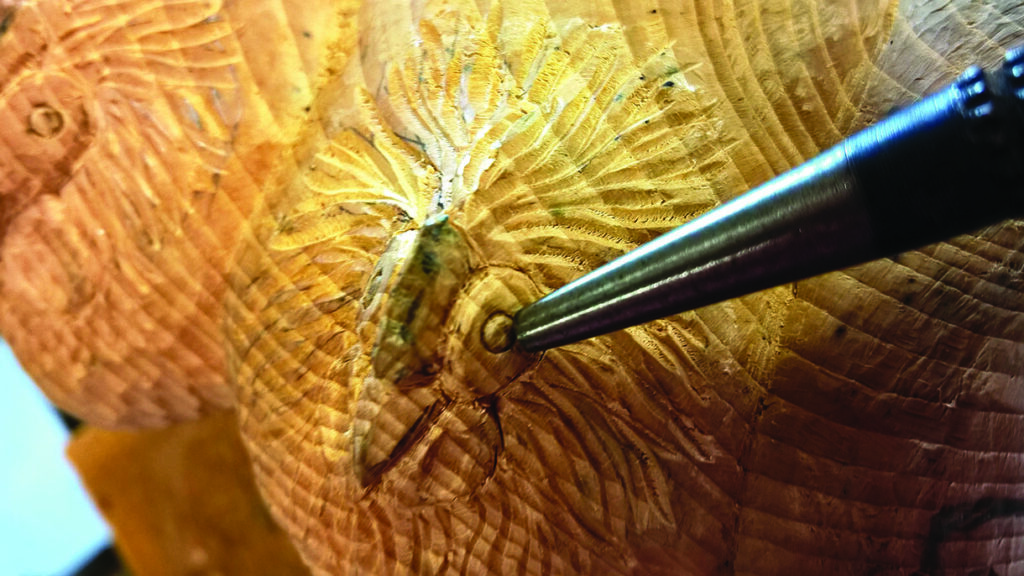
26. On each side of the head use a nail punch to mark the eyes, then cut a hollow within the wattles using a No.9, 10 or 11, 3mm. Finally, tidy up all meeting edges between the bird and the top rail on which she is perched. Repeat the process for the two outer hens, ensuring the meeting edges between them and the sides of the posts they are touching are cut cleanly
Wood carving in progress with chisel tool.
27. If you have not already done so, smooth and adjust the dimensions of the lower rail and slightly chamfer its upper edges each side, ready to drill through
Carving wood with electric saw.
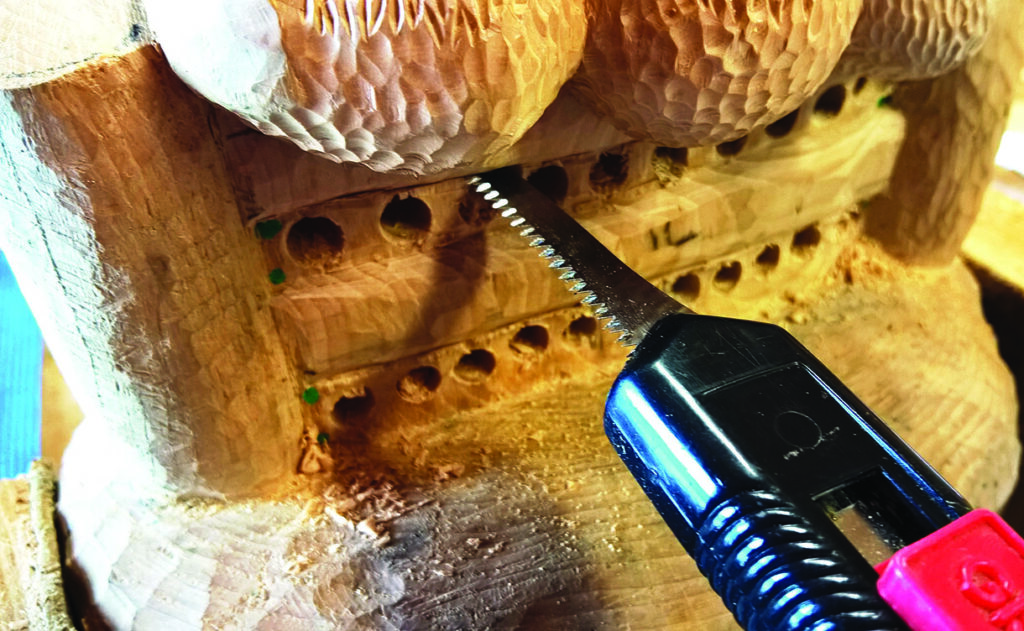
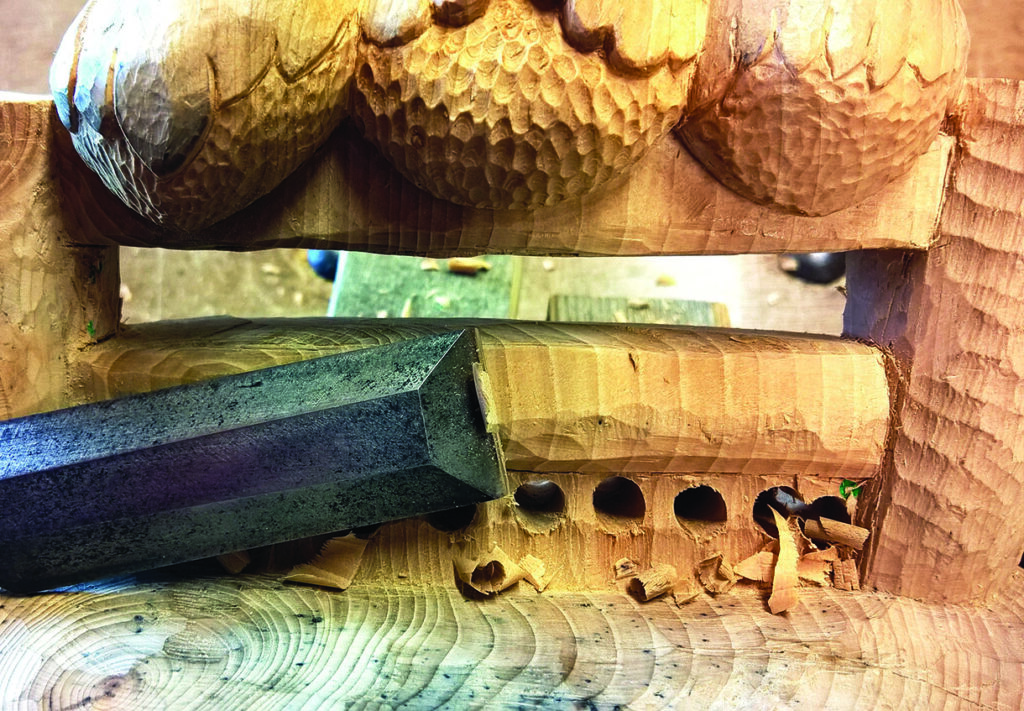
28. Using a hand drill fitted with a 1/4in wood drill bit, set it in the void-to be between both the upper and lower rails, and the lower and ground/base. Drill a series of holes in the waste section, partly drilling from the opposite faces in case the drill bit breaks out on the opposite side and damages the rail, or the bit direction is inaccurate. Then use a keyhole saw or similar, to cut horizontally along towards the post each side. Repeat the process along the upper surface of the lower rail towards each post and carefully remove the wood between the two rails with a No.3 gouge
Close-up of a detailed wood carving.
29. Smooth off the upper surface and faces of 2nd rail by paring with a flat/No.1 chisel then repeat the procedure on the lower surface of the second rail and the ground. Smooth the base beneath the lower rail then round the bottom of posts into the base. Adjust and tidy the insertions of the ends of the rails into the
two posts
Close-up of intricate wood carving with chisel tool.
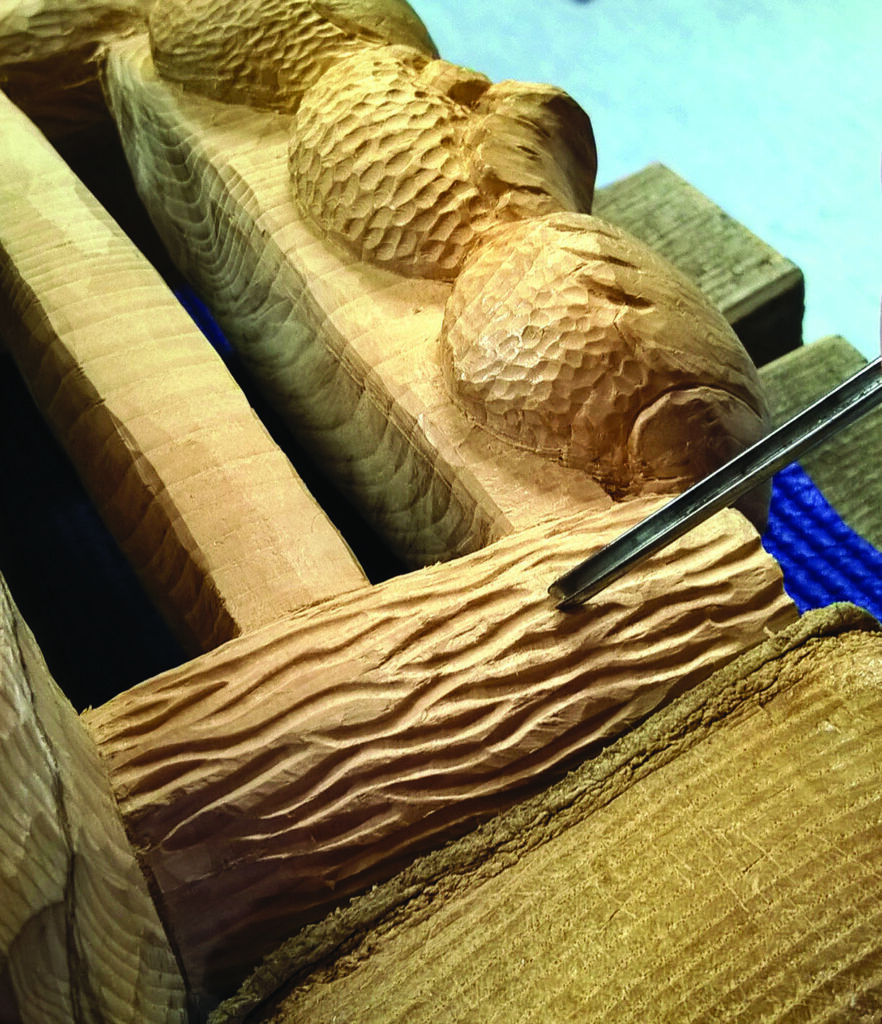
30. Using the 3mm V-tool, cut concentric circles on top of the posts to represent the annual rings. The bark on the posts was represented by using a No.11, 3mm and cutting wavy grooves lengthwise along them

Finishing the heads

Close-up of wood carving with tool detail.
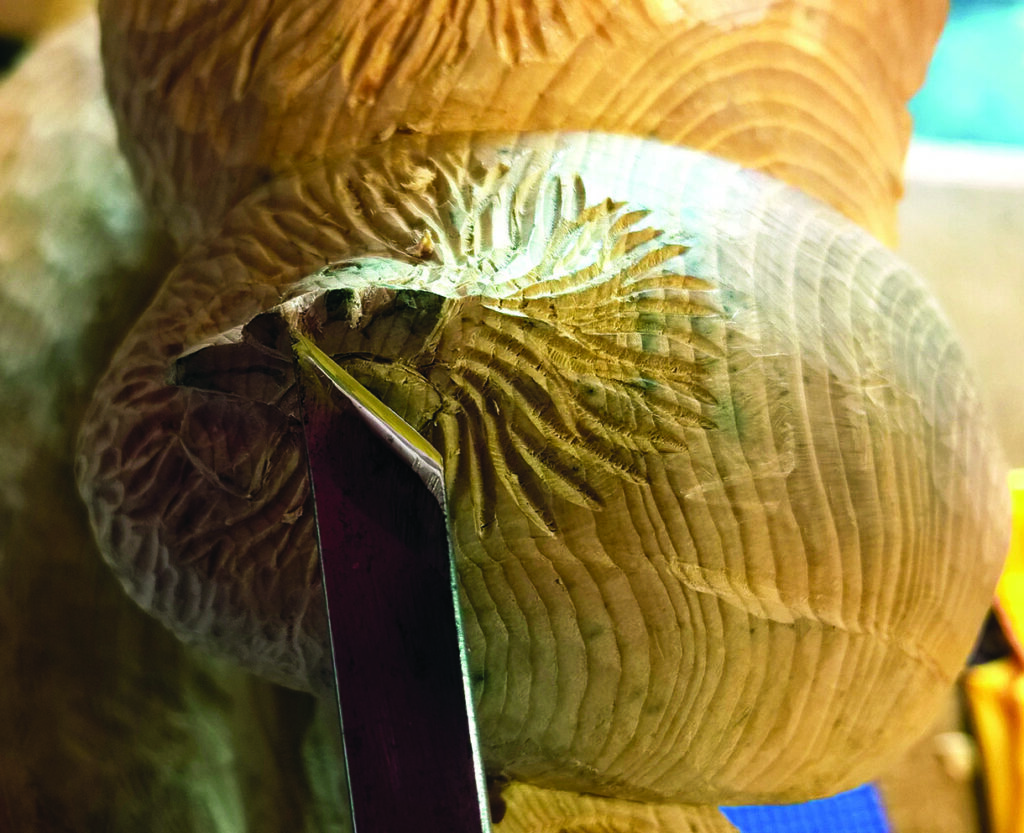
31. Using alternate cuts from each side of the beak with the 6mm skew chisel, pare the upper mandible to shape, then mark a dividing line between the upper and lower mandible with the 3mm V-tool, the corner of No.3 gouge or point of skew chisel, cutting inwards from the tip. Then with a No.3 or No.5, 3mm, remove below the lower mandible, shaping it so that the beak projects forward. Finish the comb by cutting upwards and sideways from each side with a twisting action at intervals along its length to form its crenellations. Then repeat the above for the other hens

Applying a finish

Wooden bench with carved seashells in field
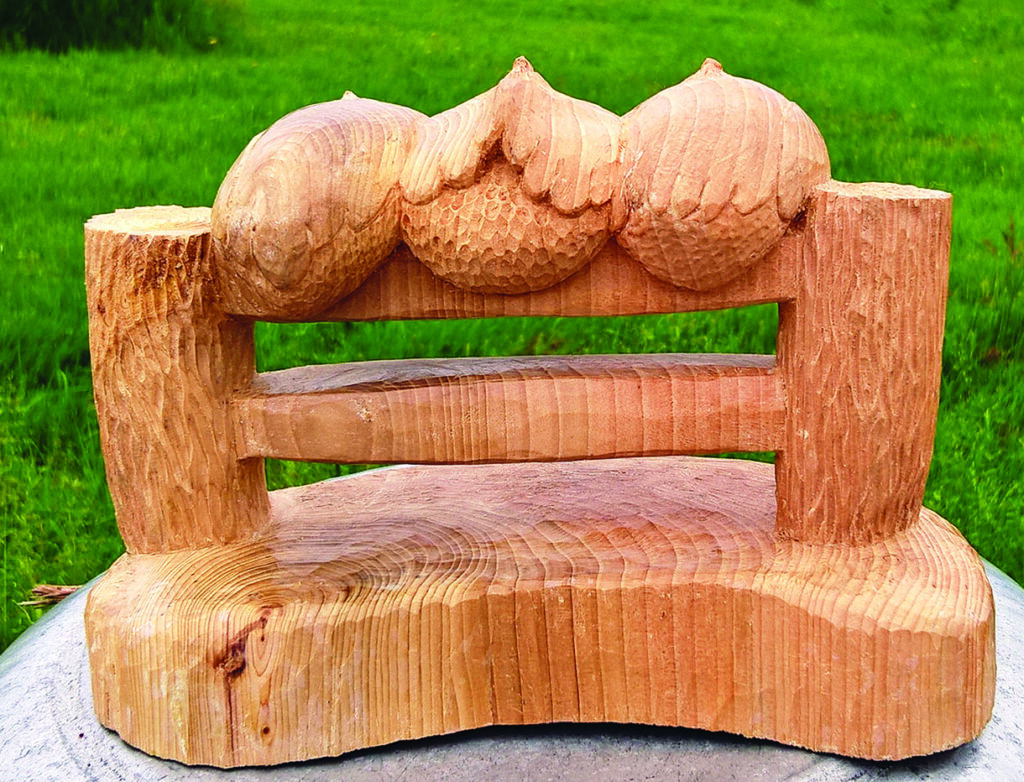
32. Carefully pare and remove any deep cuts or errant digs, lingering saw cuts or evidence of drill holes, making sure all meeting surfaces are cleanly cut and splinter-free. There are many wood finishes available in the market – I finished my hens using a colourless wax polish then buffed it with a lint-free duster and a soft brush. You now have your finished carving of hens on a fence and my hens on their perch

Leave a Reply

Your email address will not be published. Required fields are marked *