The Woodworkers Institute

We bring you the very best of woodworking!

“Make it with us”

Whittling a bunny

Terry Nokes carves a baby rabbit

Colourful ceramic rabbit figurine on wooden surface.

This rabbit project was inspired by Easter, has minimal detail and can be achieved with just a single woodcarving/whittling knife. For this reason jelutong (Dyera costulata) was selected as it’s one of the softest timbers for knife carving. Jelutong is fast-growing and native to Asia. Other than balsa wood it is one of the softest woods available. It’s also the source for white latex, which was used in chewing gum until the 1960s. The latex duct channels can be present and look like elongated oval holes. This timber can be quite brittle so very sharp tools are essential. Jelutong can also be purchased in boards up to 100mm thick in the UK.

If you have no access to jelutong, try Lime (Tilia Europaea), basswood (Tilia Americana) or American tulipwood (Liriodendron tulipifera). All carve well, but being plain in appearance they’re ideal for finishing with colourful stains/paints. A pyrography machine could also burn a desirable textured finish. For an oiled/waxed finish
 perhaps experiment with one of the many mahogany species.

Walnut (Juglans spp.) looks lovely but can be very hard to work by hand. Each will respond slightly differently to carving, so do experiment on waste wood before starting on the main project.

The artwork for this carving project was kindly supplied by my talented artist friend and work colleague Clive Hooley. Clive’s original drawing was in pencil and this has proved to be a fun project.
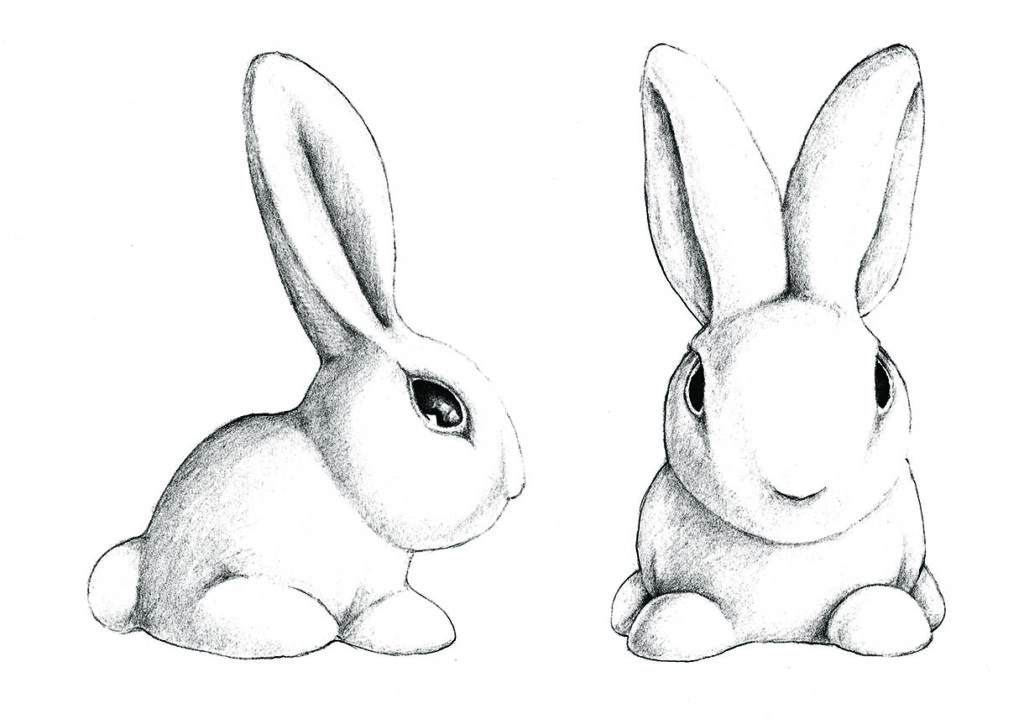
Sketch of two cute rabbits sitting.
Sketch by Clive Hooley

Things you will need

Tools:
• Dust mask
• Bandsaw
• Carving knife
• Safety gloves
• Thumb guard
• Pair of compasses

Materials:
• Jelutong (Dyera costulata) 90 x 60 x 50mm
• Glue stick
• Loop abrasives
• Hook-faced sanding block
• Brush
• Black acrylic paint 
• Spirit stains – white, purple and yellow
• Polyurethane satin spray
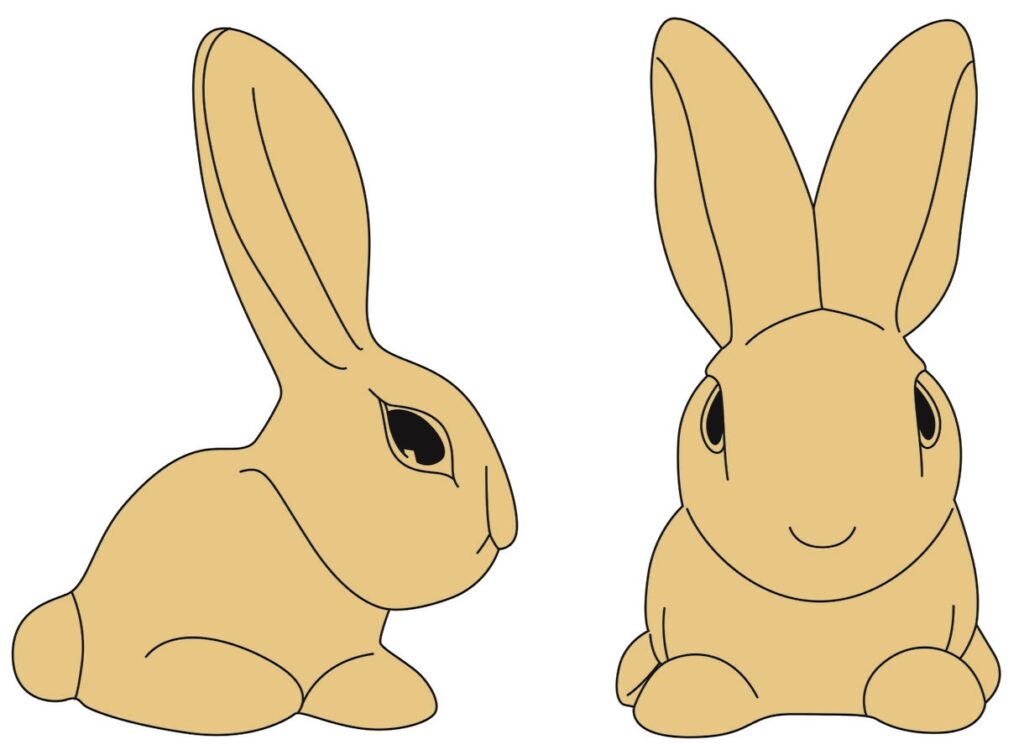
Cartoon rabbits side and front view
Drawing for carving

Rough shaping

Creative wooden rabbit crafts on saw table.
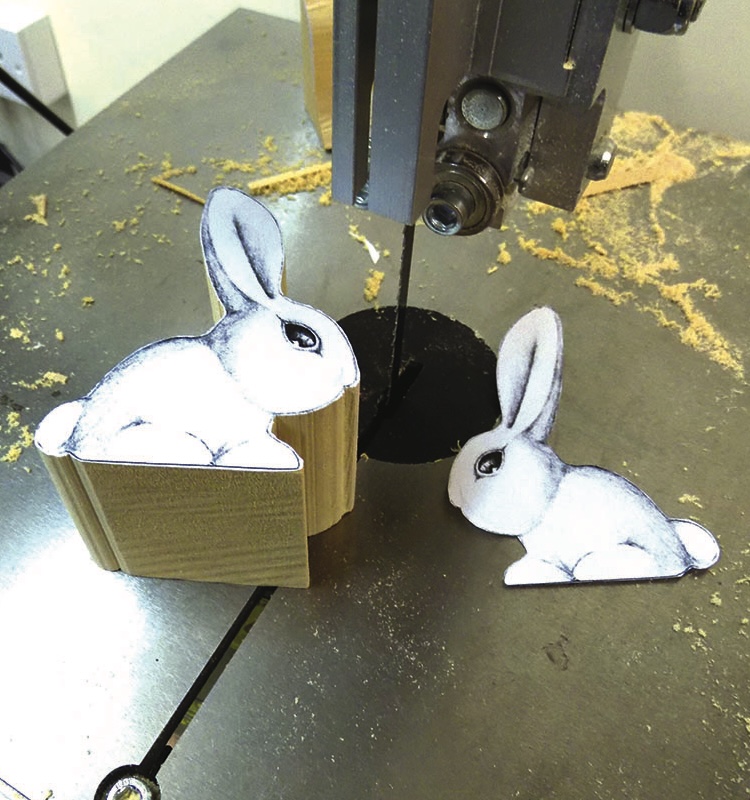
1. Align and glue/stick the template – change the size as required – so the grain direction is running vertically through the bunny. Then cut out the timber on a bandsaw. Some carvers leave 2mm or so waste around the project outline when cutting, but with knife carving, especially on harder woods, I normally cut right up to the line to remove as much waste as possible
Drawing rabbit on folded paper sculpture
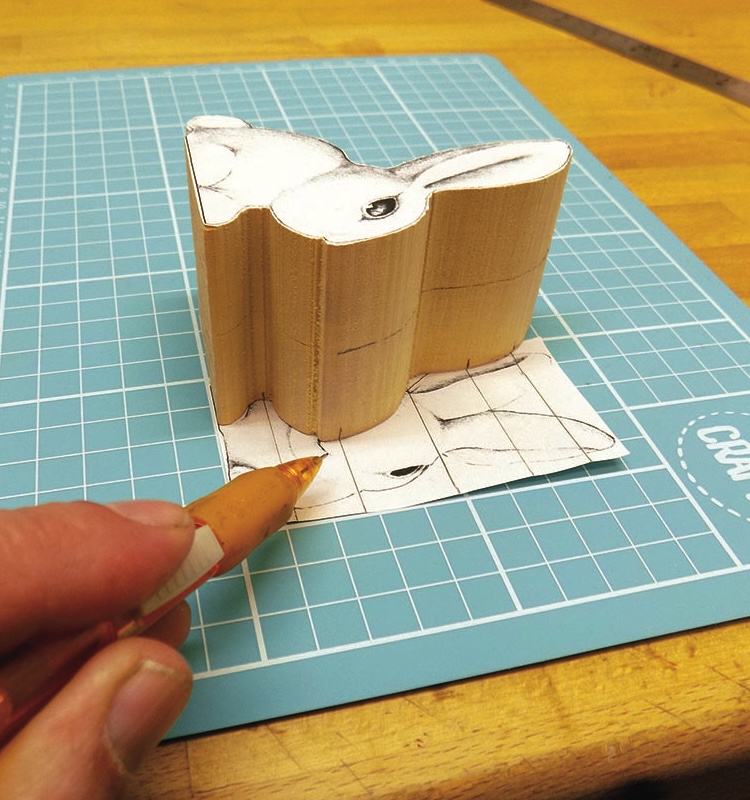
2. Using a pencil, draw a centreline around the whole carving. This line must be present and visible to the very end of your carving. Now draw in the front profile or, to be more accurate, draw horizontal lines over the paper template, then transfer these lines to the carving blank, making sure the blank is parallel with the template. A grid cutting board or graph paper can help as shown
Hand holding flipbook with a rabbit drawing.
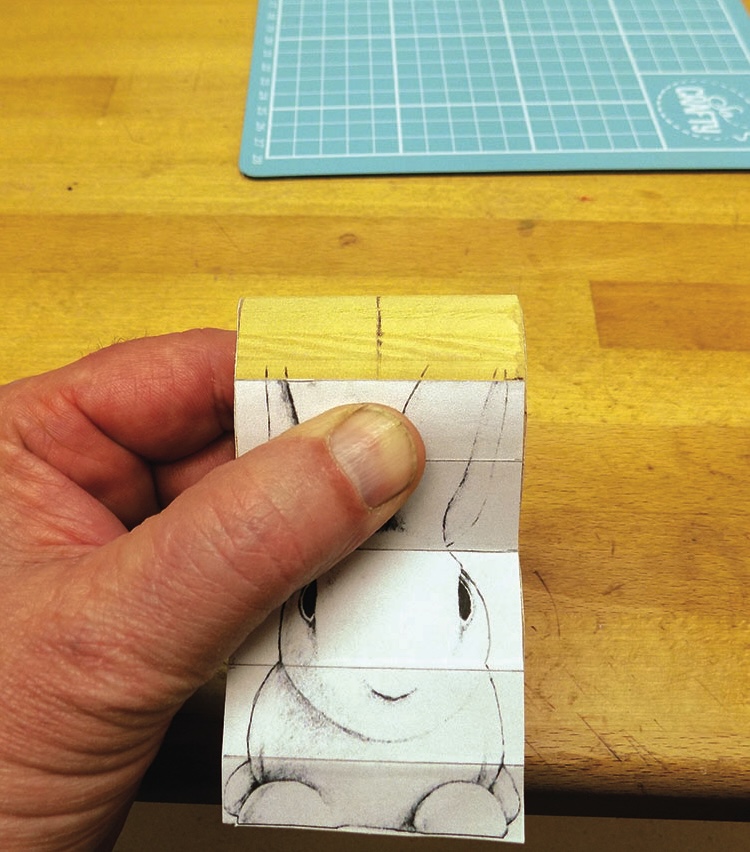
3. Now fold the template on these horizontal lines and align it with the blank. Transfer the image outline. The more horizontal lines you have, the more accurate the drawing will be
Wooden block with rabbit drawing, held by hand.
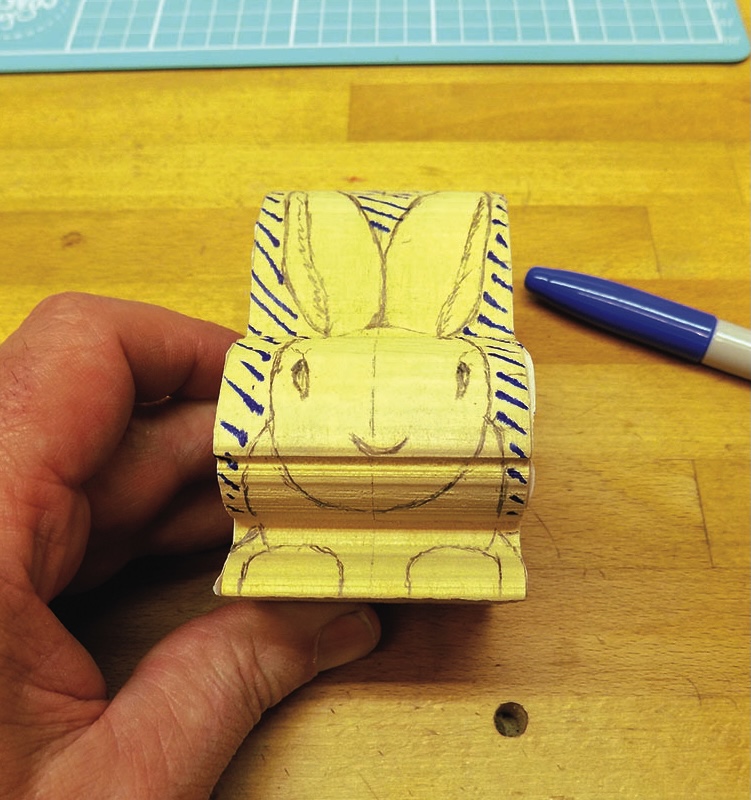
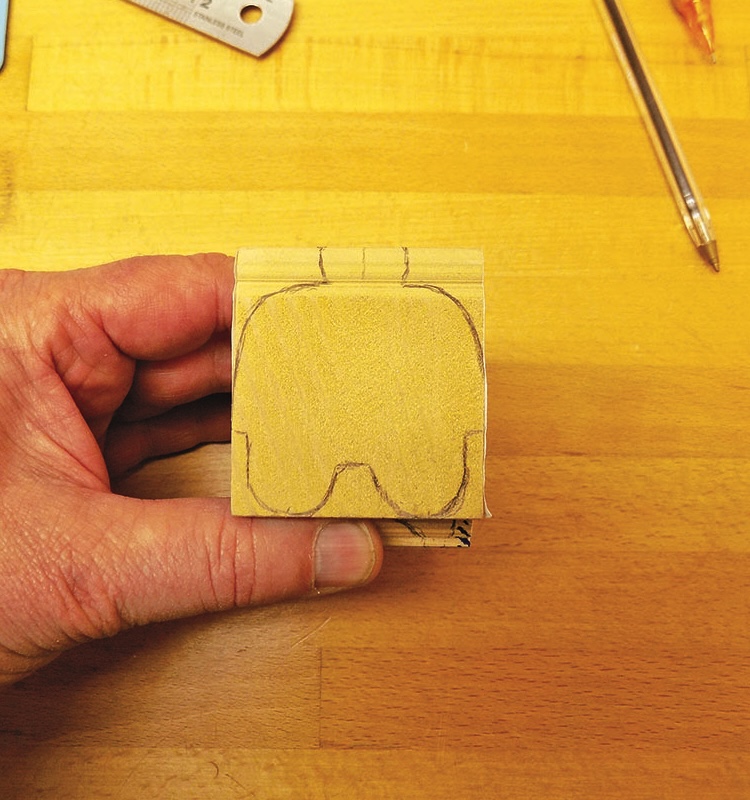
4. Now the front profile has been transferred and the waste area is cross-hatched in blue
Hand holding wood with engraved design and tools.
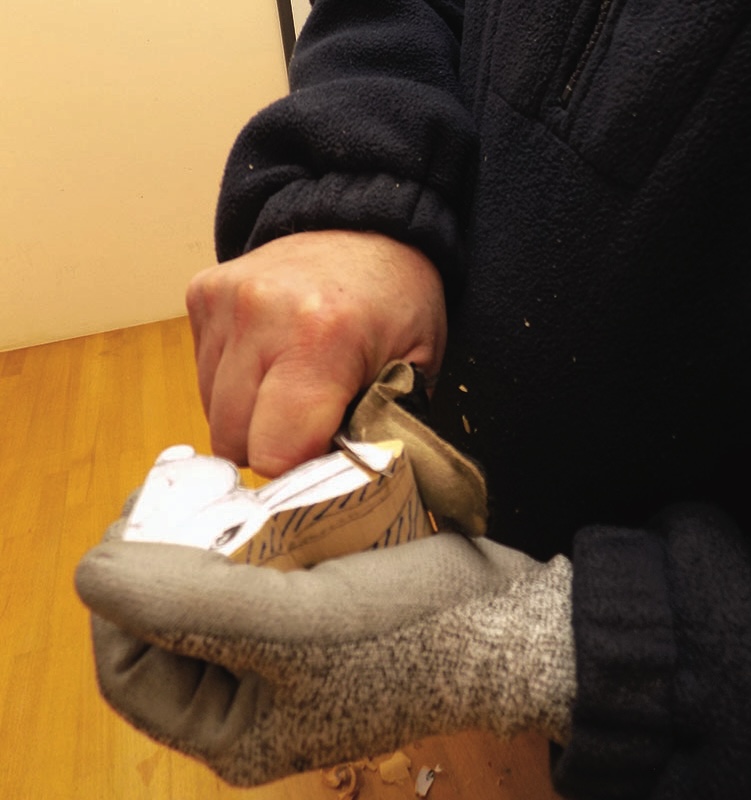
5. Draw in the bottom outline. Remove the waste from the sides, keeping the carving square – do not round over until later. This is the push cut with both hands behind the blade. At times it is good practice to keep the knife quite still and move the workpiece through the cutting edge with your other hand. My thumb on the back on the blade is to apply pressure through the cut or, more often than not, it’s stationary like a fulcrum, a pivot point for a sweeping knife cut. You will find the harder the wood is, the further you move your pivot thumb towards the knife tip. Although chips will be smaller you will gain leverage
Person carving wood with a knife.
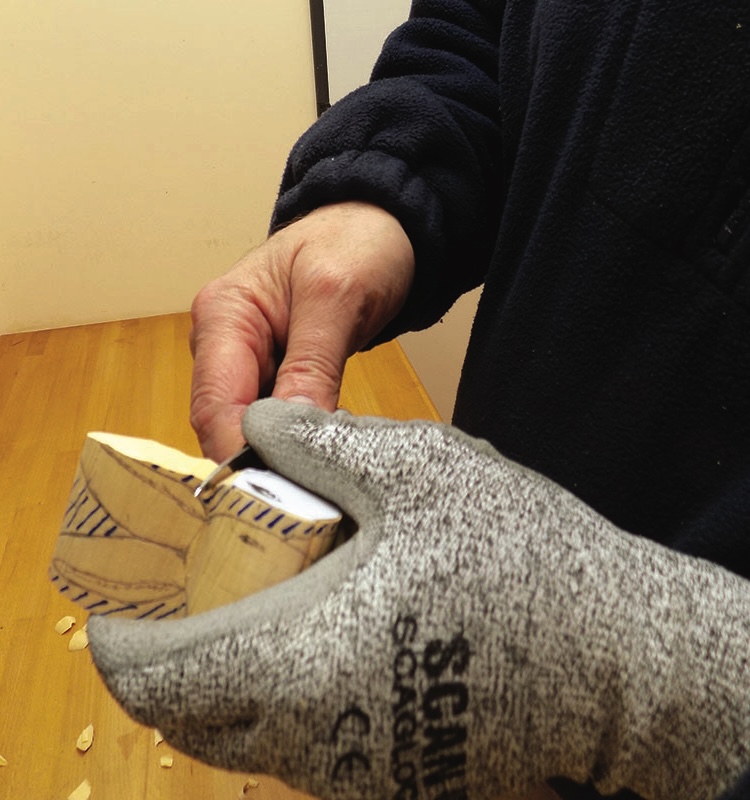
6a. This is the paring/pull cut towards your thumb. For protection, wear a leather thumb guard. The guard shown is homemade with some elastic ribbon on the back. You can buy variants of these. The blade length on this knife is 45mm and I tend to hold the handle quite deep in my hand to aid leverage. If cuts are continuously being made by squeezing your knife towards your thumb, fatigue and strains can arise
Person carving wood with protective gloves
6b. Make a vertical stop cut at the deepest waste area – for example, where the base of the ear meets the head – then carve increasingly widening V-shape waste away from each side. Note at times, when permitting, how the grain can speed up the roughing-out process. With a slight tilt of the cutting blades, the unwanted waste can split away on this weakness
Gloved hand carving wooden rabbit figurine
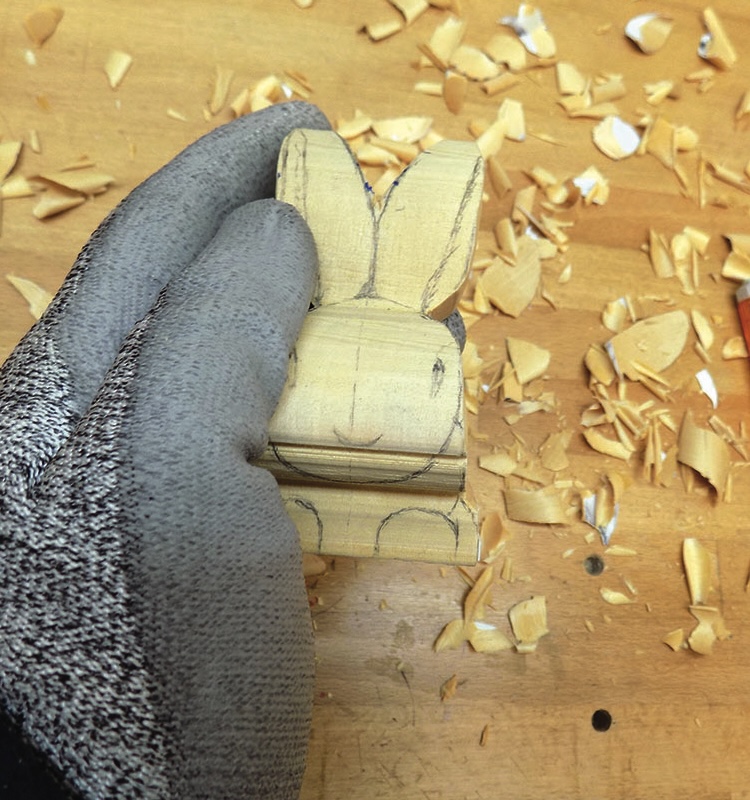
7. With the sides now carved away, remove the waste in between the ears. Double check the pencil centreline is still centred in between the face. Re-draw if need be
Hand holding a partially carved wooden bunny.
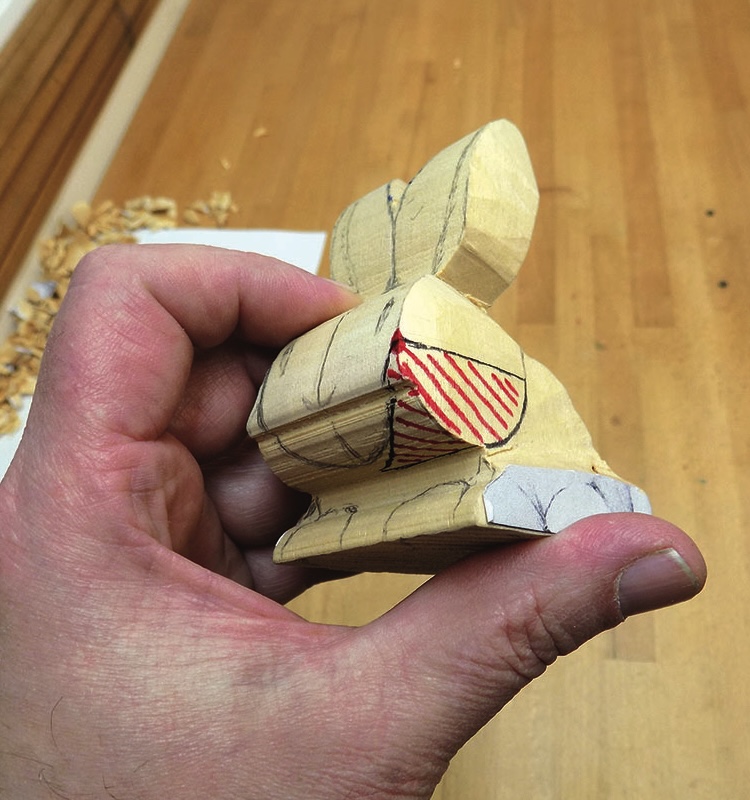
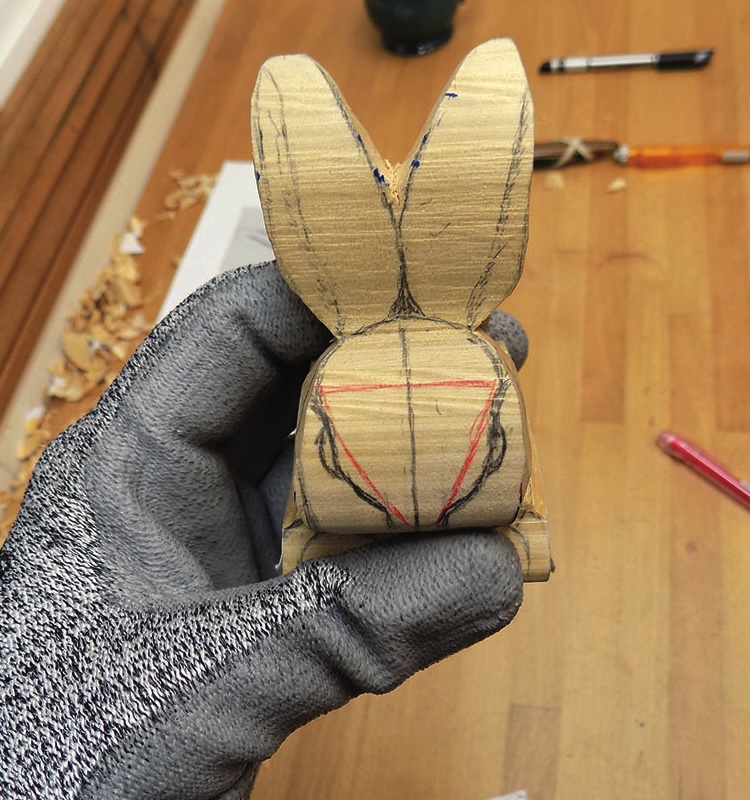
8. Next, draw or scribe a horizontal/parallel line halfway down the face on both sides. Again keep it square edged – remove waste to the centreline under the chin as shown in red
Hand carving wooden rabbit sculpture on workbench.
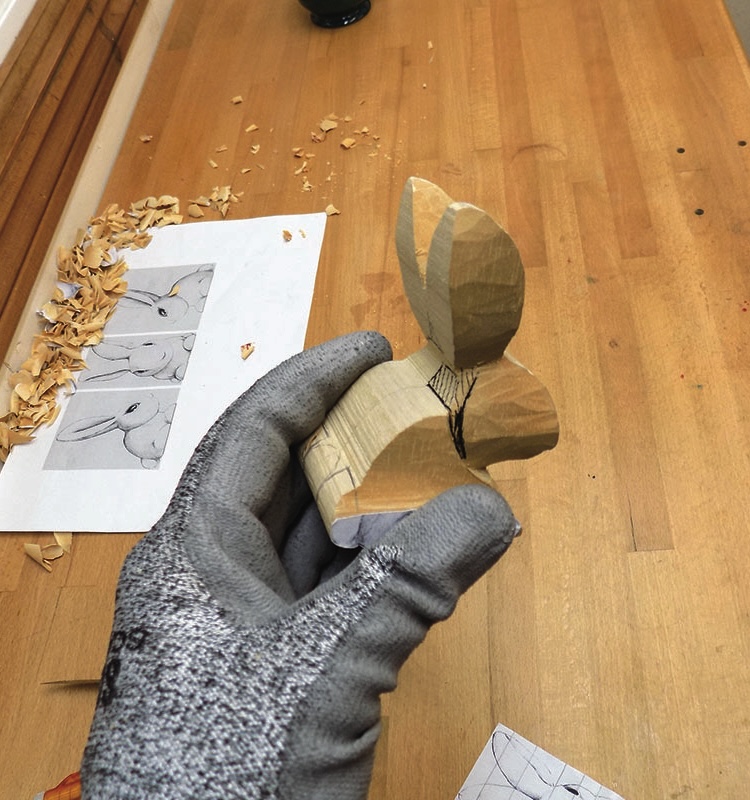
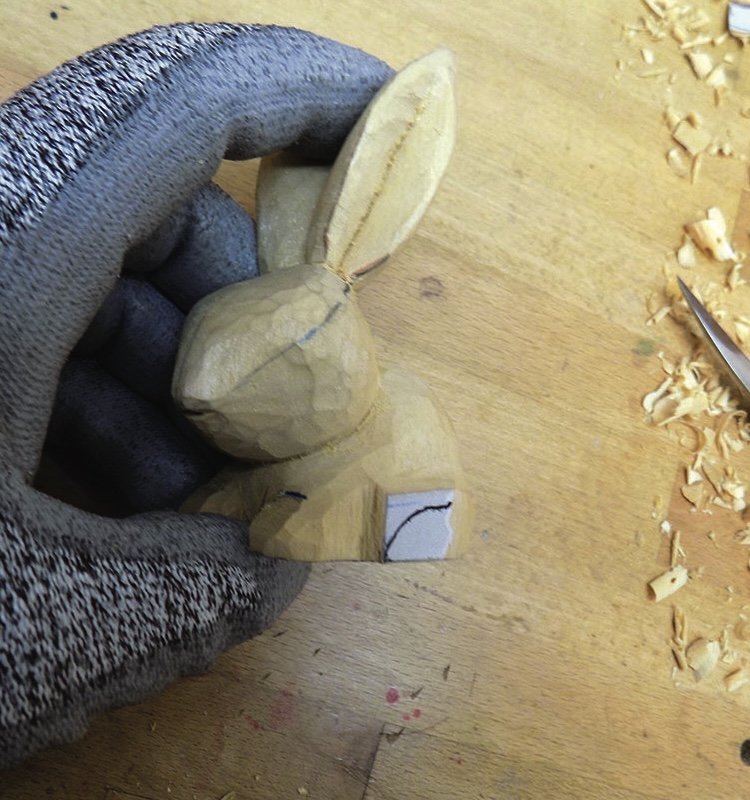
9. With the front now squared off, continue this shaping around the back of the head. Make a stop cut around the neck collar to assist debris removal and repeat on other side. Ensure at all times you keep the head symmetrical
Hand holding carved wooden rabbit sculpture.
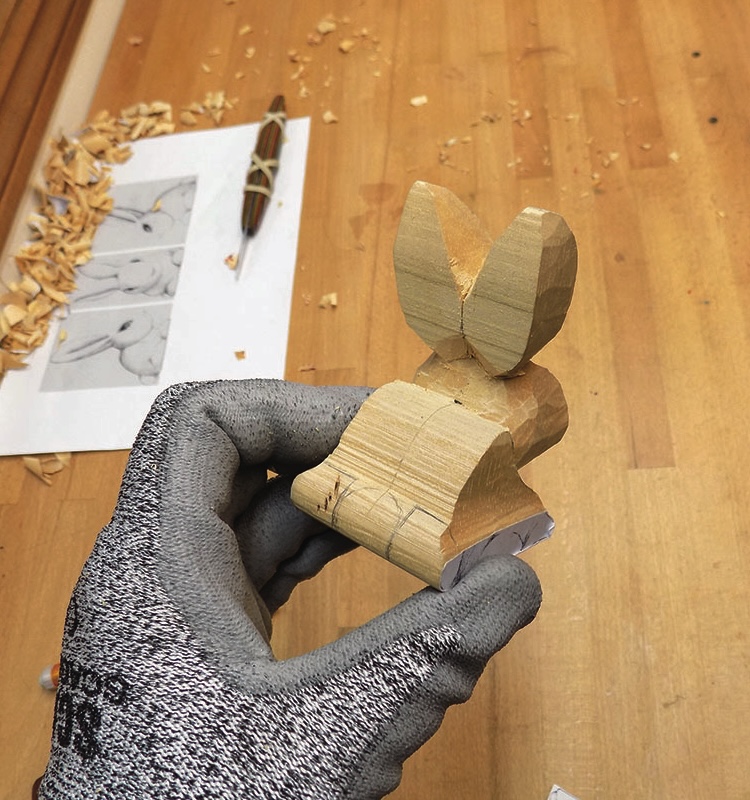
10. The back of the head also has additional cuts around the base of the ears. Note the small marks on the bottom of the carving. They are in a waste area and called latex channels – they go through the wood and come out the far side (note picture 11)
Hand holding carved wooden rabbit sculpture in progress
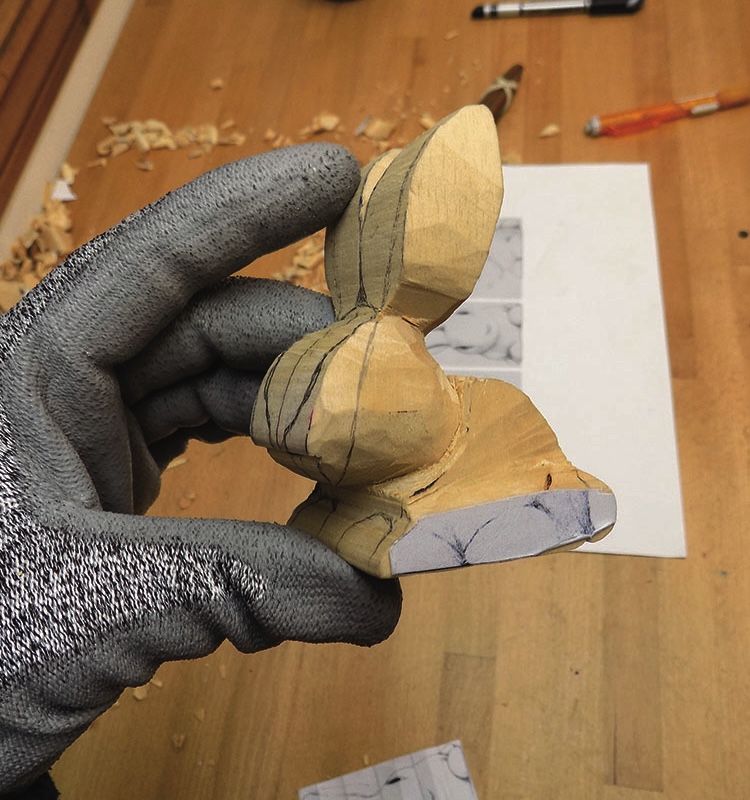
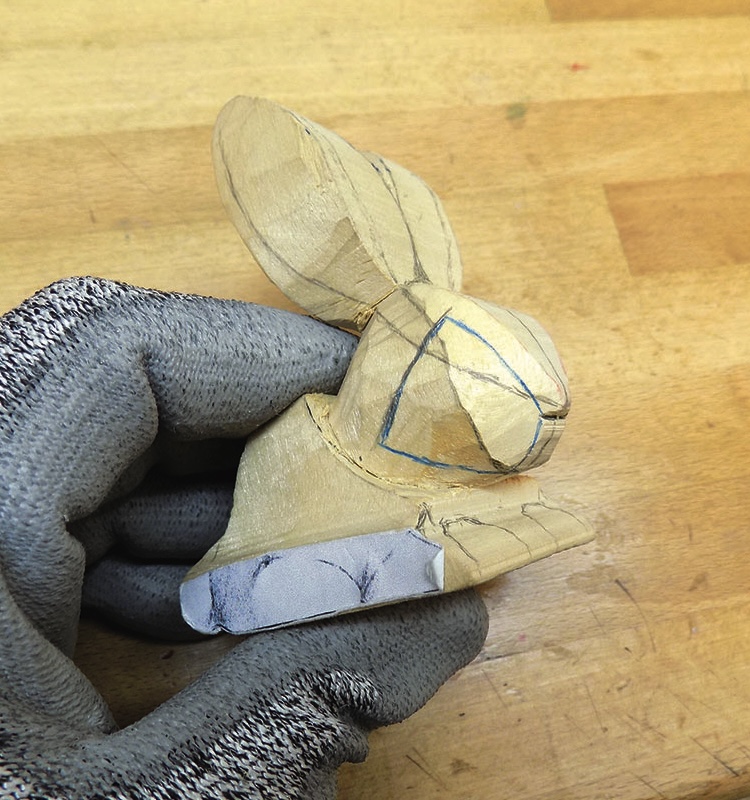
11. Now, as shown in the picture, draw a line from the ear base to the centreline under the chin. In the picture it looks straight, but in fact from the side it’s crescent-shaped, about 10mm at its widest in the cheek area
Gloved hand holding carved wooden rabbit figure.
12. Note how the drawn face has a triangular shape. Next, remove the waste between the red side lines and the crescent-shaped line drawn in step 11. Marking out accurately helps no end and eliminates a lot of guess work
Hand holding wooden rabbit carving in progress.
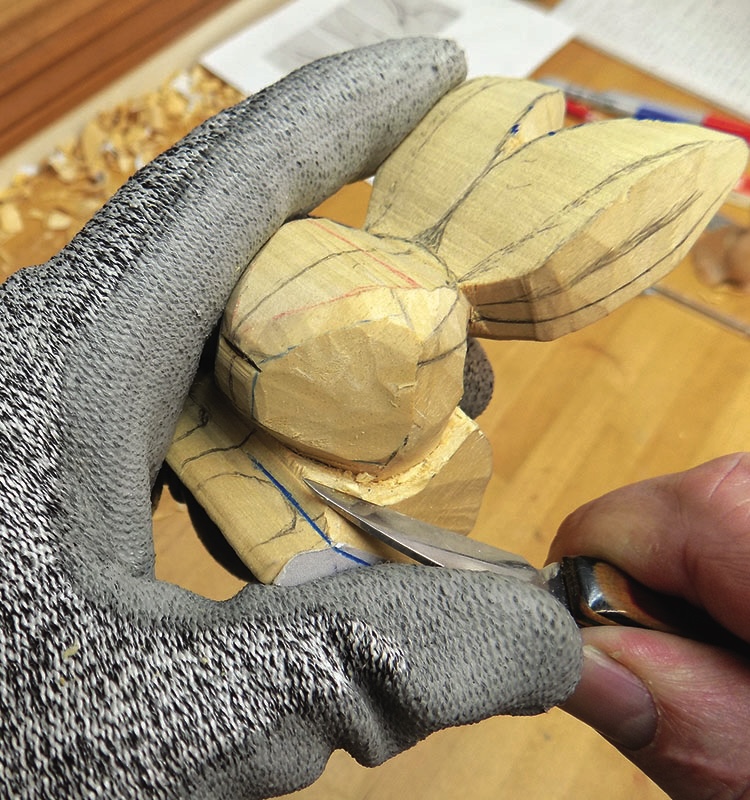
13. The drawn shape in blue now needs to be removed on both sides to create a wedge towards the nose. Remember the forehead has a triangle shape. This is a tutorial, but with time and practice you’ll find yourself not having to draw any of these guidance marks and instead start watching the new facet lines created.  To ensure symmetry, when you make a cut on one side of the rabbit, immediately replicate the cut on the other side. It’s easy to get carried away on one side and then forget the steps needed for the other side. Just watch the facets created and keep the head carving as symmetrical as you can
Hand-carving wooden rabbit sculpture with craft knife.
14. Now, from the blue line above the paws make a scoop cut. This cut isn’t straight, it curves upwards to the neck line and then extends up around the body side. Now carve and smooth off around the whole neck, including any leftover sharp edges of the lower head if need be

Top tip:

When possible and it is good practice – try locking together in position both your blade and thumb at a set distance apart, and then again move the workpiece through its cutting edge with your other hand. Notice where your thumb/guard and the workpiece make contact. This is now the pivot point. 


The ears, tail and nose
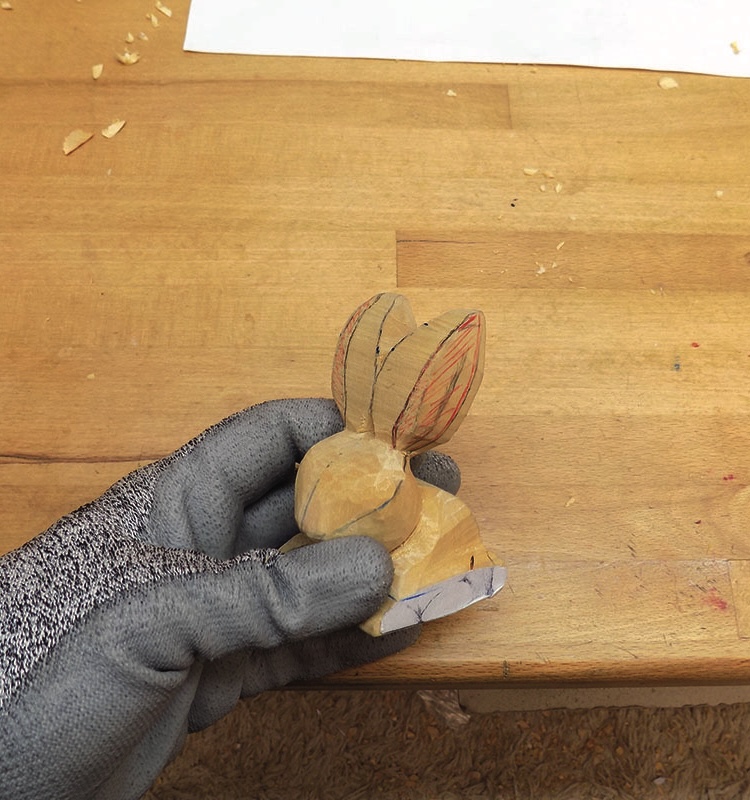
Gloved hand holding a carved wooden rabbit figure.
15. Next, study the templates and draw the inside part of the ears. Remove this waste with just a straight cut, don’t hollow out just yet. Do not rush this, spend some time getting it right
Hand holding wooden rabbit carving on workbench.
16. Using multiple light cuts, round off the ears, and then the back – keeping that original centreline
Gloved hand carving a wooden rabbit figure.
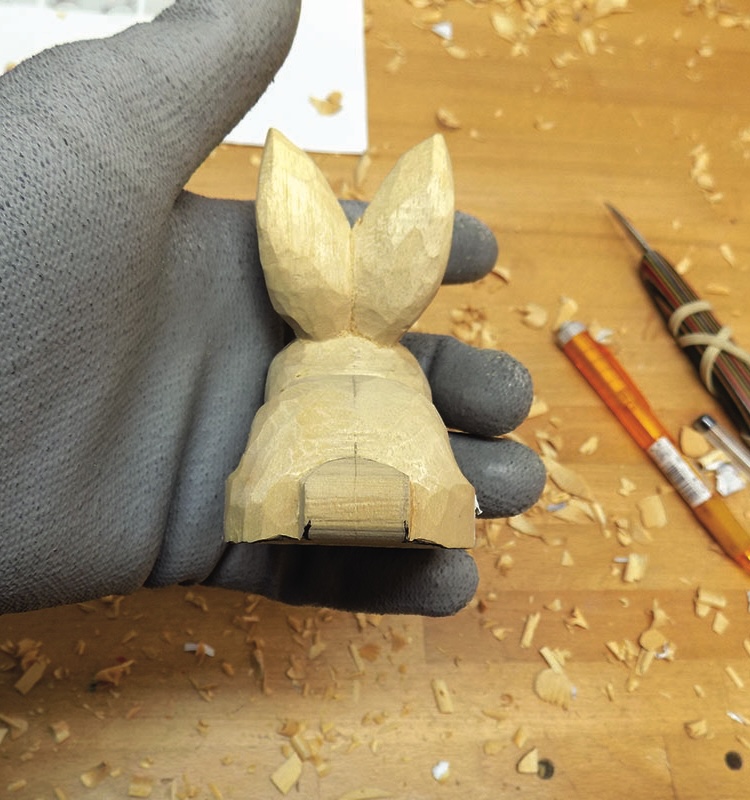
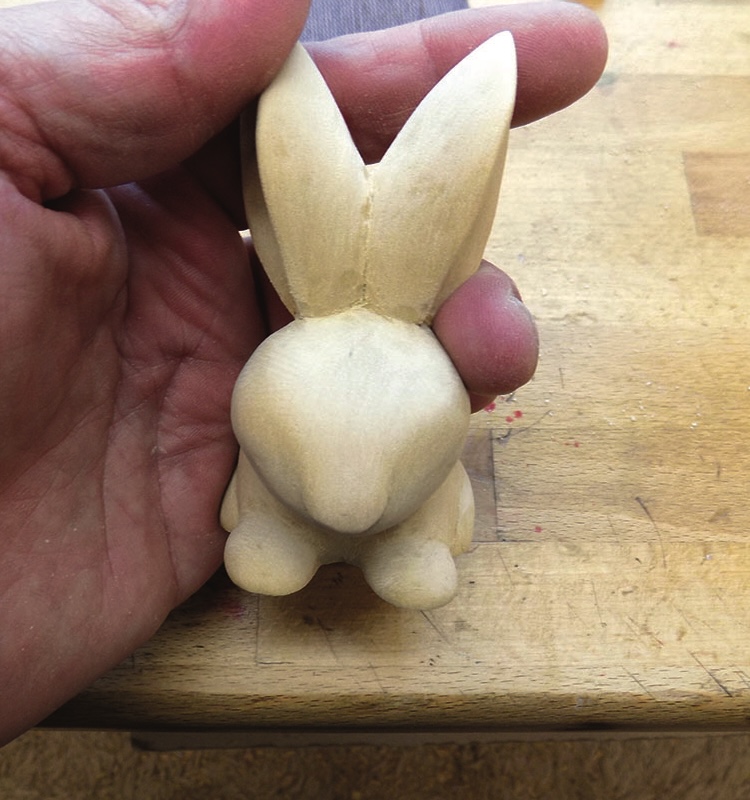
17. Now hollow out the ears by creating a V-shape then remove waste around the paws and tail
Hand holding small carved wooden rabbit figurine.
18. Finally shape the tail and nose, and thoroughly check all the carving is complete. Remove and blend in any high pointed ridges. Now sand the piece down to 320/400 grit. This is just removing high spots only by hand sanding, and not reshaping the form. Always finish sanding with the grain. Be aware though – any wood dust generated is hazardous to the respiratory system so wear a suitably rated dust mask

The eyes

Rabbit drawing and sculpture creation process
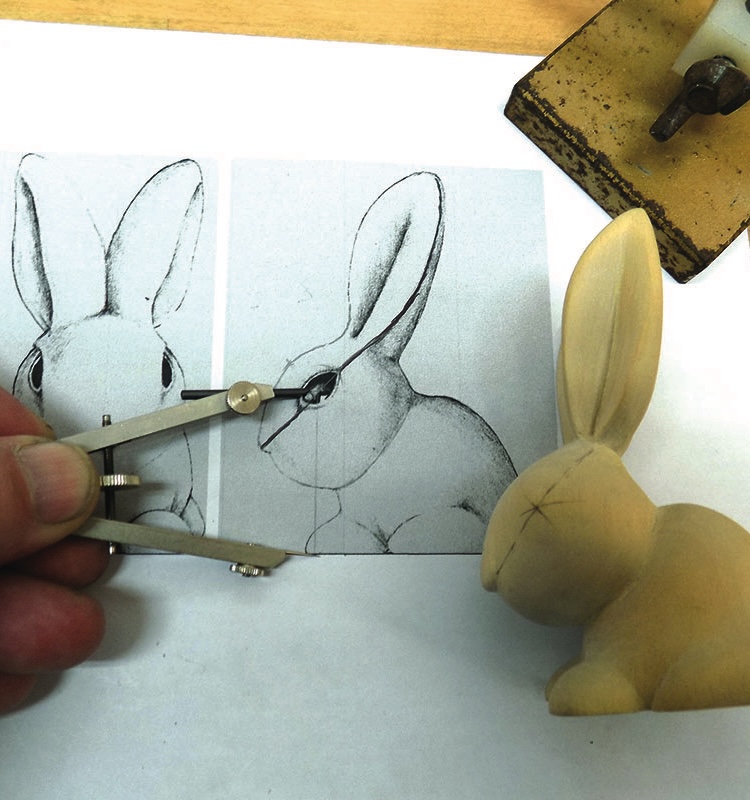
19. Re-draw lightly in pencil the eye centreline that extends from the ear. Next ,measure the eye height and transfer it to the carving with compasses or scribe where the two lines cross – this will be our eye centre height. Repeat this process on the other side
Carving a wooden rabbit sculpture with reference sketches.
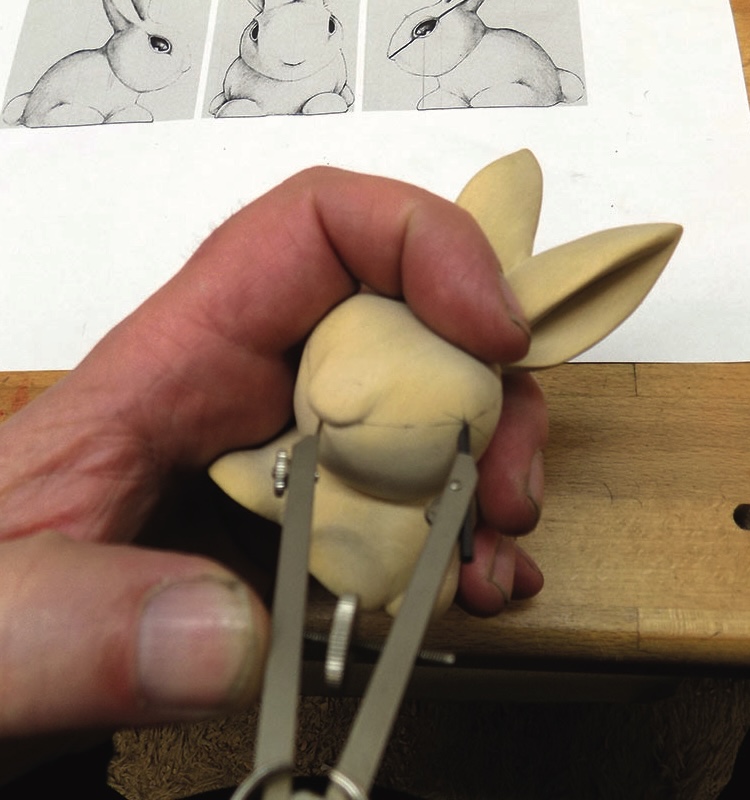
20. Just out of interest, we can double-check our eye position accuracy. This only works if your head is carved symmetrically. From the original centreline under the nose, transfer the eye distance measurement from the first side to the other side as shown. This should land on, or be very close to, your other eye position
Gloved hand carving a wooden figurine.
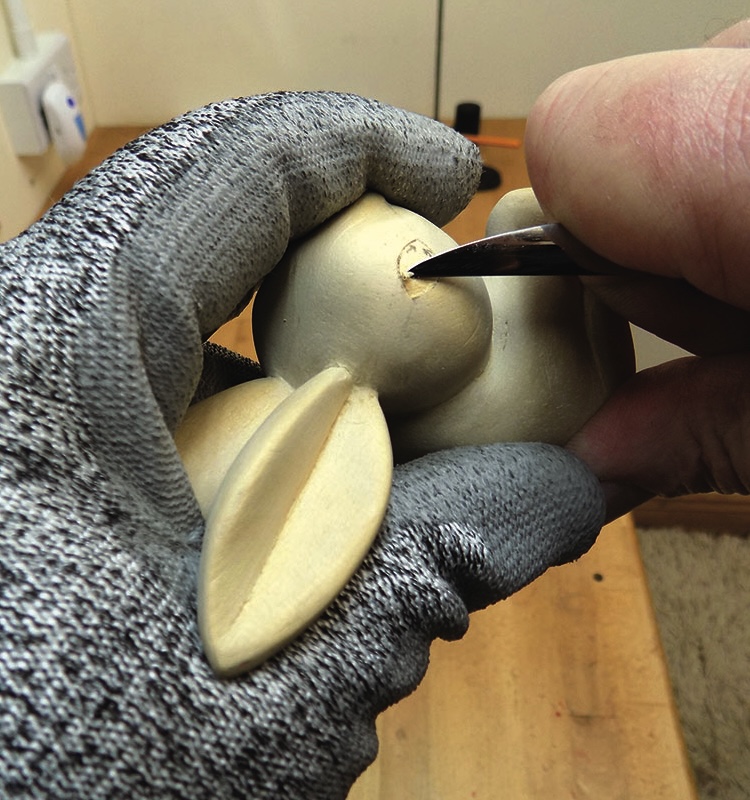
21a. Next step is to pencil in the eye shapes and carve them. The eyes are likely to be the main focal point when looking at the finished carving, so are important. Compasses are again used to ensure eyes are the same height, width and shape on each side
Unfinished wooden bunny carving on table
21b. Now roll the carving around in your hand – it’s our final check to ensure the eyes look good before carving. First, angling your knife handle high, aim towards the very centre of the head and make a small stop cut with the knife tip, going around both eyes about 2-3mm deep. There are four stages to dome over the eye. Follow the direction of each of the four little arrows to carefully dome over the eye. You will find two arrow cuts are made with the push cut technique. The other outstanding two arrow cuts are made with the pull cut technique
Carved wooden rabbit in gloved hand
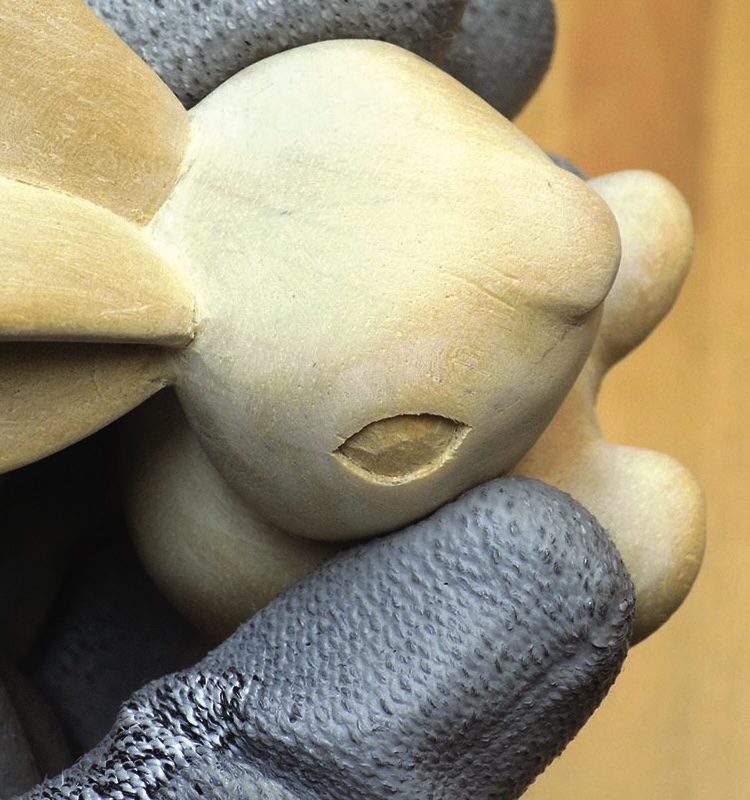
22. The finished eye. You can gently sand this if you end up with facets that you do not want
Wooden bunny with stain, brush, gloves on table.
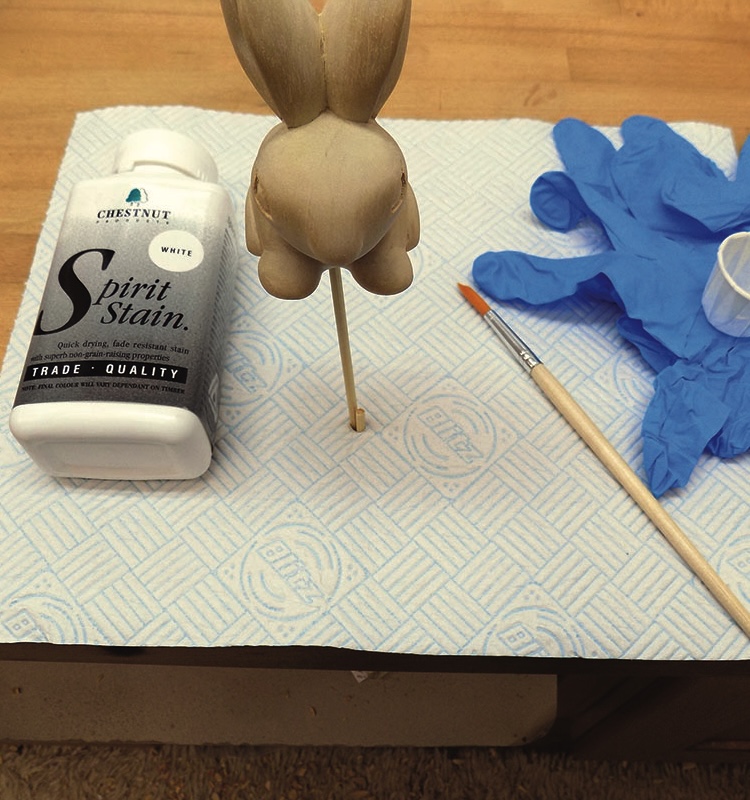
23. Use your own preferred finish of choice. On this occasion I experimented with coloured spirit stain, but water-based/acrylic stains will work well too.  To ensure an even base colour, a few layers of white stain were applied. While the dye was damp, and to ensure a soft-edge melding of colours, I applied small amounts of different mixes of colours to get a blended natural rabbit colour. The tendency of colours to blend with each other when they are damp is a great help here. While the colour is still wet, use a dry brush technique to reveal the white base coat for the fur effect
Ceramic rabbit figurine on two-tone background.
Ceramic rabbit figurine on wooden table surface.
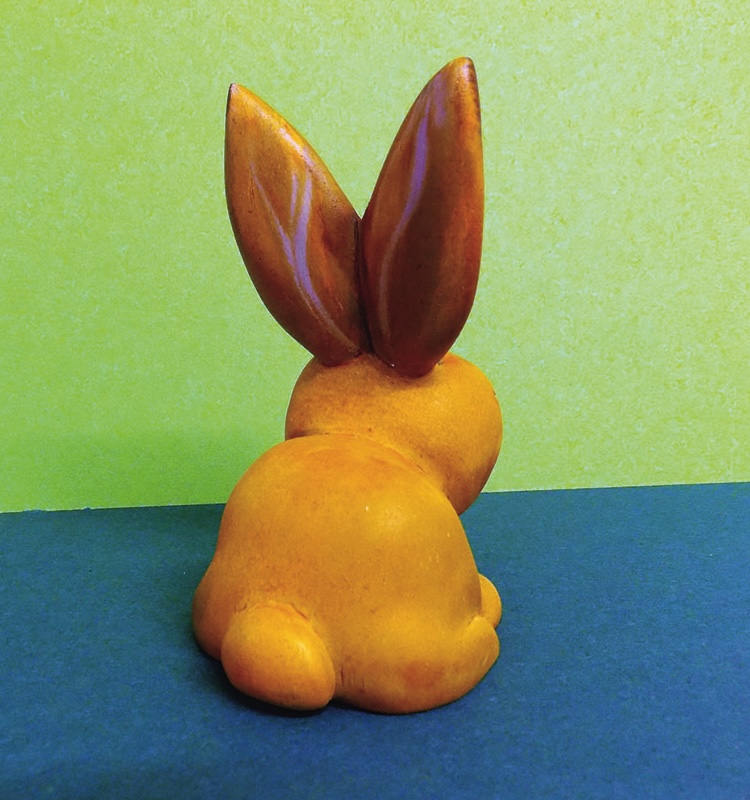
24. The rabbit finished with satin polyurethane

Leave a Reply

Your email address will not be published. Required fields are marked *