
Geoffrey Laycock looks at some of the issues turners face when working with wood
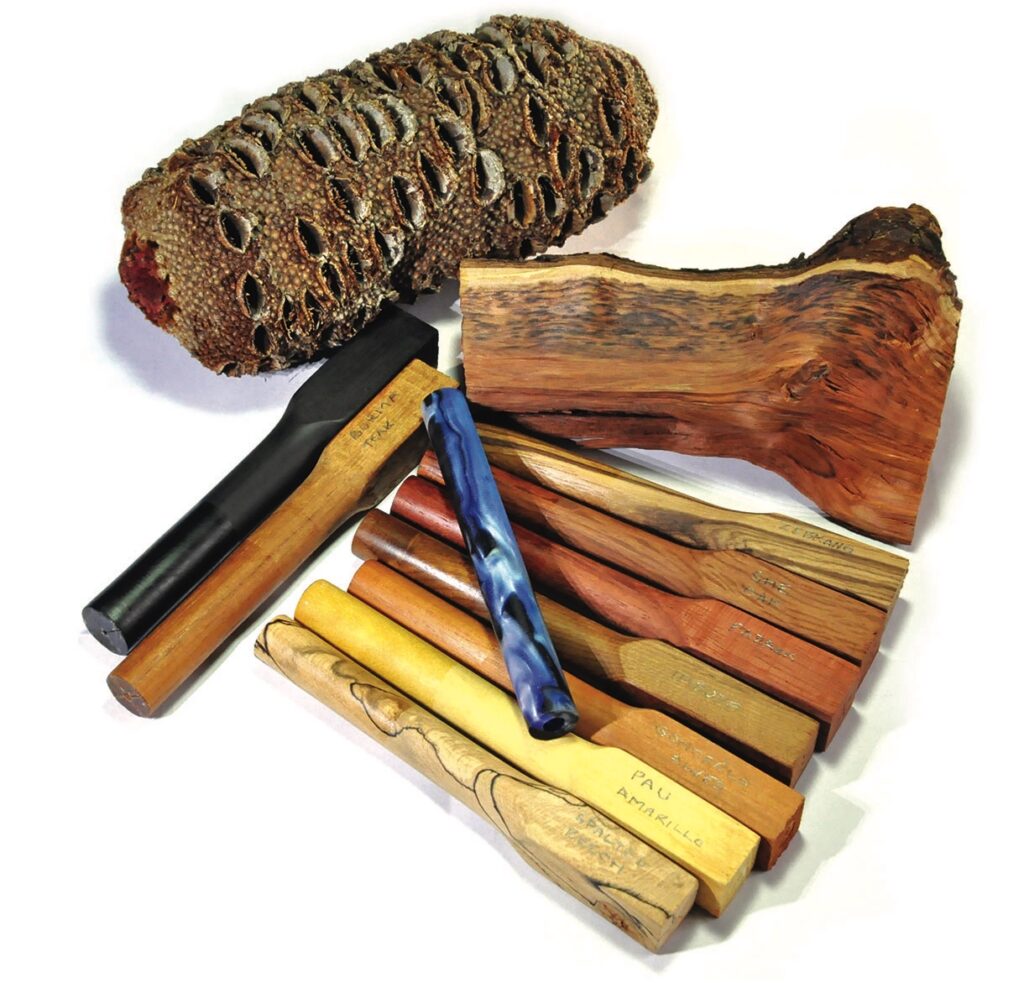
is Indian bean tree (Catalpa bignonioides) – not nice stuff, toxic and another example not included in WIS 30.
The pen blanks are in sawn, turned and finish applied sections for clients to see; some of those common
ones are in WIS 30. Don’t forget other materials such as acrylics.
Woodturners know all wood is not the same and those differing characteristics are what allow the infinite variety of turnery we produce. But, thinking about staying safe and healthy, those characteristics can be a big influence. Starting with big pieces, size and density influence whether we may be injured by an out-of-balance piece flying off a lathe, a piece of green oak has far more potential to injure than an equivalent-sized piece of seasoned ash.
Hand contact with some timbers can cause health problems. Yew (Taxus baccata), for instance, causes dermatitis and systemic effects, such as headache and blood pressure drop. Splinters are yet another problem with greenheart (Chlorocardium rodiei), afrormosia (Pericopsis elatae) and wenge (Millettia laurentii) being examples that rapidly go septic.
Dust health hazards
In the first article in this series we covered inhalation of wood dust. This may be created by sanding, scraping, sawing with finer blades, routing, grinding or even sweeping and it is the smaller particles, often invisible to the eye, which cause most health hazards. Having written that it is invisible, this is the stuff you see floating around in that glorious sunlight streaming through the window. Using a powerful parallel light beam is a common method of investigating airborne dust sources and control – it’s called the Tyndall effect. Try it yourself.
Wood dust can contaminate the skin and cause dermatitis, and particles getting inside the eyelids and on the outer coating of the eyeball may cause painful scratches and possible infection. Certain species are known to cause irritation: the mucous membrane inside the eyelids, or the conjunctiva and/or sclera of the eyeball, can become irritated causing extreme pain. Inhalation can cause similar irritation of the lining of the nose. Padauk (Pterocarpus dalbergioides), poplar (Liriodendron tulipifera) and oak (Quercus spp.) are examples known to do this but every individual reacts differently and some woods not known as irritants can affect some people.
Fire hazards
Wood chips can cause eye injuries, a slip risk – especially on timber floors – and are a fire risk. It is always wise to remind ourselves that fine wood dust is potentially explosive if it becomes airborne in the correct ratio of dust to air. In a small workshop this could be from using compressed air to blow dust off machines or just sweeping floors. If a suitable ignition source is present you could lose a workshop, although this is an unlikely event. It sounds stupid but I have seen a workshop being swept where there was a propane fired ‘torpedo’ heater in use. Please don’t do that.