The Woodworkers Institute

We bring you the very best of woodworking!

“Make it with us”

Branding turned work

Molly Winton explores embellishing a turned project with home-made brands using nichrome wire

Person woodburning design on wooden object.

Designs can be imprinted into the surface of the wood by stamping a heated shape into the wood fibres, just as branding is done to mark ownership of cattle. Brands can be made using nichrome wire, copper rivets/nails, copper tubing, and/or brass tubing. When copper and brass are used, ensure they are solid copper or brass, not plated. Copper conducts heat better than brass, however brass does work. Nichrome wire can be bent and configured by hand, or through the use of a variety of pliers or wire-bending tools prior to heating the wire. Once the wire has been heated (annealed), the metal hardens and will no longer be flexible. Attempting to bend and manipulate annealed wire will result in breakage. This article will explore the use of nichrome wire brands only.

Analysis of interchangeable tip pens

In order to be used, the home-made brands must be attached to a power source to heat the tips/brands you intend to use. An interchangeable tip pen that is capable of securing the legs of the tip/brand to the pen body must be used. Pens with set screws are necessary to ensure the electrical current travels up one leg, through the body of the brand, and then back down through the second leg. If electrical conductivity is broken, or not secure, the brand will not heat.

There are numerous machines available. Some are perfect for pyrography – which typically uses low heat – but branding requires a high-heat output using potentially quite thick tips and some units cannot deliver the heat output to brand well. Also, some of the handles can become hot when used with high-heat output, which makes them uncomfortable to use. You also need to find a holder that feels right, does not get hot, can deliver the heat output required and can be used with a variety of wire thicknesses to create the effects you want. Best advice is to talk to people already doing this type of work and ask what they are using. Talk to retailers and it is also worth trying before you buy.

Making the basket weave brand

Nichrome wire spools, 60 and 80 gauge.
Bare nickle-chromium resistance wire (nichrome) is needed to make the brands. It does not seem to matter whether it is nichrome 60 or 80. Both work fine. Two sizes (22 gauge, and 20 gauge) are commonly used by the author. The higher the number, the finer the wire
Assorted pliers and tools for wire work
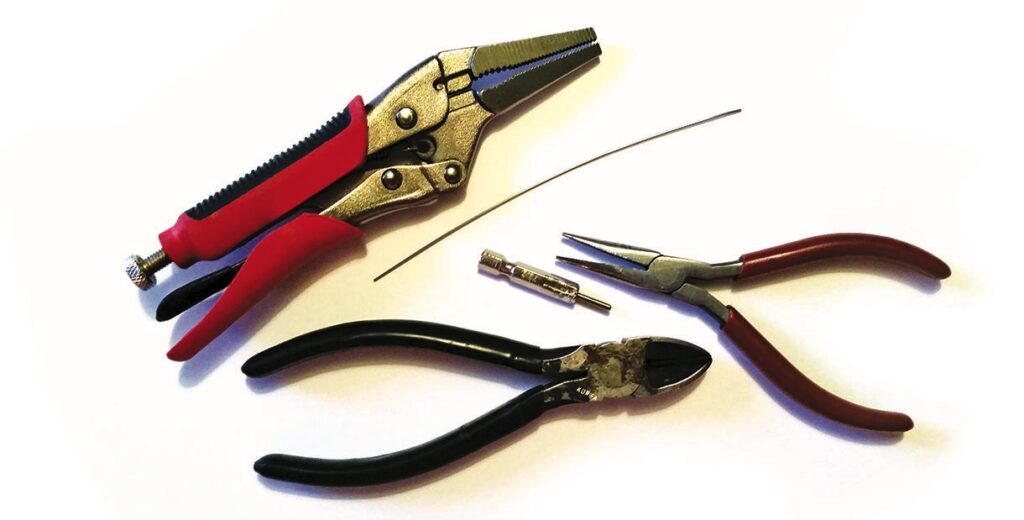
Equipment used to make the basket weave brand include locking vice grips, wire cutters, needle-nose pliers, a mandrel, and approximately 5in (130mm) length of 20 gauge nichrome wire

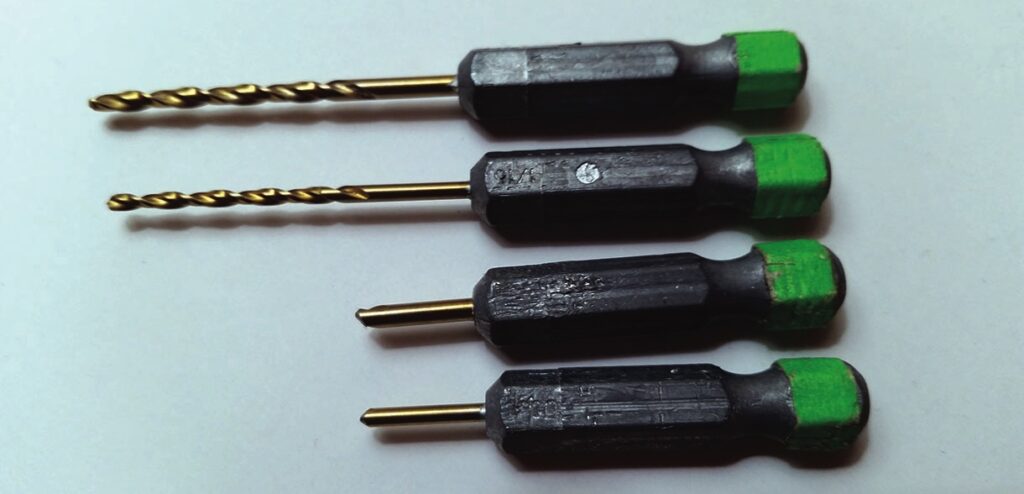
Make your own mandrel

Make your own inexpensive mandrels by purchasing hex-ended drill bits and removing the fluted portion of the drill. I found this two-piece set that works great for my standard size, and small size brands –  1.5mm and 2mm.
Four black and green small drill bits arranged.
Pliers gripping wire for jewellery making.
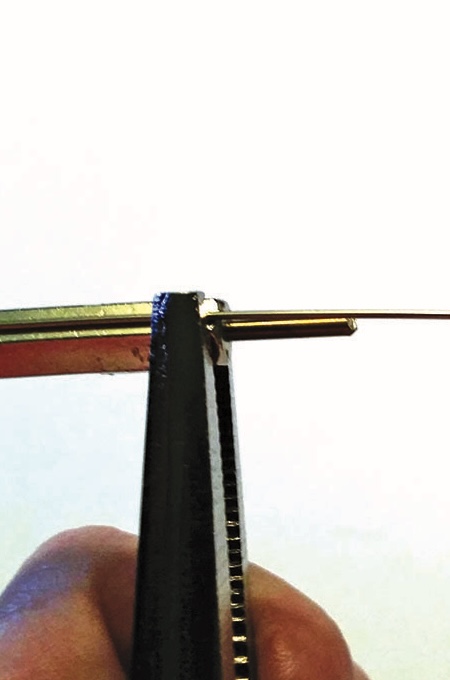
With the locking vice grips anchor the wire, with approximately 1in of the wire extending along the mandrel base (this is one leg of the brand) next to the base of the round mandrel. The wire needs to be firmly anchored, with no wiggle
Close-up of wire being coiled with pliers
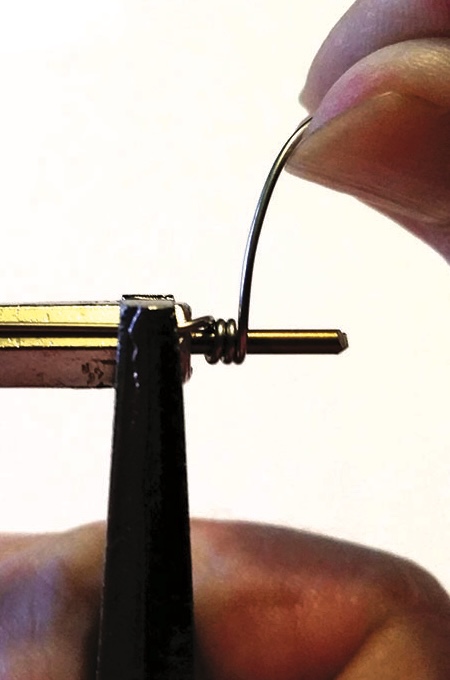
Maintaining strong tension on the wire, wrap it snugly against the mandrel with no gaps between the coils
Hand using pliers to wrap wire coil.
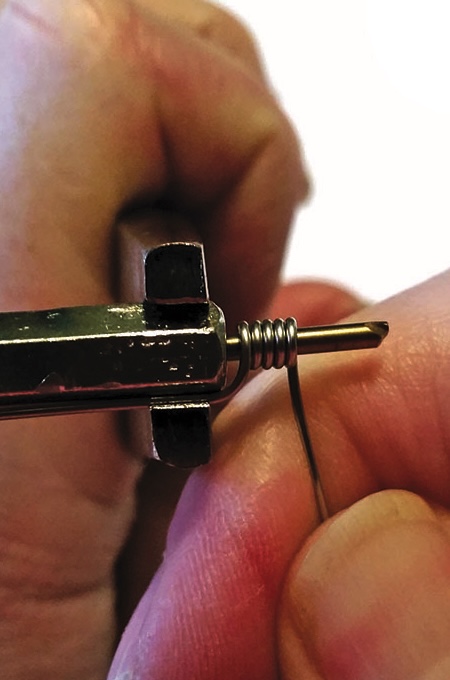
Wrap a total of five coils with the wire exiting the brand on the same side of the mandrel that the wire entered the coils
Hand holding a metallic gadget close-up
Release the vice grips and slide the brand off the mandrel
Hand using pliers to bend wire.
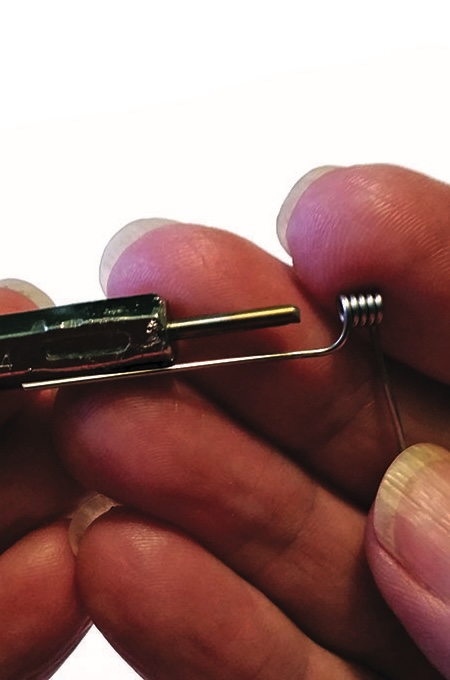
Now grip the coiled end of the basket-weave brand with your pliers
Pliers twisting wire coil tightly.
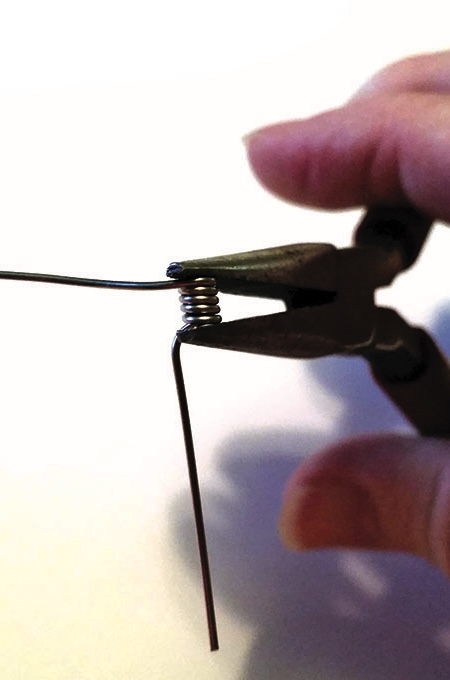
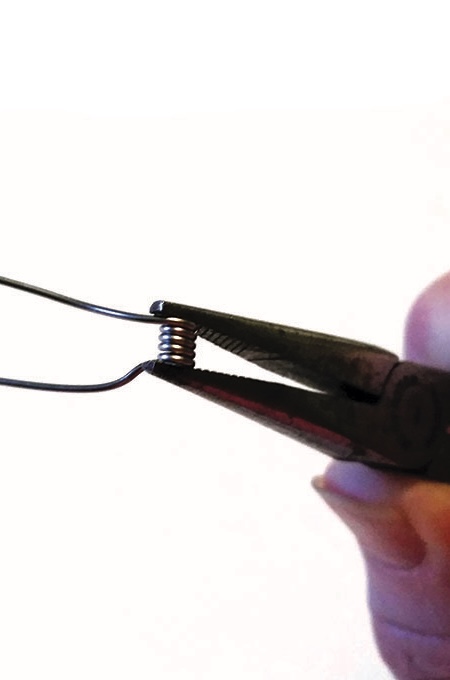
Hold the coils between the jaws of the needle-nosed pliers gently but firmly, so they don’t distort, and bend the shorter of the two legs parallel to the other
Pliers twisting metal wire end into spring shape.
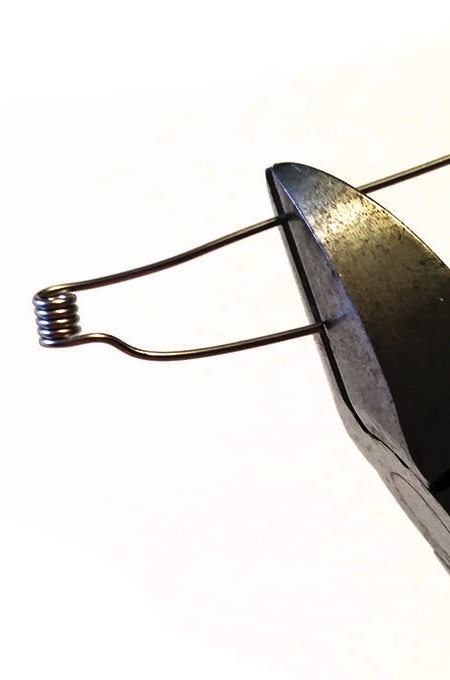
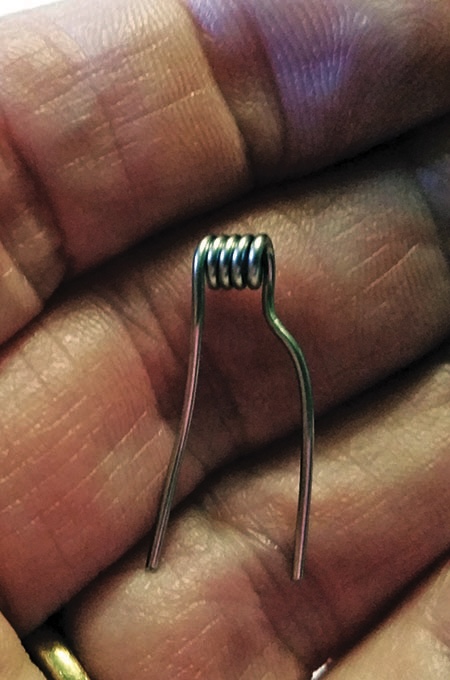
Trim the legs to an approximate 20mm. Leaving the legs too long will lose stability of the legs when the brand is heated and applied to your project
Hand holding a small metal coil.
The completed brand

Basket weave pattern

To get a nice even pattern you need to view the work as if ithe surface is gridded out with squares or rectangles to match the shape of and size of your brand. Draw in a grid if you want. Keep your brand in line with the starting position and gently place the brand onto the surface. Maintain an even pressure until you get the shading and depth you want. Now make another brand in the same orientation. next to your previous one. Now rotate your brand 90° to the previous ones and create two new brands side by side. Then repeat the process until you have finished.

Close-up of woodblock with red stamp tool.

Making the S spiral brand

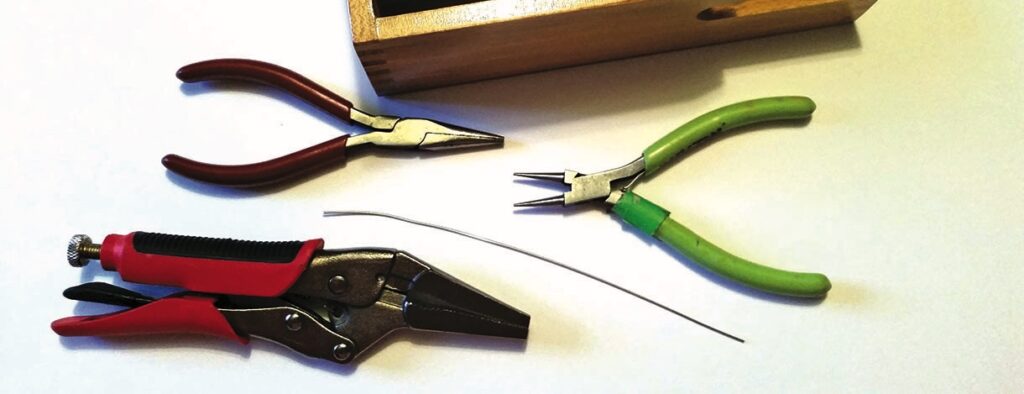
The equipment used to make the S spiral brand includes locking vice grips, needle-nose pliers, dual round cone pliers, something to hold the vice grips (you can use a bench vice) and an approximate 150mm length of 20 gauge nichrome wire. The types of pliers and clamps shown will help make most brands so you are set to go with making many more brands to suit your requirements. All you need in additions is a selction of nichrome wire in various gauges.
Jewellery pliers and wire on table.
Holding wire with pliers using hand
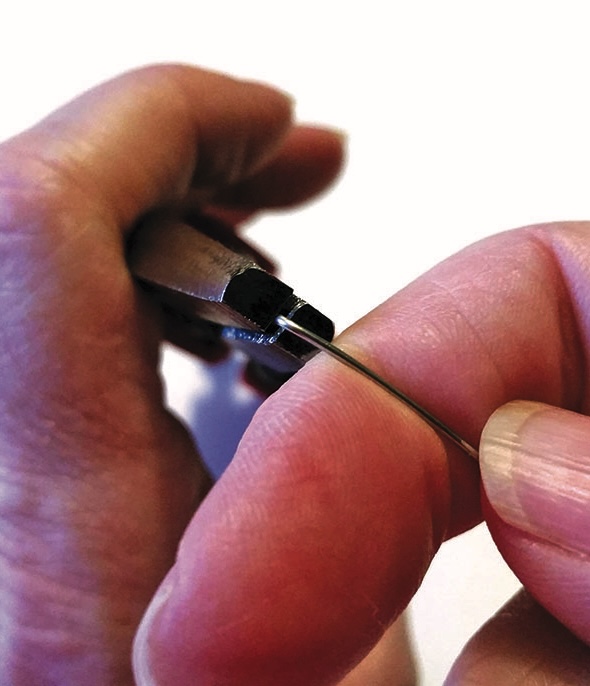
Lock the wire securely within the jaws of the vice grips, extending the wire approximately 25mm into the jaws
Hand using pliers to bend metal wire
This 1in length will be one leg of the brand. Bend the wire extending out of the jaws, so it is perpendicular to the secured leg
Person bending wire with pliers.
Hold the wire in a relaxed underhand grip with your right hand, and the left hand holding the vice grips
Hand bending wire with pliers
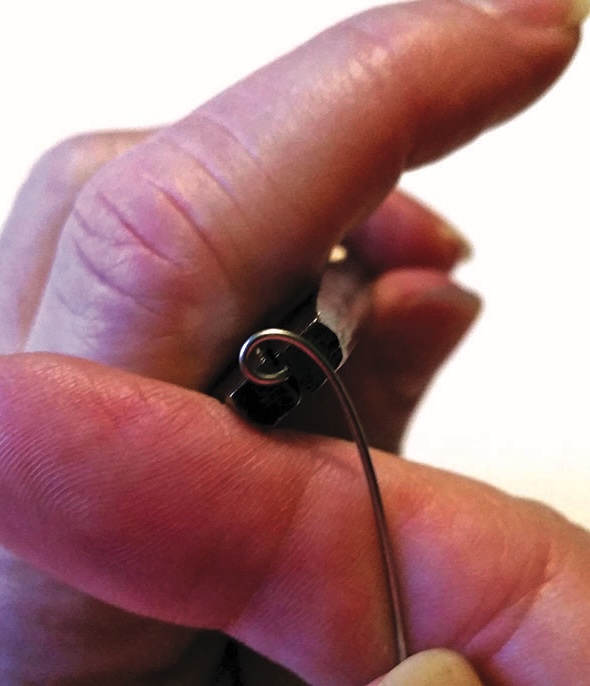
Rotate the vice grips to make a tight centre hole of the spiral
Hand holding a coiled metal wire.
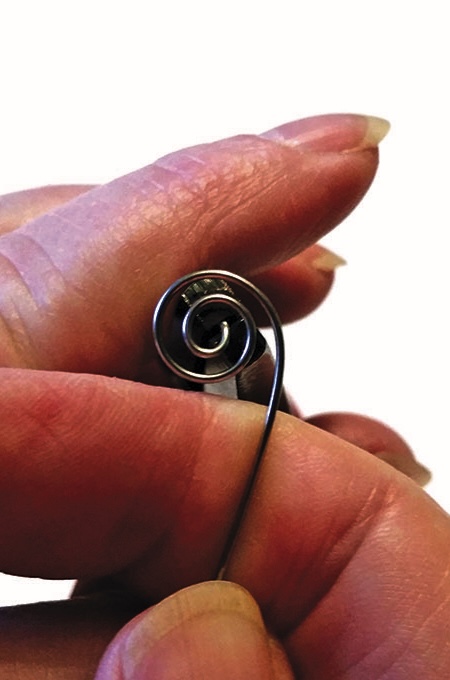
Continue to rotate the vise grips, gently feeding the wire into the spiral leaving a small gap between the wire. After two spirals, stop and secure the vice grip into something that will hold it (I’ve used my tool box. A bench vice is also handy.)
Pliers with wire in tool holder.
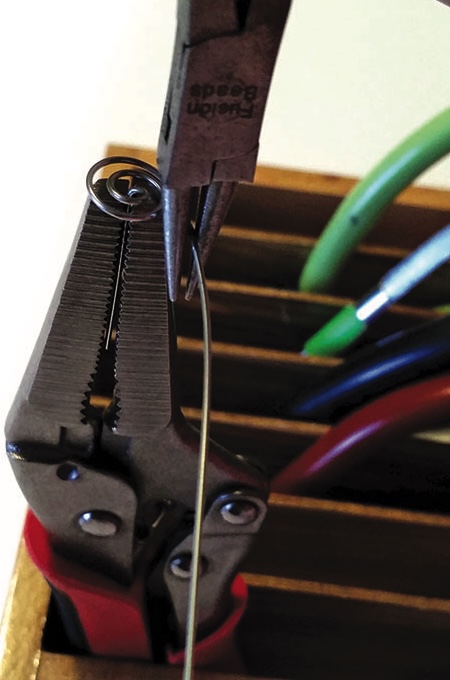
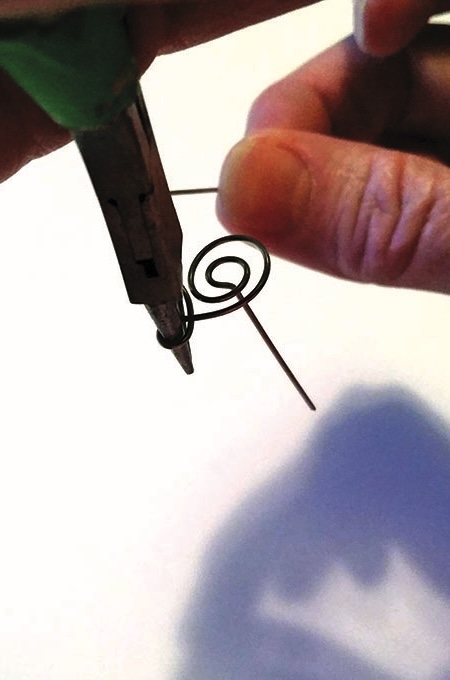
Firmly grasp the long end of the wire, close to the spiral, with the round cone pliers
Close-up of pliers holding a metal ring
Bend the wire back on itself to create a S-shaped profile. The severity of the profile is up to you, but a gentle curve is what I am aiming for with this brand. This is the beauty of brands, you can create as many variants or styles to suit your requirements and tastes
Pliers bending wire into a spiral shape.
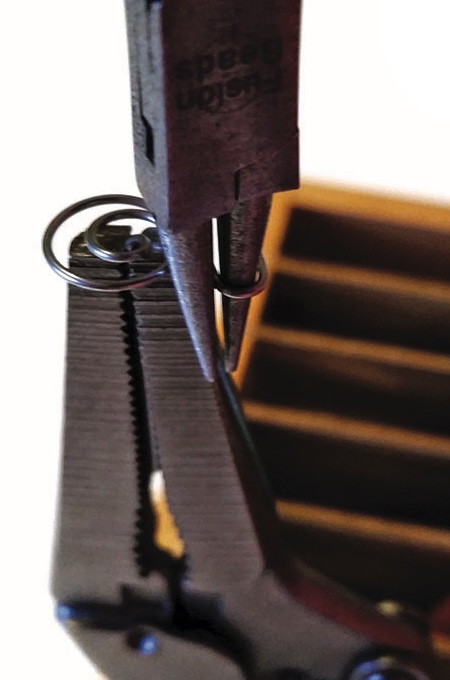
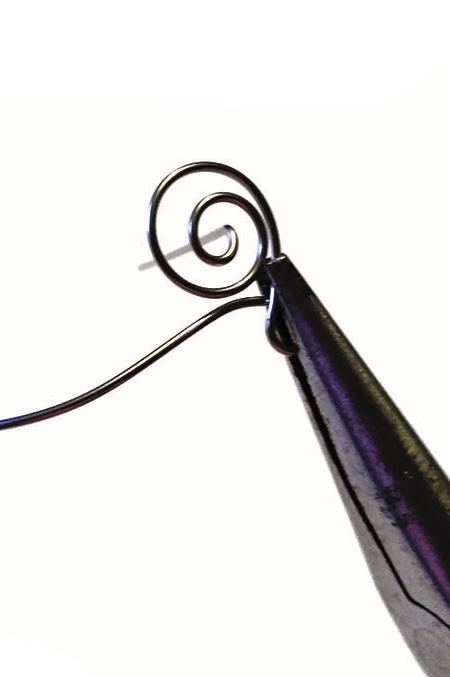
Bend the long end of the wire backwards, snug against the right side cone
Pliers bending a wire into a spiral shape.
Remove the brand from the vice grips and continue to grip the cone pliers firmly. Gently move the long end of the wire to the inside of the first leg. There is enough flex in the wire to manage this without distorting the brand
Hands using pliers to twist wire spiral
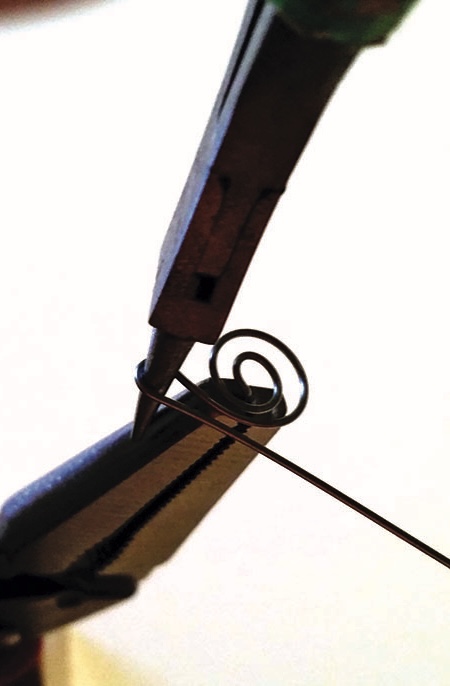
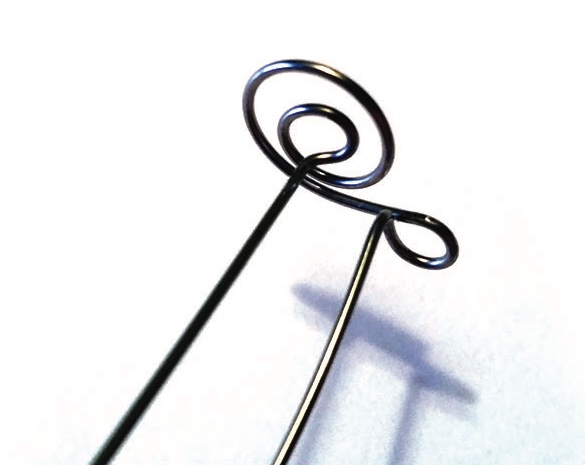
Continue bending the long portion of wire to cross under where the wire enters the cone plier, making a circle
Pliers curling wire loop
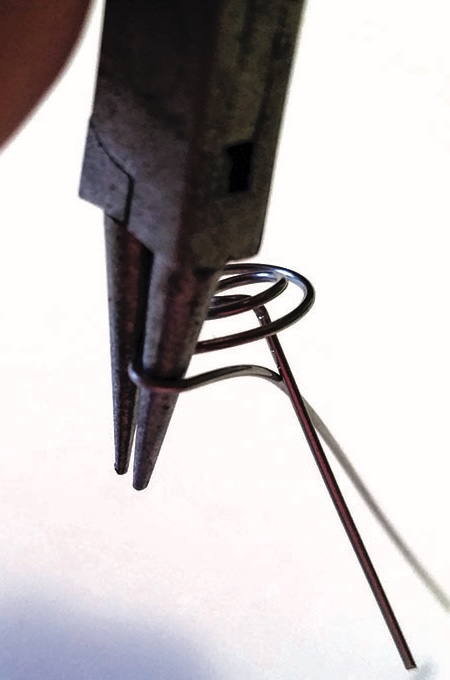
Switch to the needle-nosed pliers, spanning the top circle, and bend the long end of the wire down parallel to the first leg
Metal spiral hairpin on white background.
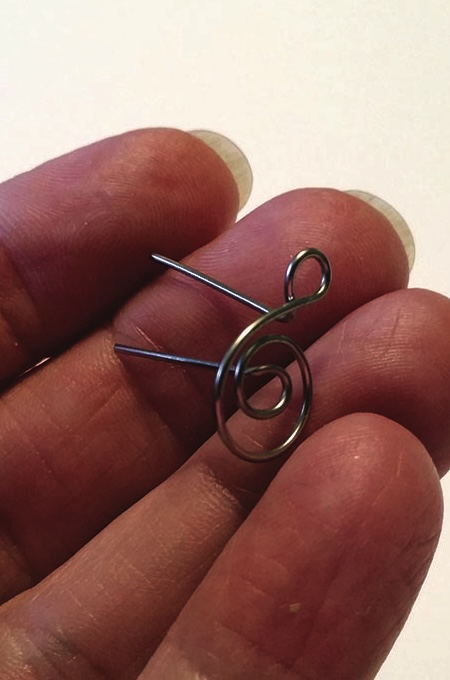
Gently tweak the coils of the brand to ensure each coil is on the same plane, so all parts of the brand will make contact with the surface of your project. If a coil sits slightly higher than the one next to it, gently bend them to the same level. Leave a tiny gap between the lower intersection of the single circle. If the wire touches at this intersection, the electrical current will short out at this point and not heat the entire brand. The electrical current needs to flow uninterrupted
Hand holding small metal wire clip.
The completed brand ready for fixing into your pyrography unit

Application of the brands to your project

When turning the project I placed shallow score lines within the area designated for the herringbone pattern, in the hope this would assist with the calculation of the number of lines to be burned and ensure an even layout. As I burned each line it became obvious they were not helping. Since they were shallow, they did not present a problem, because the brand burned them away.
Person burning design into wooden object.
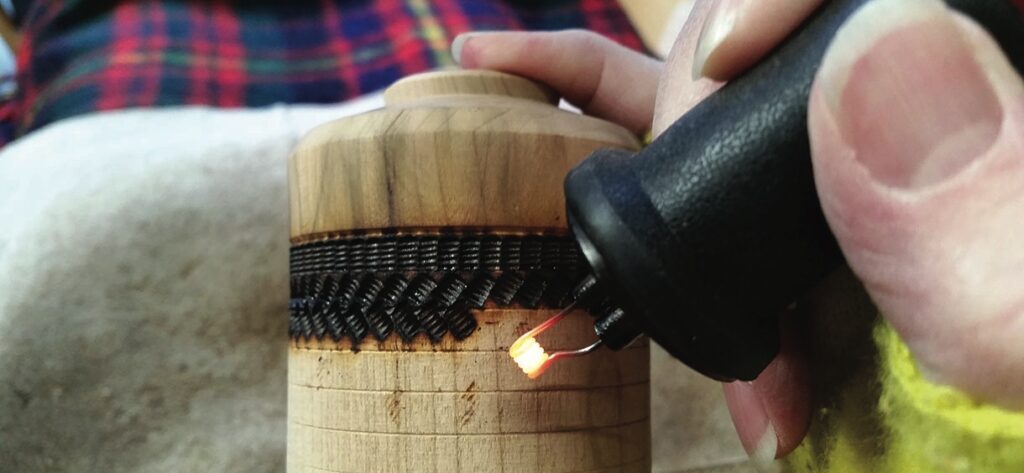
I burned the first line in a vertical orientation to provide a border. For line two I tilted the orientation of brand placement approximately 45° to the right, completed that row, and, for row three, tilted the orientation 45°
to the left. Each subsequent line was alternated back and forth to achieve the herringbone pattern
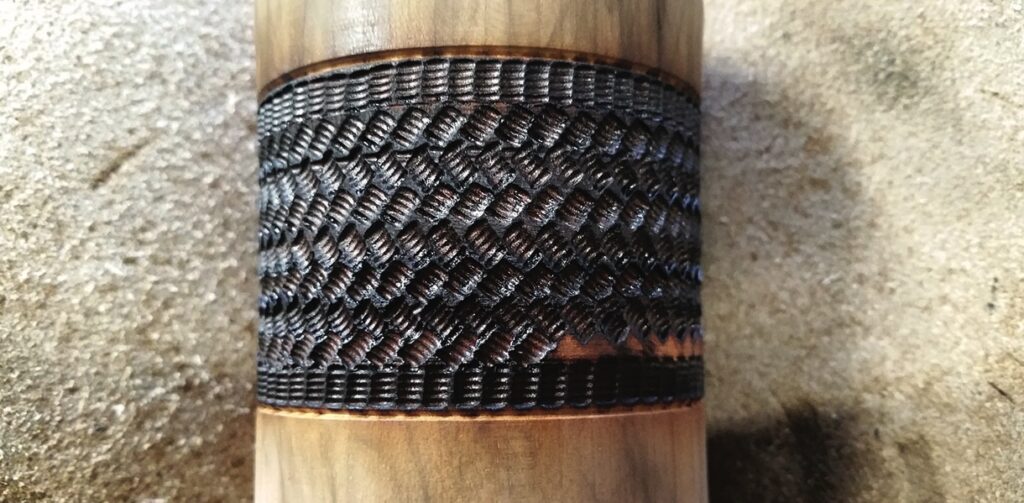
Wooden staff handle with black decorative pattern.
Prior to the final line of the herringbone pattern I burned the bottom border row of an all-vertical orientation
to match the top border. This allowed me to blend the final herringbone line into the border row
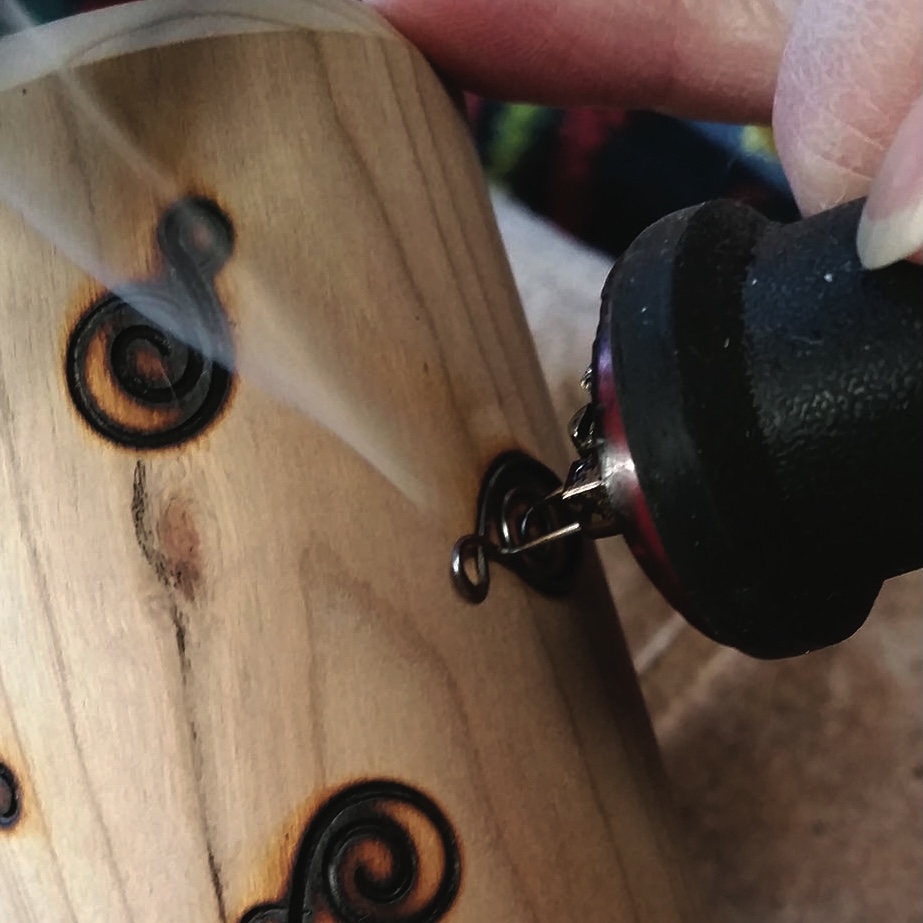
Wood burning tool creating spiral design on wood.
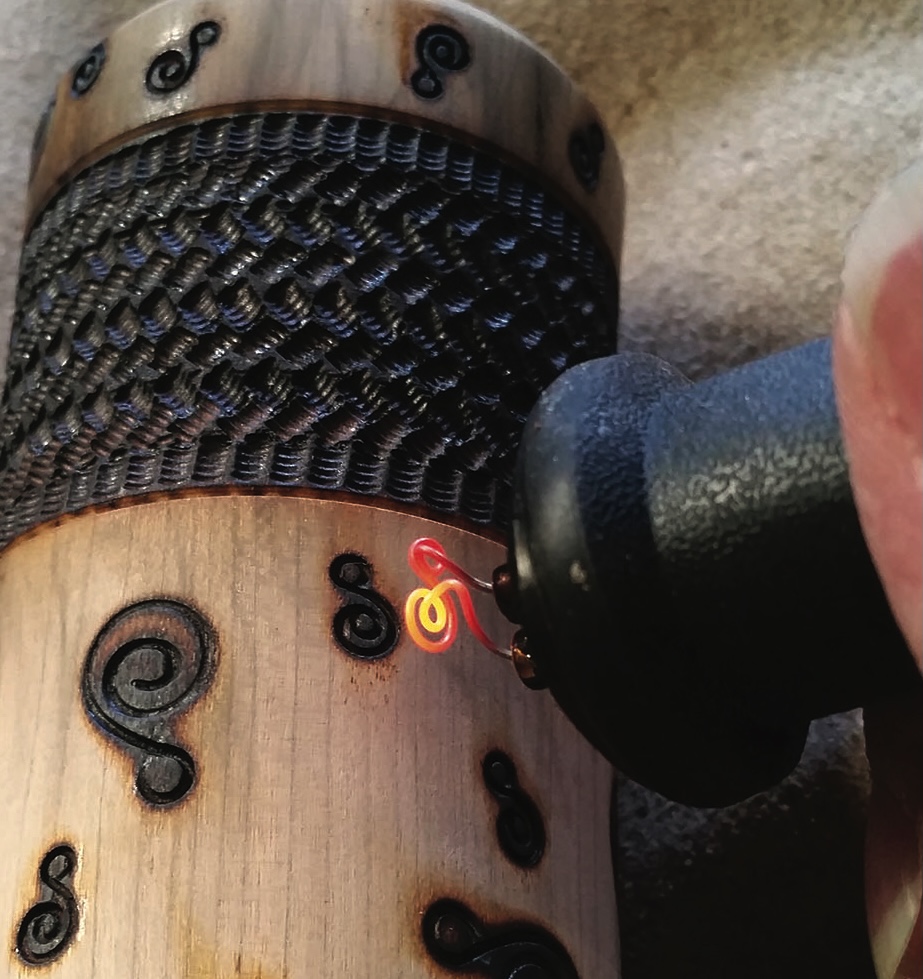
The S spiral brands were then randomly…
Woodburning spiral design on wooden object.
…placed around the base and top of the vessel

For more variety

To add a little variety to the project I made a second S spiral brand using 22 gauge nichrome wire,
to scale the size of the brand down. It was made exactly the same as the larger S spiral, just smaller.

Application of finish

The finishing technique I have decided to apply is a combination of black acrylic paint (semi-gloss), followed by application of a product called Gilders Paste. I painted the entire vessel inside and out with the paint. Apply the paint sparingly to avoid filling the branded portions with the paint. Once dry, I taped off the herringbone portion so as not to accidentally colour it with the paste. Application of the Gilders Paste can be done using a cotton cloth or other applicator, but I prefer using the pad of my index finger. I have better control of where the paste goes, and the quantity applied. Copper in the primary coat and Celtic Bronze was used to highlight the small S brands to provide some visual depth.

Gilders paste

Gilders Paste is a mineral spirit-based finish with a consistency similar to shoe polish. It comes in 28 colours, 12 of which are metallic. They can be found in some art and craft supply stores, but frequently the entire 28 colours are not available. To see and purchase from the entire stock, visit the website at gilderspaste.com.
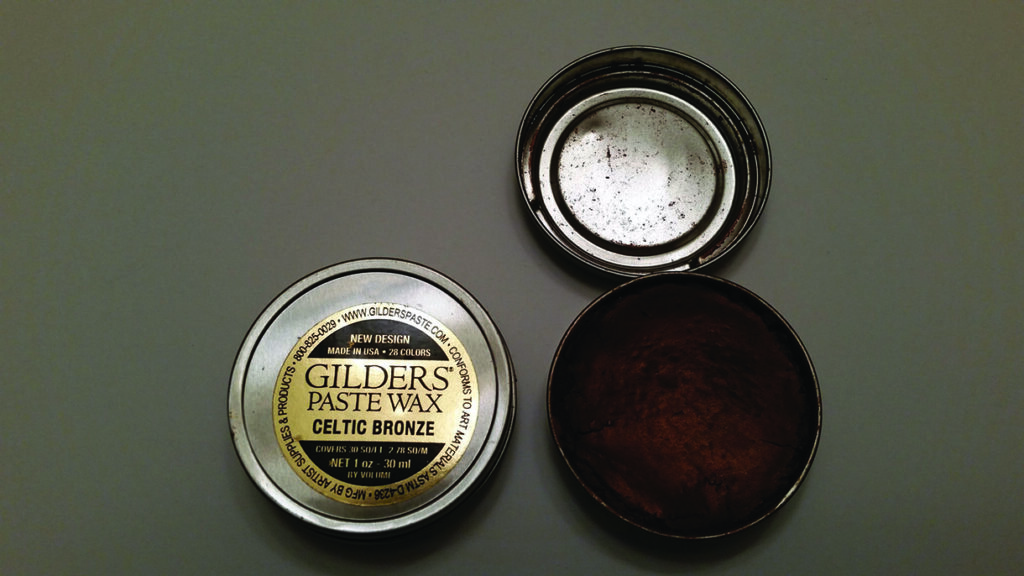
Open tin of Gilders Paste Wax.
Decorative brown metal vase with swirl patterns.
The completed project

Leave a Reply

Your email address will not be published. Required fields are marked *