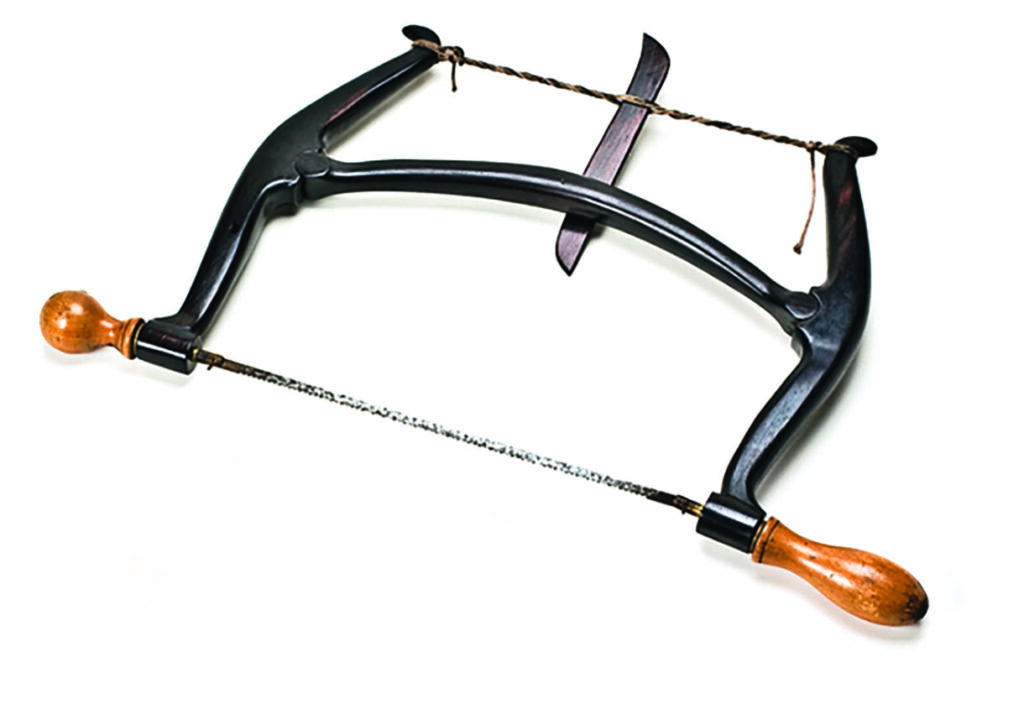
John Adamson looks at traditional one-man saws
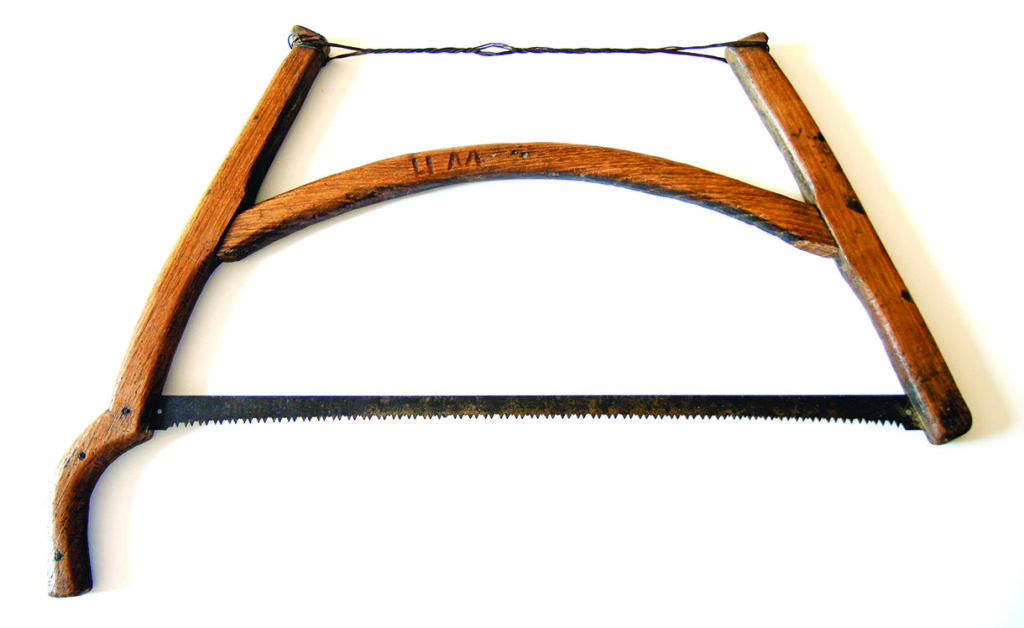
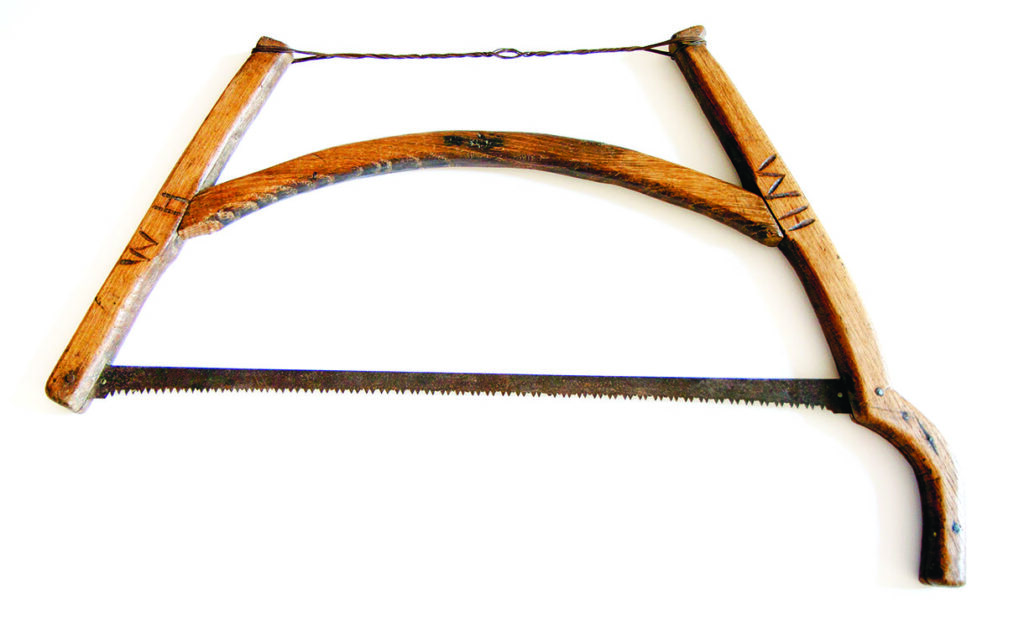
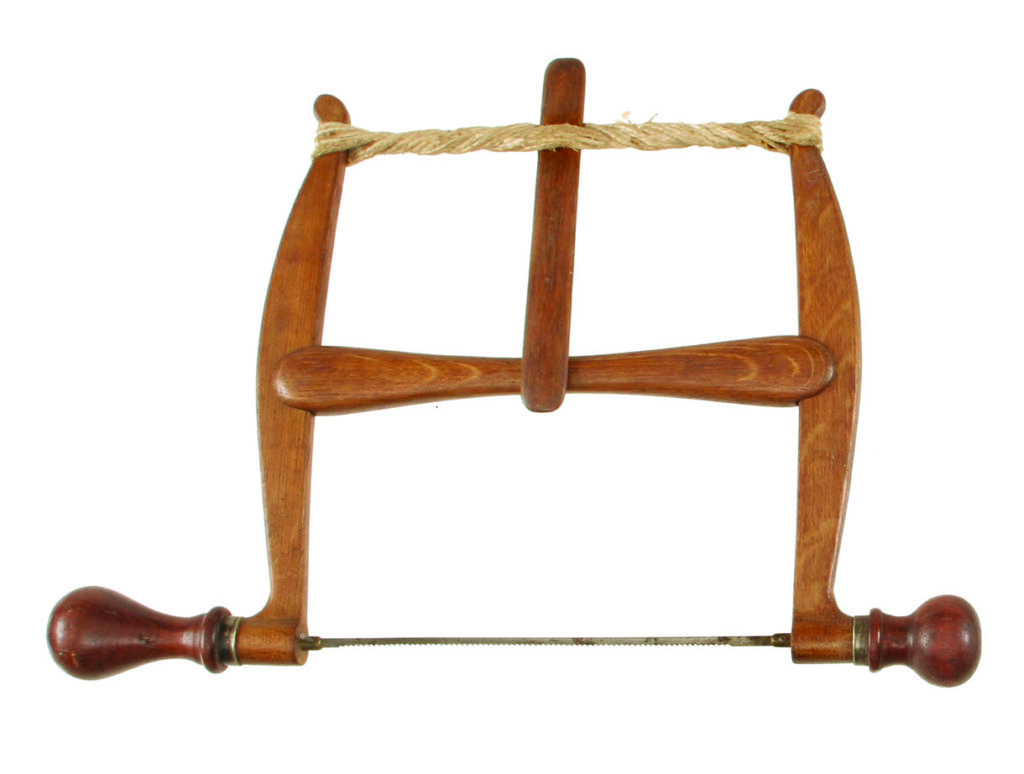
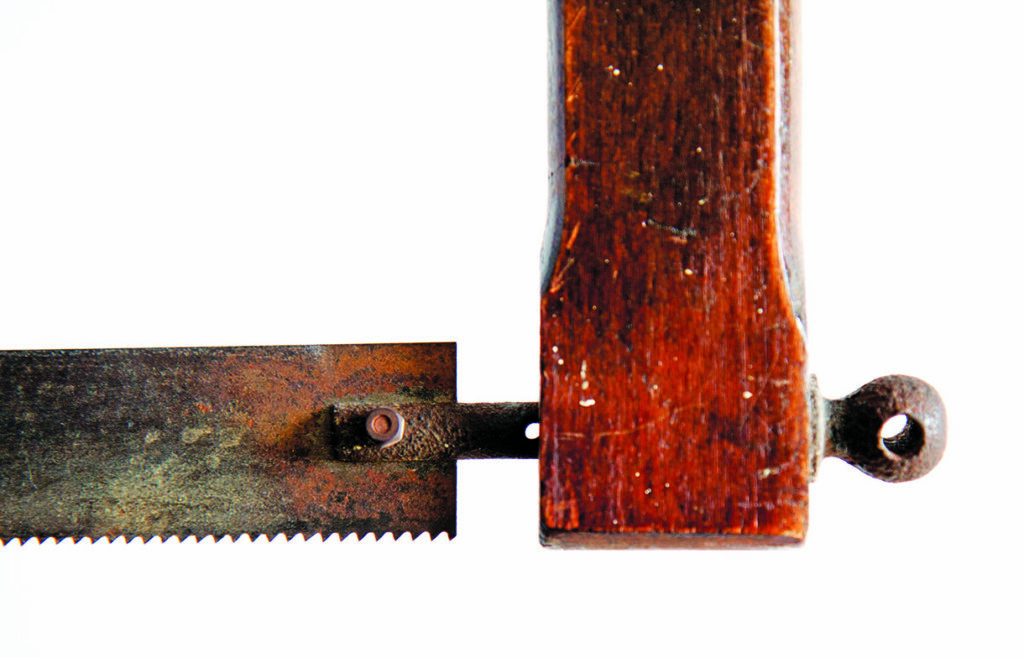
The frame of this English woodcutter’s saw in elm may well have been made by its owner. The blade or web is pinned in the cheeks set 27in apart and is tightened with twisted wire across the top of the frame. There would probably have been a toggle stick to twist the wire. PHOTOGRAPHS BY JEAN-PAUL MULLER
The poet’s spectral image of old Sweeney, the woodcutter, with his ‘bow-saw, held stiffly up like a lyre’ as he went from hazel bush to hazel bush and ‘angled his saw in’ before moving on to the next is eerily compelling! But Seamus Heaney, in the opening lines of his poem ‘Station Island’, does more than describe an apparition recalling his childhood in rural Ireland; he conjures up a rustic picture of a man sawing wood that is probably older than history itself.
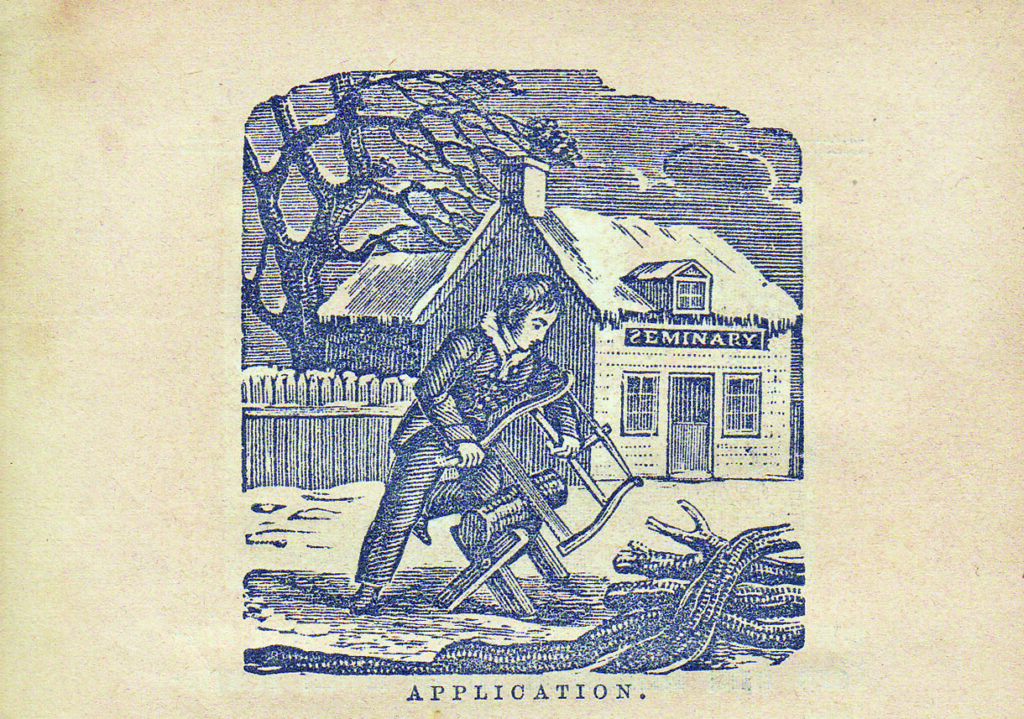
Yet for all that Sweeney would not have been wielding what we now think of as the classic bow saw; he would in all likelihood have been using a woodcutter’s saw. It is easy to forgive Heaney’s apparent poetic licence, nevertheless, for both saws have essential features in common, and there has been a lack of clarity in naming saws of this type, as we shall see.
One-man saws
The mechanical advantage of a thin and/or narrow saw blade held under tension on some kind of frame has long been acknowledged and is shared by a wide range of saws. There is lower risk of buckling or snapping when such a blade is strained on a frame, and when compared with the performance of frameless handsaws, it offers greater cutting accuracy and efficiency. This is true of metal-framed saws in the woodworking trades, such as the hacksaw, the fret saw or the coping saw, as well as of other metallic saws such as those used by armourers, surgeons – and, even in miniature, by dentists. Confusingly, but not surprisingly, the modern-day log saw with bow-shaped frame in tubular metal that likewise holds its blade in tension is often called a bow saw as well!
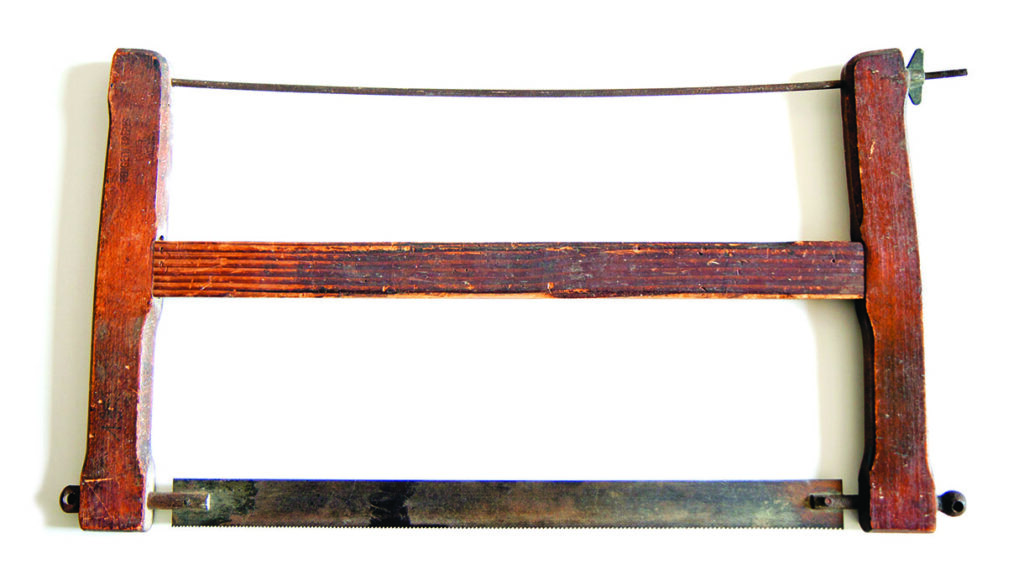
But all of the saws I have just listed have metal frames. What I wish to focus on are traditional one-man saws where the blade is held along one margin of a wooden frame and its tension achieved by leverage. Saws, such as the time-honoured two-man framed pit saw, where the blade is strained in the middle of a rectangular wooden frame, are thus precluded. Both the woodcutter’s saw held in Sweeney’s hand and the classic bow saw belong to the same special family of saws whose blades are held taut by a simple but very effective pair of wooden levers with mortises into which the tenons at the ends of a central stretcher or brace fit loosely and act as fulcra. A tensioning device brings the top ends of the levers towards each other, and as it does so the bottom ends move outwards straining the blade held between them. While the blade on a woodcutter’s saw is wide and rigid, that on a classic bow saw is narrower, often with the added facility of being able to twist it to the desired angle to the frame. This makes it ideally suited for straight or curved work of greater length than the distance between the blade and the stretcher, and it also means that rip-cutting as well as cross-cutting are possible. On the traditional woodcutter’s saw the cheeks are sometimes sharply curved and one of them is slightly longer than the other, extending at the lower end to form a rudimentary handle; in the United States the traditional wooden buck-saw is of striking similitude in appearance to this saw and is used on a saw-buck or saw-horse to cut logs. In contrast, the classic bow saw has handles turned on a lathe and these are fitted in line with a narrow blade. We might mention a couple of other frame saws here from the same family: while the frame on a cooper’s head saw is very similar in design to that on the woodcutter’s saw, the frame on a bettye saw, as used by chair-makers and wheelwrights, can, like the classic bow saw, be angled by turning the handles on the blade axis.
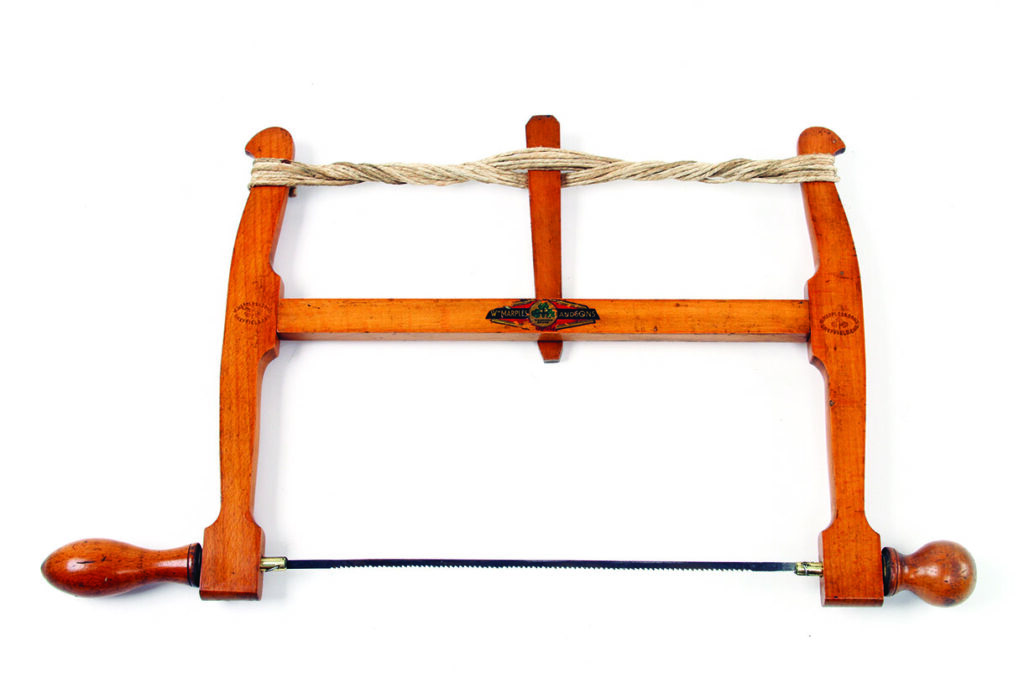
of Sheffield first introduced in 1875. PHOTOGRAPH BY JOHN JAMES, COURTESY OF DAVID STANLEY AUCTIONS
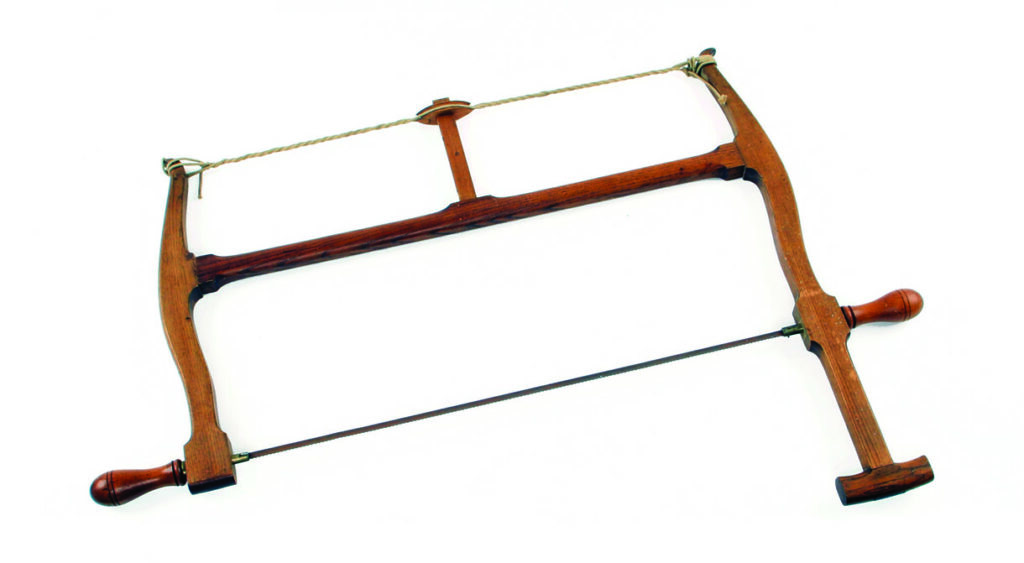
to a metallic hacksaw. PHOTOGRAPH BY JOHN JAMES, COURTESY OF DAVID STANLEY AUCTIONS
History of bow saws
It is not known how far back in history the idea goes of straining a saw blade on some kind of frame. We do have evidence that the Romans had at their disposal different types of frame saw with taut blades. The simplest resembled a bow with the blade strained by a length of springy wood bent to join the blade at each end. But they also had other frame saws; on one of them with wooden cheeks and a stretcher, the blade was tightened with a cord or sinew twisted and held tight with a toggle stick so that it would not unwind. The ends of the cheeks were shaped in such a way that the cord or sinew would not slip off. This could also lend elegance to the tool, at times making it remarkably like a lyre in outline. In Roman Woodworking, Roger B. Ulrich illustrates a stone altar to Minerva, the goddess of crafts, now held in the Capitoline Museums in Rome, on which a frame saw has been carved in low relief. Astonishingly, the saw shown is of a design that has altered little to this day.
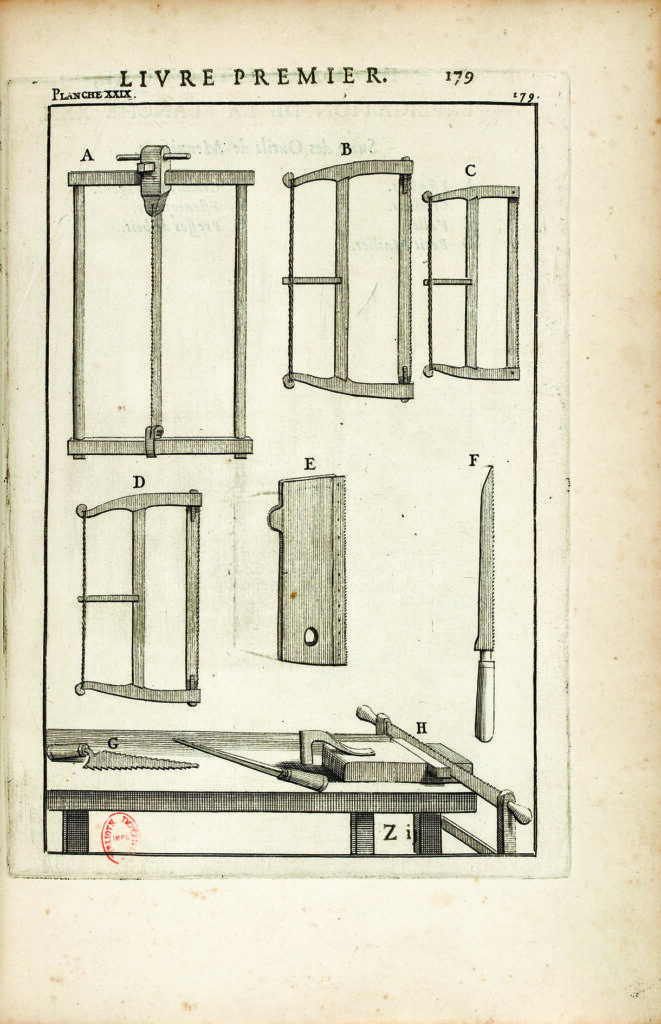
From the 16th century onwards illustrations of wooden frame saws seem to become more common. In one of Jost Amman’s woodcuts adorning Hans Sachs’s Ständebuch or book of trades (published in Nuremburg in 1568), a woodworker is shown cutting with one. Another frame saw, simply labelled sega or ‘saw’ in Italian, is featured in a woodcut of saws and planes in the plate section at the back of Agostino Gallo’s Vinti Giornate dell’Agricoltura e de’ Piacere della Villa (1569). In function it is identical to the Minervan one, but its cheeks have been turned on a lathe. The French chronicler and historian André Félibien, in his Principes de l’architecture, de la sculpture, de la peinture, et des autres arts qui en dépendent (1676), illustrates three different wooden frame saws, all of them at first glance very similar in design: the scie à débiter or framed cross-cut saw, with a blade that can be turned; the fine-toothed scie à tenon or tenon saw with a rigid blade; and the scie à tourner, or literally a turning saw (a name sometimes given in English for the bow saw because the blade can often be turned, but here a saw with a rather wider blade). The most striking thing is that all three are with unhandled rectangular frames and broadly follow the design and functioning of the saw as depicted on the altar to Minerva. Perhaps almost as striking to Anglo-Saxon eyes today is the idea of there being a frame saw with stretched blade designed specifically for cutting tenons. Nowadays, when we hear ‘tenon saw’ in our mind’s eye we see a handled backsaw with its strengthening rib along the back of the blade. As long ago as the turn of the 18th century the royal hydrographer and mathematical lexicographer Joseph Moxon in his Mechanick Exercises defined this saw in these words: ‘The Tennant-Saw,’ he wrote, ‘being thin, hath a Back to keep it from bending.’ Were tenons in British workshops cut with a wooden frame sawlike Félibien’s at some time before that?
Interestingly, when Joseph Moxon describes and illustrates what he calls a ‘Frame or Bow-Saw’ in his same chapter on joinery there seems to be, at least from our perspective, an element of imprecision. His written description matches either: ‘The Office of the Cheeks made to the Frame-Saw is, by the twisted Cord and Tongue in the middle, to draw the upper ends of the Cheeks closer together, that the lower end of the Cheeks may be drawn the wider asunder, and strain the Blade of the Saw the straighter.’ His illustration shows a frame saw without handles, but it is hard to tell if its broad blade is rigid or will turn. Were ‘frame saw’ and ‘bow
saw’ really synonymous at that time?
Although there has been a legacy of illustrations and descriptions of wooden frame saws from down the ages, few of the tools themselves are known to have survived from before the 19th century. This may be because they were remarkably cheap tools to make or buy. When a frame saw became worn out it could easily be replaced. While this type of saw has today been superseded for many jobs by the metal coping saw in Britain and North America, craftsmen in continental Europe have to some degree continued to make use of the wooden frame saw for a wide variety of tasks. Yet the French, in a feat of linguistic economy, have sown more semantic confusion by recycling the name scie à chantourner, originally the term to denote a wooden-frame bow saw with swivelling blade held taut with cord and toggle stick, and making it their name for a modern-day metal coping saw.
Contemporary saws
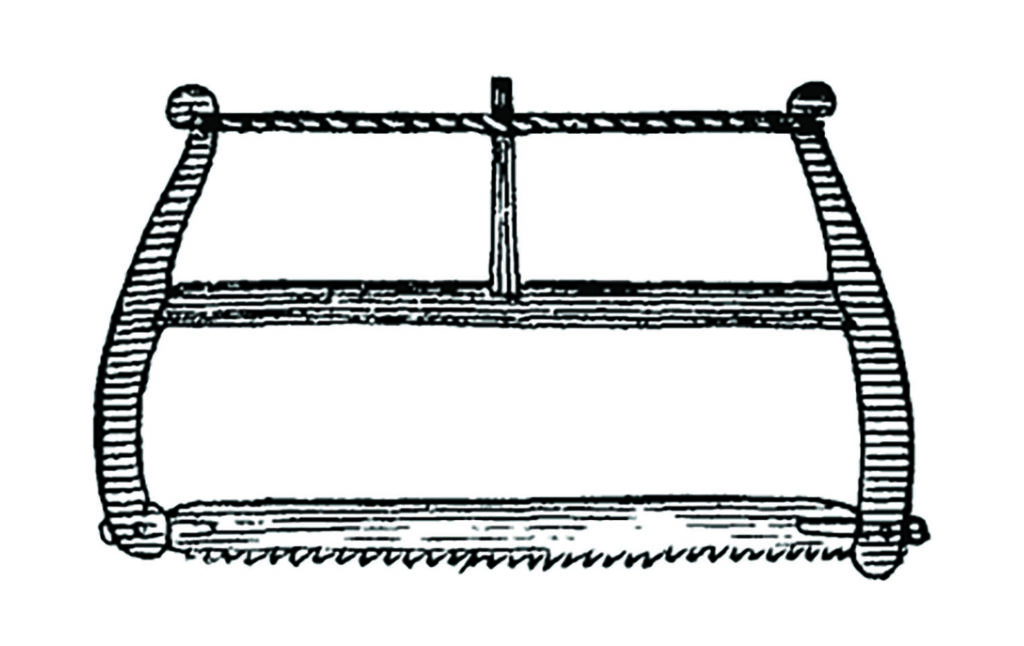
A hasty visit earlier this year to Gaignard Millon, that wonderful treasure trove selling hand tools for woodcarvers, joiners and furniture-makers in Paris’s Faubourg Saint-Antoine, not far from the École Boulle, confirmed that there was still a demand for frame saws. I asked for one and my eye was directed towards a frame saw made by Ulmia in Baden-Württemberg hanging on the wall. When I asked if any were still being manufactured in France, I was told that to the shop’s knowledge that was no longer the case. That of course does not gainsay the possibility of craftsmen still making their own, as I am told still holds true in Switzerland. Further investigation revealed other handled frame saws of various blade lengths are still being made in Germany by Ulmia, and also by Dictum, so it does look as though this saw still commands special status in some continental workshops at least. Ulmia’s frame saws have a spring described as ‘a torsion safeguard’ let in at the junction between the stretcher and the cheek to prevent warping of the frame. The firm’s frame saws come in various models, one of which, the Spannsäge, is somewhat misleadingly labelled a buck-saw in the English version of their catalogue; another one, the Absetzsäge, is called a cross-cut saw. Also available with a Japanese blade, the Spannsäge is for a coarser push-to-cut work, while their cross-cut saw is recommended for fine work including tenons and dovetails. Dictum’s frame saws come with cedar-wood stretchers for lightness and to reduce vibration, and with Japanese saw blades made exclusively for the firm with various tooth patterns on offer for cutting across or with the grain, or, on a narrow jig blade, for scroll cutting. Perhaps the fact that in 1895 the tool-makers Jacob Busch in Remscheid registered an outline image of the continental frame saw as their trade-mark with the legend Spannsäge [frame saw] betokens how much store German craftsmen set by this highly versatile saw.
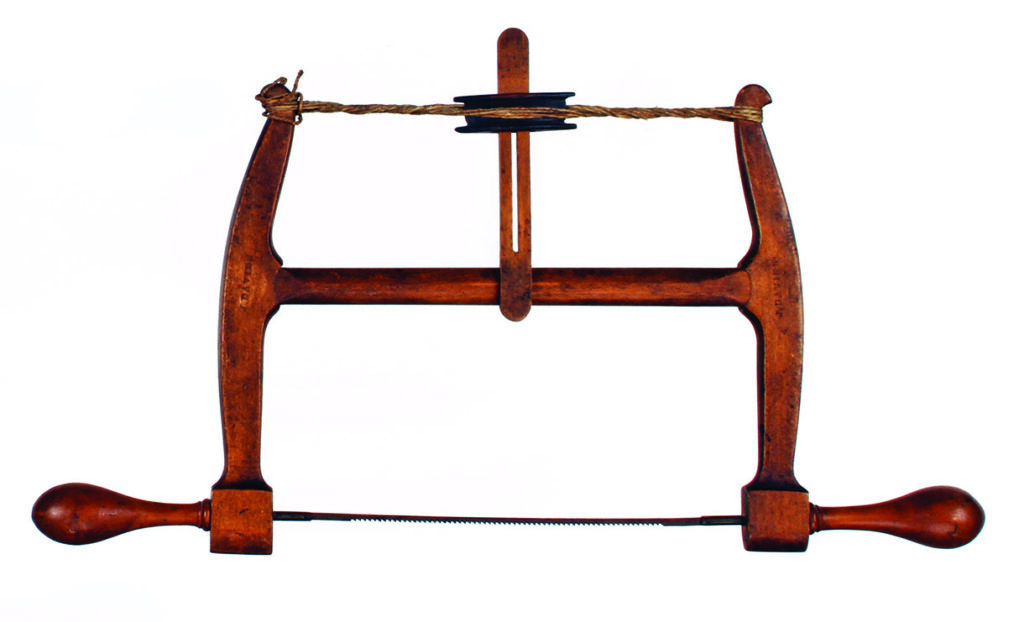
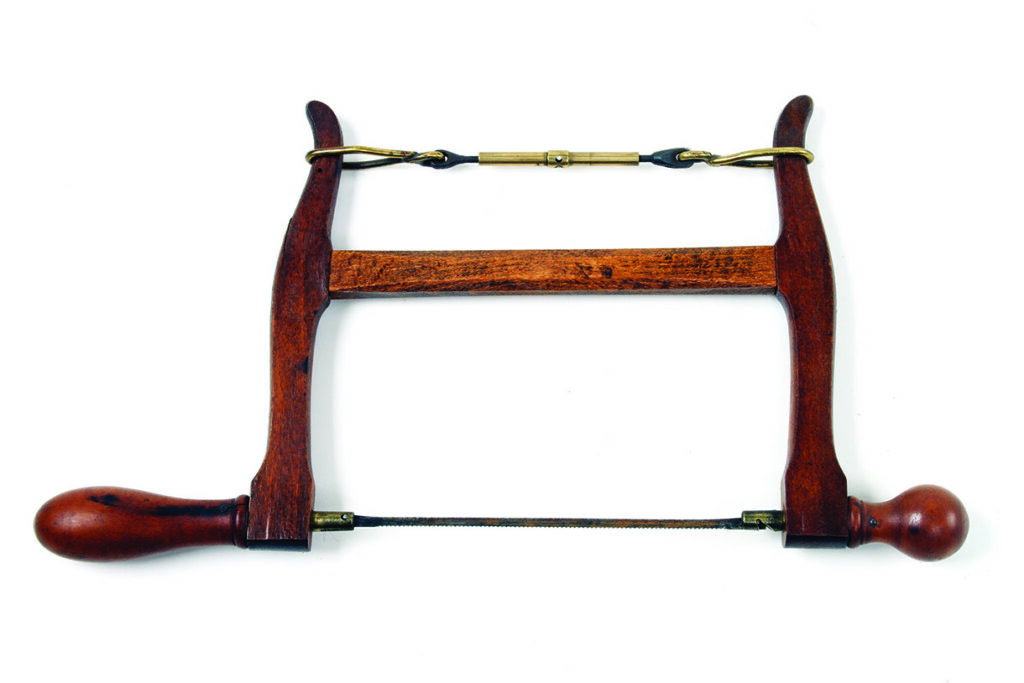
And what about the wooden frame saw in the UK and North America today? Well, there is Thomas Flinn & Co., the traditional saw and hand-tool manufacturers in Sheffield, who still make a classic English bow saw in beech with narrow blade that can be angled for curved work. I was, however, unable to find any new factory-made bow saws of this style in North America; significantly there was nothing emanating from either Veritas or Lie-Nielsen. So, this might lead us to conclude that some scroll-sawing in Britain is still done with a bow saw but little in North America. In the Anglo-Saxon world, much work, it seems, is now generally tackled using metal saws such as coping, fret, panel or tenon saws. Is there still a place then for the classic bow saw? And should British and North American woodworkers perhaps also be considering the use of the continental frame saw as a new way of tackling some of the other cutting chores in the workshop? This would not be for the sake of hand-tool nostalgia but because of the astonishing efficacy of the frame saw as an all-rounder.
Tips for collectors
1. Many vintage wooden frame saws of the ‘lever’ type, including classic bow saws are available at very modest prices. Some are homemade, some factory-made but the latter do not always come with a maker’s mark.
2. Even traditional bow saws with elegantly shaped or chamfered components in more exotic timbers are not dear, for example the rosewood bow saw from the David Russell collection fetched £120 before buyer’s premium.
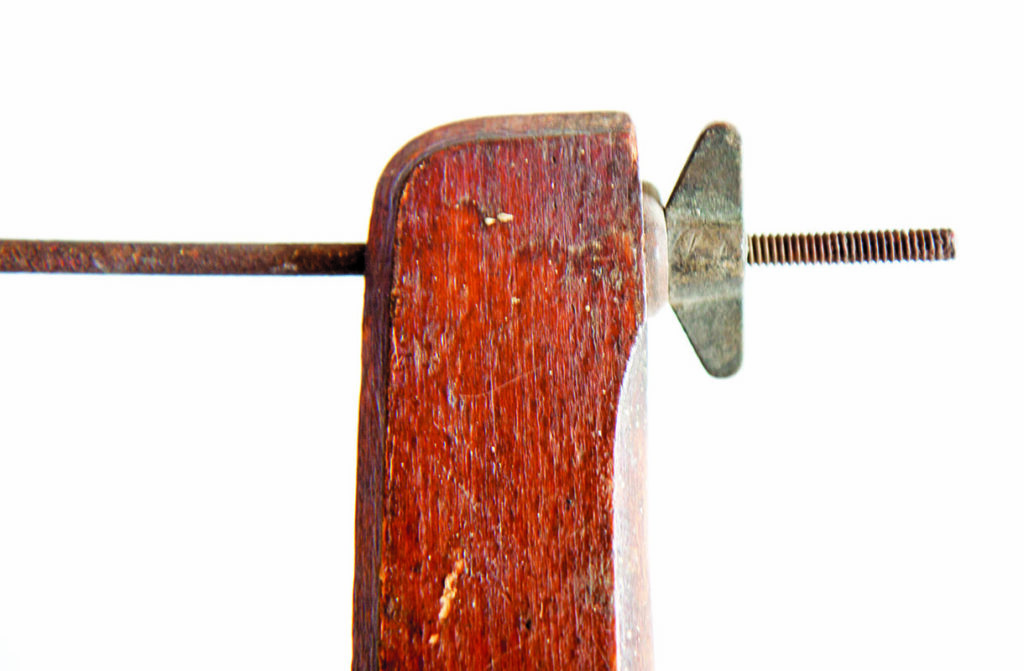
3. One area worth exploring might be the multifarious ways of tensioning the blade: from sinew to twine; from simple toggle stick to bobbin; from twisted stout wire to rod; from wing nut to turn-buckle.