
Jim Hooker raises the issue of identifying wood species by common and Latin names

PHOTOGRAPH COURTESY OF SHUTTERSTOCK/ALESSANDRO CRISTIANO
The purpose of this article is to start a discussion about the words we use to identify the material we all love – wood, and also challenge the way our magazine – for that’s how I believe many loyal readers view F&C, deals with this subject at a practical level. Such abstract matters may not seem immediately interesting or important to readers thirsting for furniture-making knowledge and inspiration, but I believe it should be important to all of us.
As a starting point, it’s worth exploring the evolution of common wood names. These usually originate in the depths of history, but what species they relate to has evolved and varied from country to country and sometimes within countries. This is often because colonisers came across a timber in a new continent or country which in some way resembled a wood with which they were familiar, so they bestowed the familiar name on it. Cedar is a good example. In European furniture making ‘cedar’ would usually mean cedar of Lebanon (Cedrus libani), but in North America it would almost certainly be taken to mean one of a number of unrelated species including members of the cypress, juniper and thuja families. In Australia it might even refer to Toona ciliata which is a member of the mahogany family and one of many species of which mature examples have all but disappeared as a result of unsustainable exploitation. In other cases, common names are bestowed on a new species by the timber trade for purely commercial reasons. ‘Mahogany’ is one example – this familiar and much-loved wood from a family of closely related species native to the Caribbean and Central America became expensive and then effectively unavailable, also because the wild populations had been exploited almost to the point of extinction, so the cachet of the familiar name is used to promote other (often palpably inferior) species to the benefit of profit.
All of this is a recipe for confusion. But does confusion arising from, at best, innocent cultural differences and, at worst, commercial misrepresentation really matter? I would argue that it matters a great deal for three reasons.
When wood species really matters
First, I think we should be told precisely what wood species is being referred to when this is important to us. F&C recognises this by quoting Latin botanical names alongside common names. Project articles are a good example of where this information is important. Here the writer is, in effect, inviting us to replicate something he or she has made. So far, so good, but the information needs to be right otherwise we are being misled rather than simply being left in the dark. I would choose the latter every time because I must then make up my own mind what wood species I need to use to replicate the look of the original. In a recent F&C project article the piece was stated to be ‘out of genuine mahogany (Khaya ivorensis)’, which immediately raises the question – what is meant by genuine mahogany? I suspect that most people with even a little knowledge of the history of mahogany would expect the species to be Swietenia mahogani or one of the related Caribbean or Central American species, and yet it was stated to be the African species Khaya ivorensis. It certainly looks more like Khaya because I have yet to see a piece of it that replicates the rich deep red/brown colour of the Swietenias, but who knows?


The international dimension
My second reason why accurate identification matters is thrown into focus by F&C’s increasingly international profile in both readership and content. As such it is surely vital that it gets it right for all its significant markets with their varied perceptions of the meaning of common names. An example of where F&C consistently gets it wrong is maple. F&C normally brackets this as Acer campestre, commonly known in the UK as field maple, generally a relatively small field and hedgerow tree that is also widely planted as an ornamental but not for timber production. So, while the attribution may be appropriate for a UK woodturning magazine whose readers will tend to use interesting, locally sourced non-commercial species, it’s pretty unlikely that field maple will be used for any significant piece of furniture. In the rare cases where it is, the maker is likely to think it important enough to be worth mentioning. In reality, most UK makers using maple are likely to use North American hard maple, Acer saccharum, which is widely available here in good width boards.
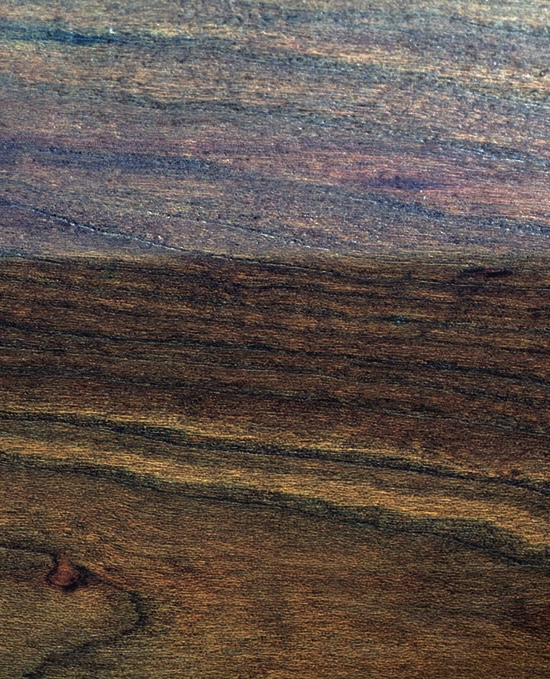
An even more confused but very different example is cherry. F&C sometimes names this as the North American species Prunus serotina and sometimes as Prunus avium. The former, commonly known as American cherry, is a pinkish mid brown when cut, quite quickly darkening to orange brown. It is widely available in the UK although perhaps less popular than it was 10 or 15 years ago when it was ubiquitous in hotels and shop fittings. To further illustrate the minefield of common names, Prunus avium literally translated from the Latin, means bird cherry but most authorities link it with the common name ‘English wild cherry’ while attributing ‘English bird cherry’ to Prunus padus, a non-commercial species. However, English wild cherry is commercially available, although you may need to seek it out. It’s a notably paler and more stable colour and, to my eyes at least, much more beautiful than its American cousin. My guess is that most pieces identified by F&C as Prunus avium are in fact American cherry because of its much wider availability and again, a maker using English cherry would likely regard this as a point worth mentioning.
Conservation
Lastly, knowing what we mean when we talk about wood species is vital to the cause of nature conservation. Far too many timber species are now threatened or at risk and this is something that concerns me and, I am sure, many other committed furniture makers. OK, the timber used by amateurs and professional bespoke furniture makers is a drop in the ocean of timber consumption but what we do is a small but important part of the process of setting the tone as to what is ethically acceptable. I don’t want to play even the smallest part in species extinction and habitat destruction. For this reason, I try to use UK native species wherever possible and any decent timber merchant should know where his native timber comes from. It also has the added bonus of saving on timber miles.
A solution?
So how can F&C make life easier for readers like me? I suggest that species names be given only in project articles and others where the specifics of working a particular type of wood makes it relevant. There is little or no value in quoting botanical names in news items, articles about antiques or in tool descriptions, e.g plane handles. Leaving aside any question as to usefulness, in such articles the information will often be hard to ascertain with certainty and so just increases the chances of getting it wrong. This approach would have the advantage of saving scarce editorial time which could be devoted to ensuring that the species name really is correct where it’s given and make other articles more readable by the exclusion of spurious detail.