The Woodworkers Institute

We bring you the very best of woodworking!

“Make it with us”

Decorative coat hook

Mark Ivan Fortune carves an unusual decorative oak coat hook
The creative process of wood carving is not only a manual physical one, but more challengingly, it is an inner emotional process of artistic feeling. When one embarks on a creative endeavour one comes face to face with self-reflection and inevitably self-doubt. As the edge tools penetrate the wood, it is as if one is diving into unknown waters. To fully immerse oneself in the experience one must embrace this uncertainty as the essence of the art. From this vulnerable state comes an opportunity for one’s own self-expression while creating something genuine and true.

In a practical attempt to minimise the unknown, one may look to clay modelling, drawing and sketching; and be well advised to do so. But no matter how conclusive we are in our preparation, even when the ground work has been carried out by another hand; a certain liberty of execution must prevail to maintain the integrity and life of the carving. Photographic copying of natural leaves, clever as it is, holds little interest. Much more compelling is the delineation of subjects reimagined; stylised Gothic leaves of bulbous form; creeping and menacing. Or the rich frills of the Regency period. Here I have drawn from two distinct retrogressive styles of foliage and combined them to create a practical everyday item where the decorative aspects can still be appreciated when in use. Due to the inherent nature of the piece, the use of undercutting shall not be employed as it must remain practical and robust.

Things you will need

Tools:
• Personal and respiratory protective equipment
• No.11, 1.5 and 3mm
• No.8, 6 and 10mm
• No.6, 3, 13 and 22mm
• No.6, 16mm fishtail
• No.5, 8 and 10mm
• No.3 gouge
• No.1,10mm
• V-tool
• Male punch
• Light hammer

Materials:
• Oak (Quercus robur) 240 x 190 x 32mm 
• PVA adhesive
• MDF backing
• Screws
• Coat hook

Drawing

Mounting

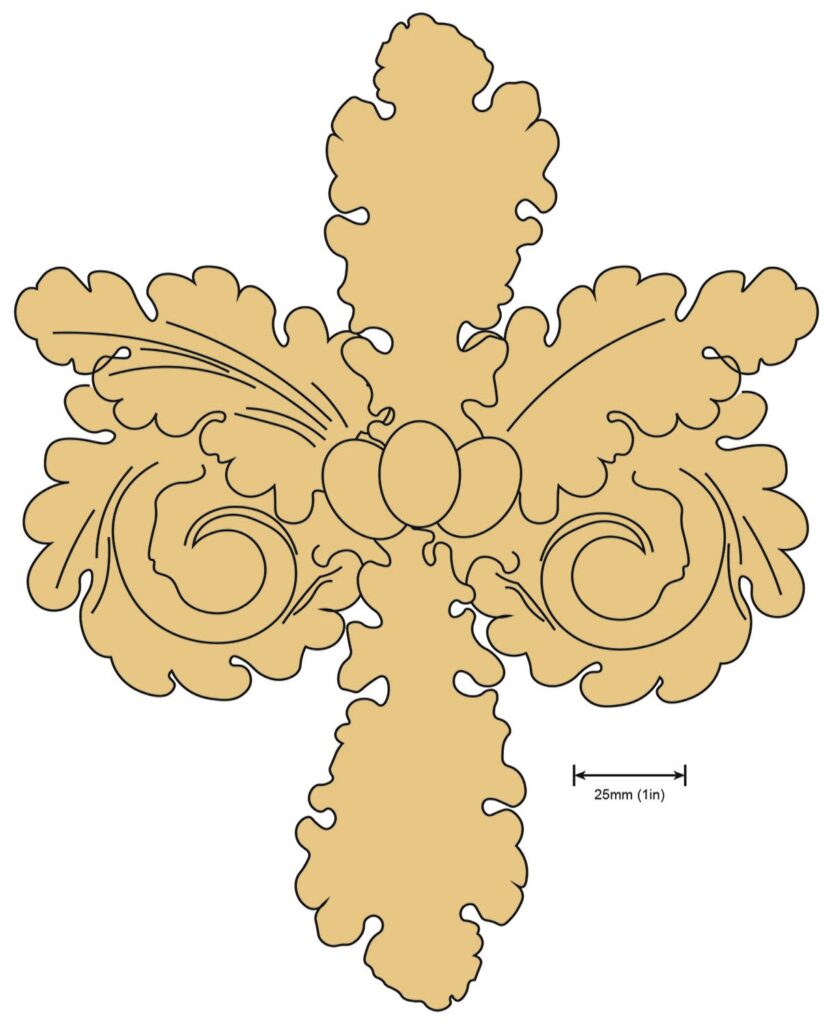
Give some thought on where and how the piece will be mounted. Your local hardware store can offer practical advice on mounting that best suits your application. Adjust the drawings to suit the backing plate of your coat hook. Consider the practical and aesthetic qualities of the hook and the screws that fix the hook to the carving. 


Carving
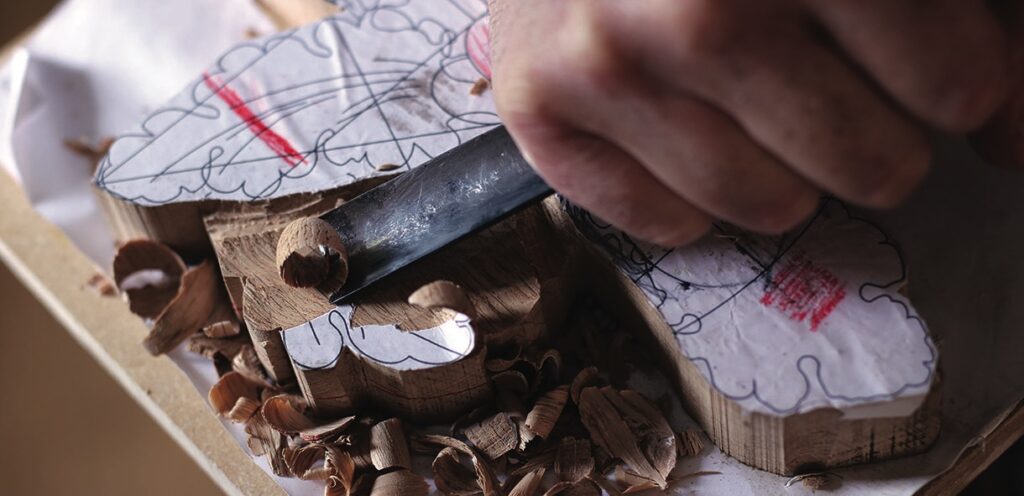
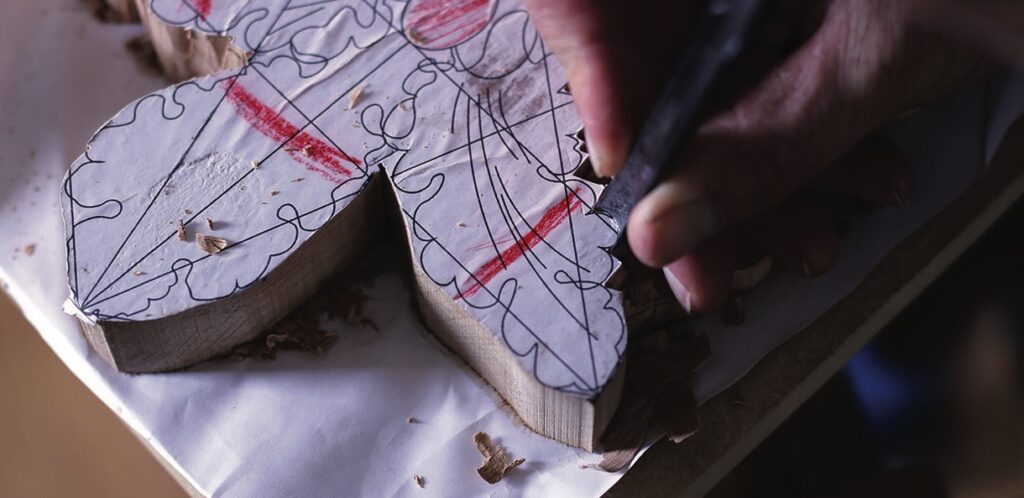
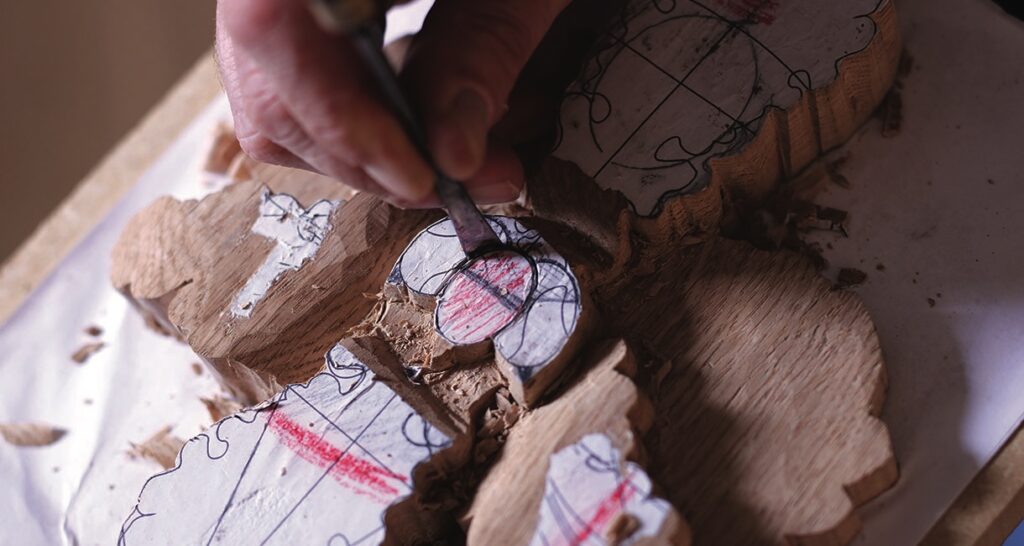
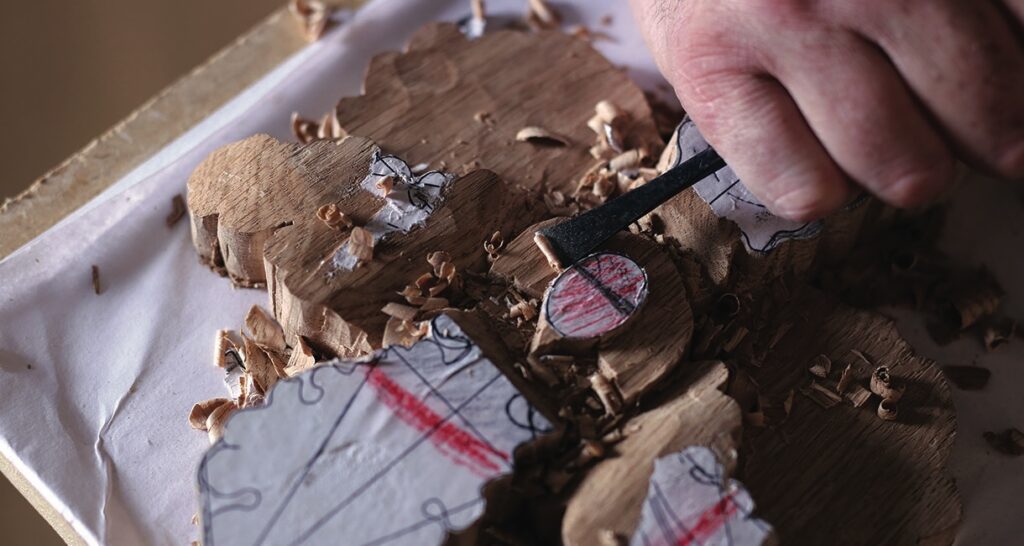
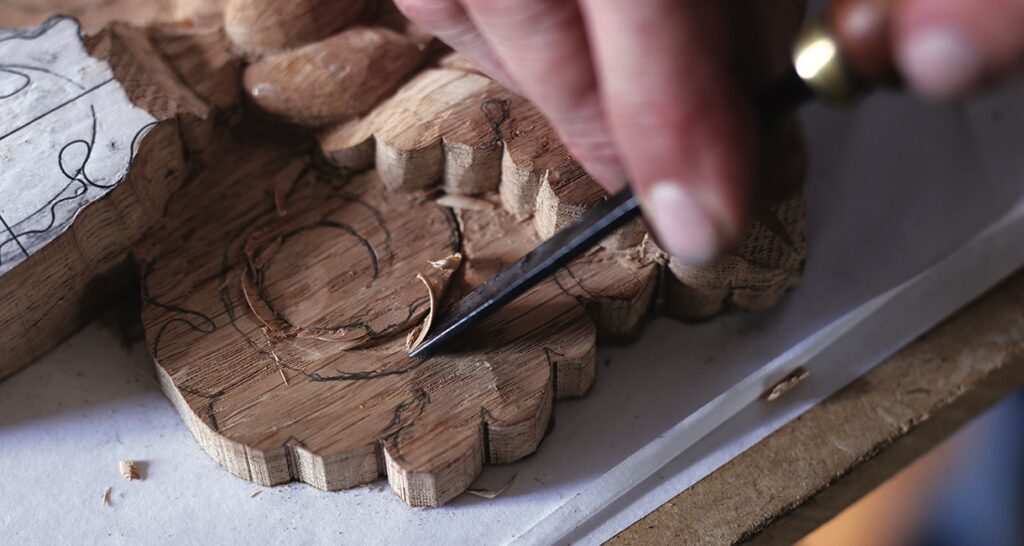
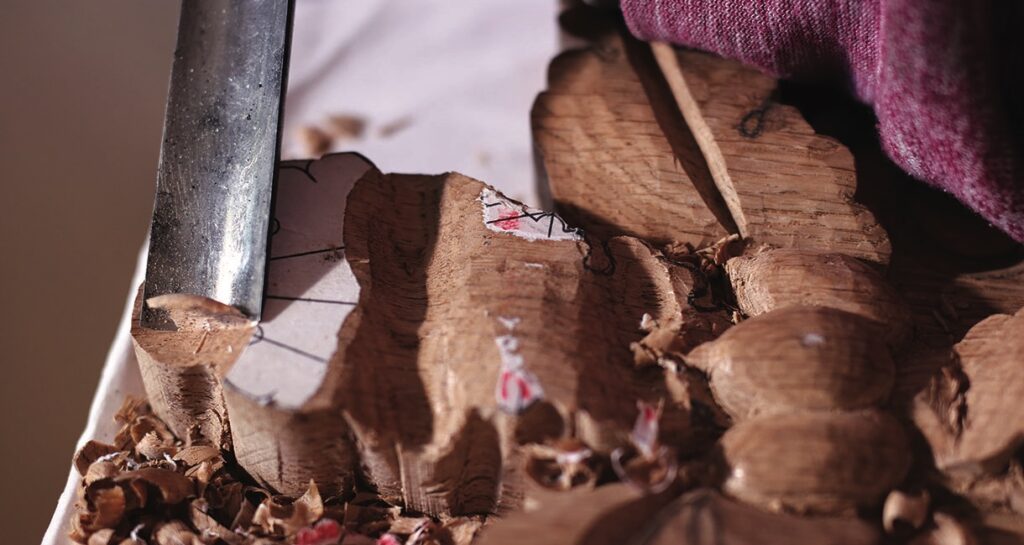
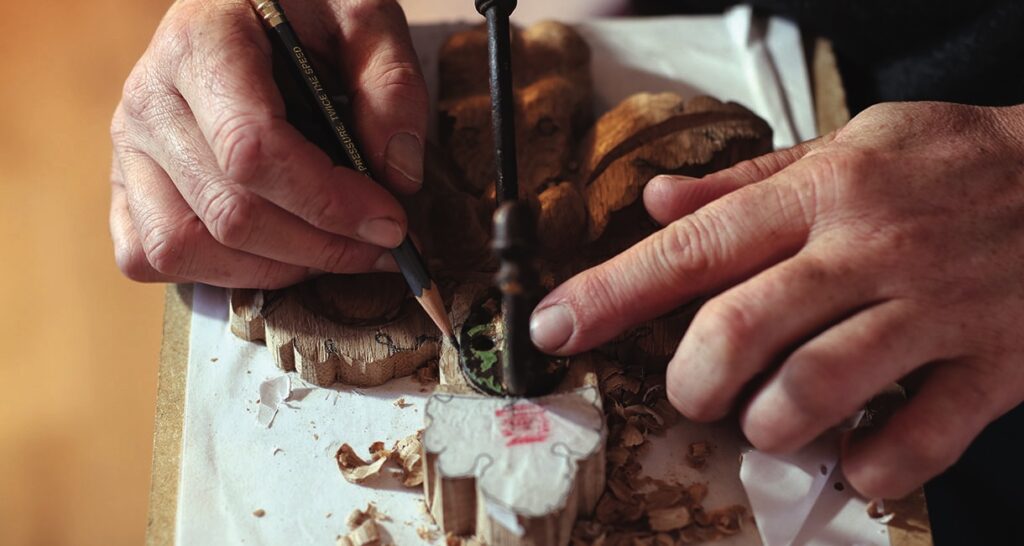
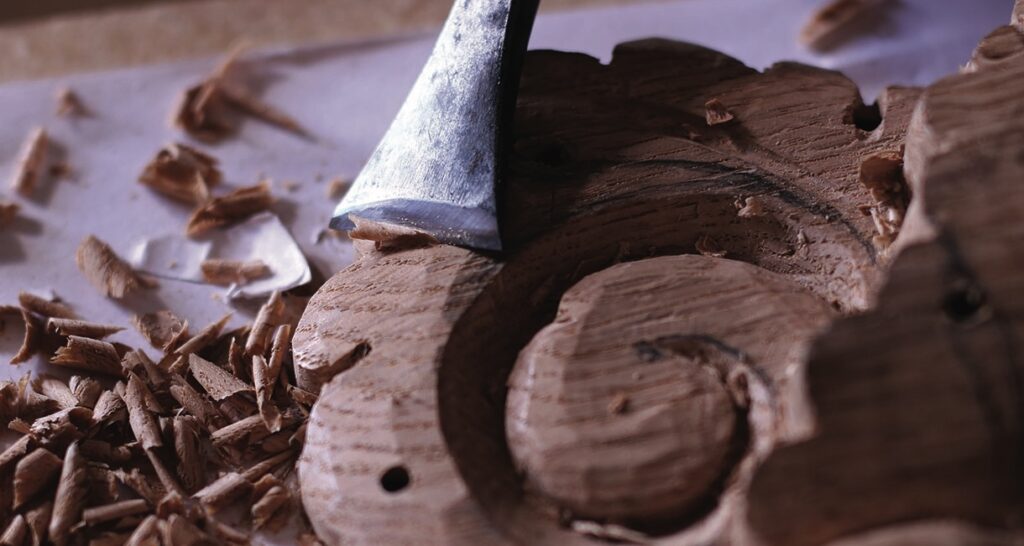
1. Cut out the traced blank, leaving any sharp corners for the carving stage. Glue to an MDF backing with paper sandwiched between. Ensure mating surfaces are flat as any gaps will result in breakage during the carving stages. Mark the scrolled leaves down to half the thickness of the blank. Separate the forms. Begin by first working in from the sides with a v-tool to prevent breakage. Then with a No.6, 22mm reduce the height to half the thickness of the blank
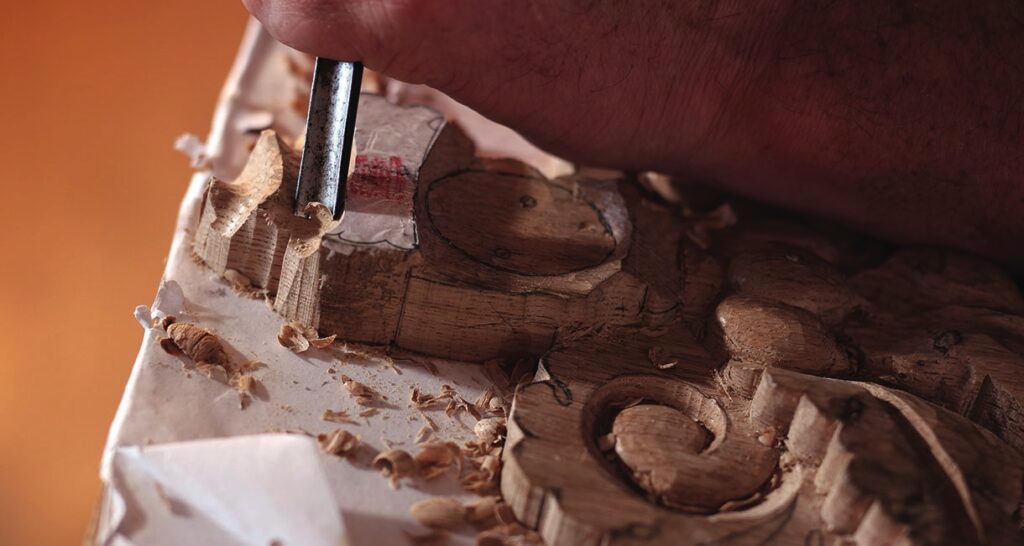
2. Alternating between the V-tool and the appropriate sweep gouge, refine the lower portion of the outer leaves. Use vertical stab cuts, taking care not to undercut. Use a skew or fish tail to clean the base of the cuts. Level the spiral sections to a clean finish with a No.3 gouge
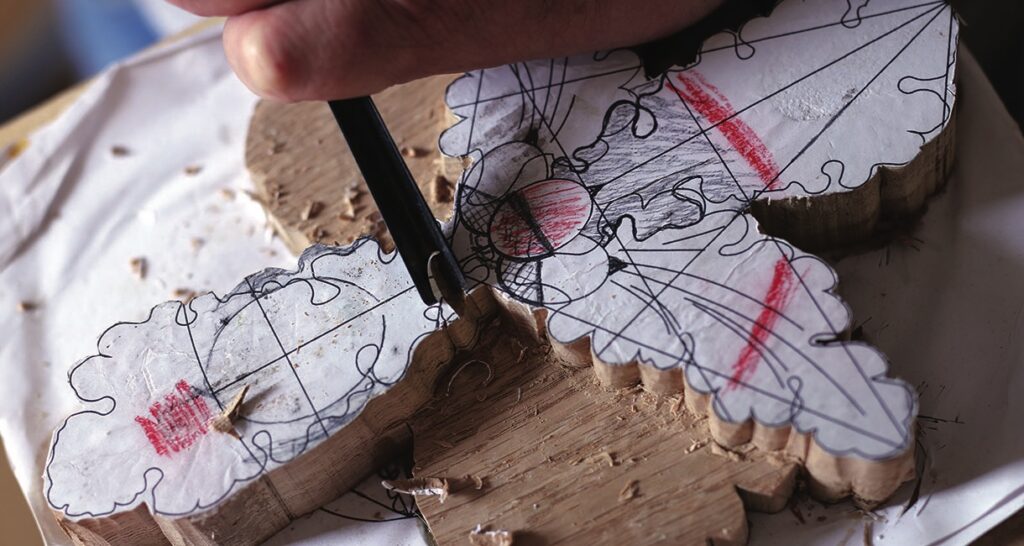
3. Separate the lower leaf with a V-tool, cutting down to 6mm above the spirals while keeping a safe distance from the acorns
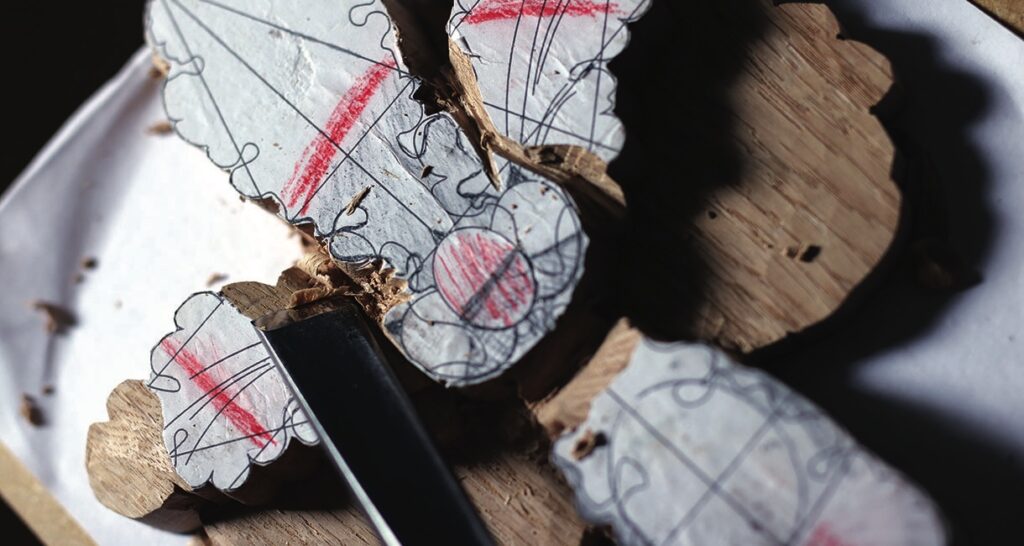
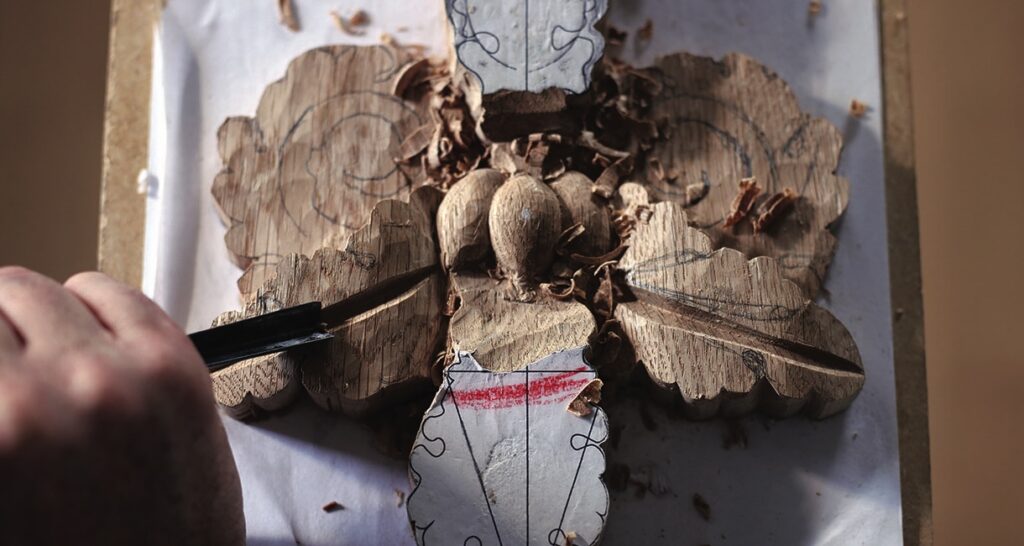
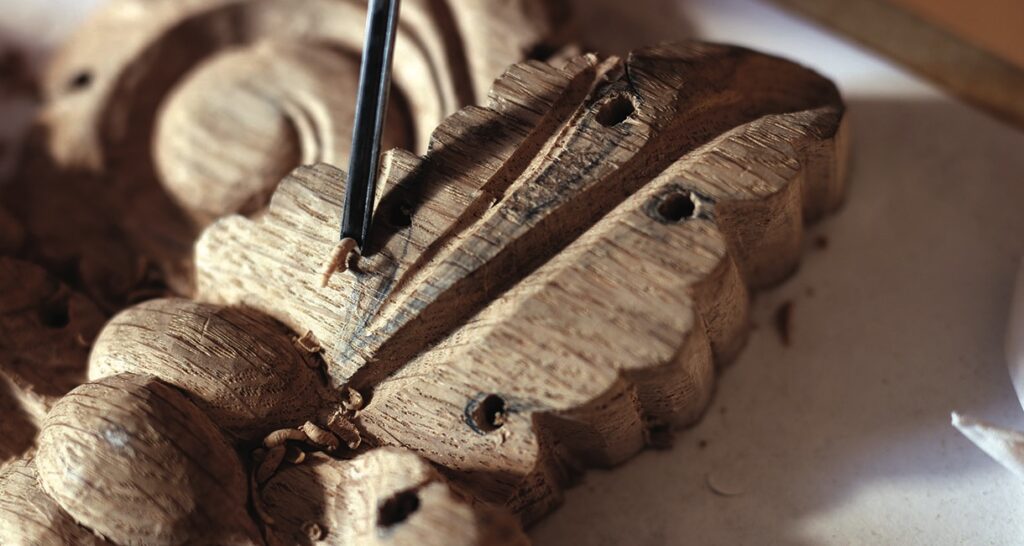
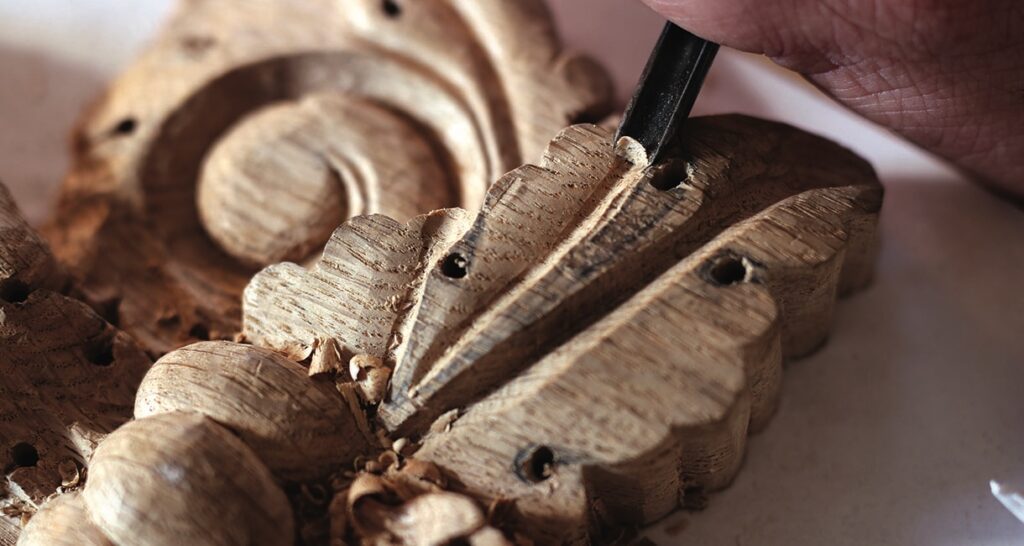
4. Now separate the outer leaves by tilting a V-tool so it is cutting at 90° on the acorn side. Invert a No.3 gouge and round over the leaf into the root of the V-cut. Alternate between these two cuts to gradually bring the leaves down to the desired depth. Round over the leaves towards the tips. They should embody a soft wing-like flow
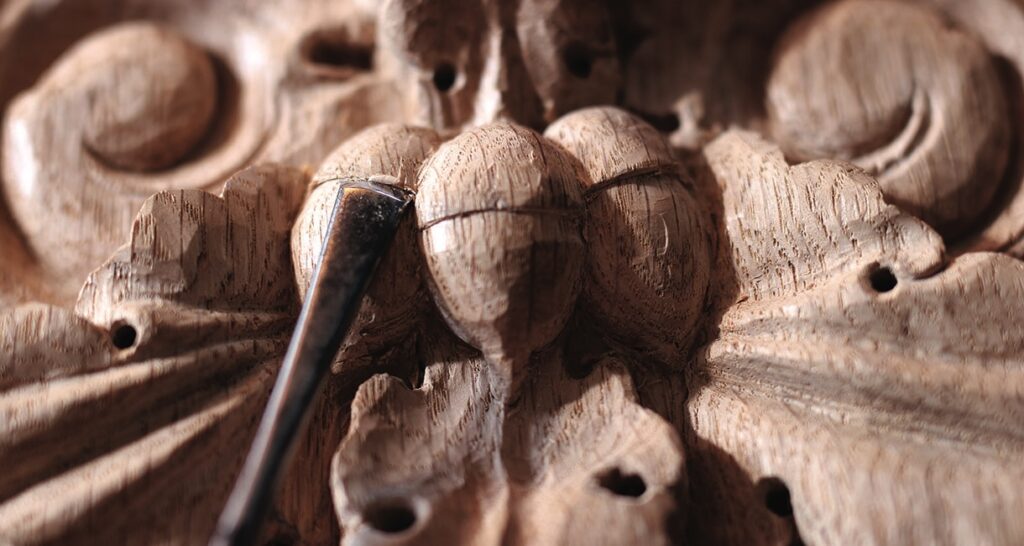
5. With a V-tool refine the outline of the acorns by first cutting away the waste between the tips at an angle and then stabbing vertically. Clean around the grouping of acorns with No.5, 10mm and No.6, 8mm gouges. It is vital to the piece that the shape of the acorns is maintained by stabbing the outlines accurately 
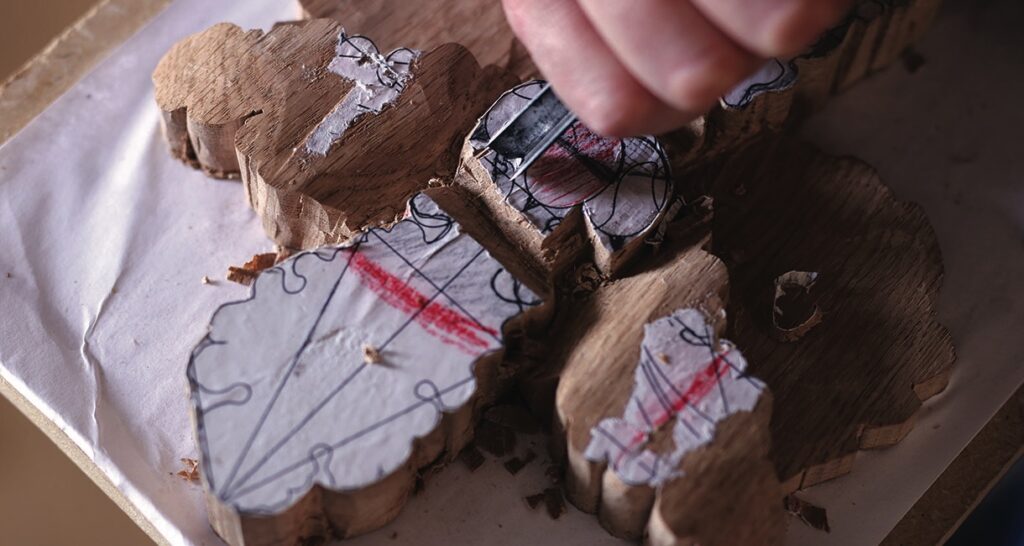
6a. Gently stab the central acorn, dropping the height of the two flanking acorns down to a flat plane
6b. Reduce the upper and lower leaves to achieve enough clearance to form the acorns

Carving Spheres

Carving clusters of any spherical forms that abut one another presents a unique set of challenges. It can be a great help to draw the acorns in section as three circles abutting one another or to model them in clay so as to gain a better understanding of how they relate to one another. Keep in mind the aim in this piece is to create a representation of three acorns abutting one another. They do not need to be geometrically correct. 
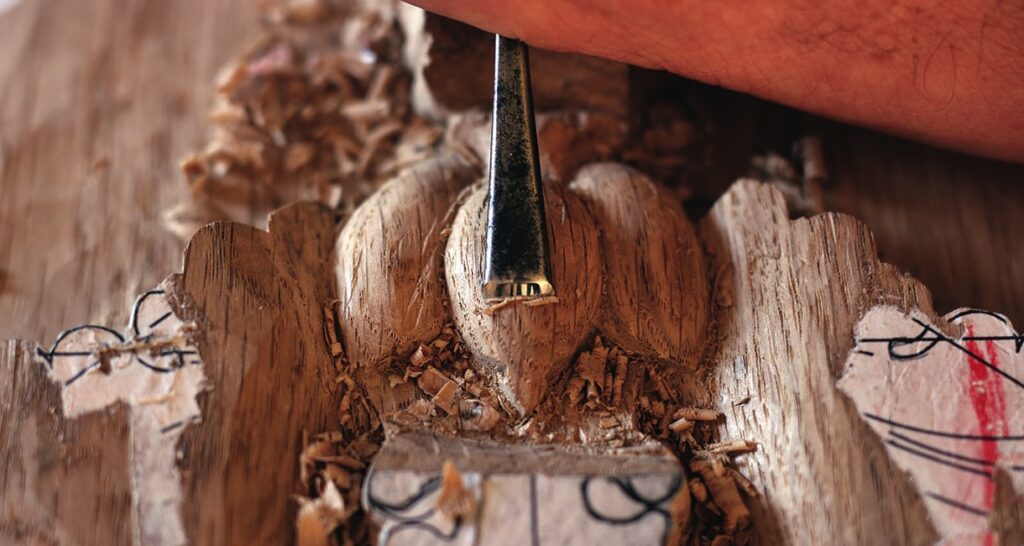

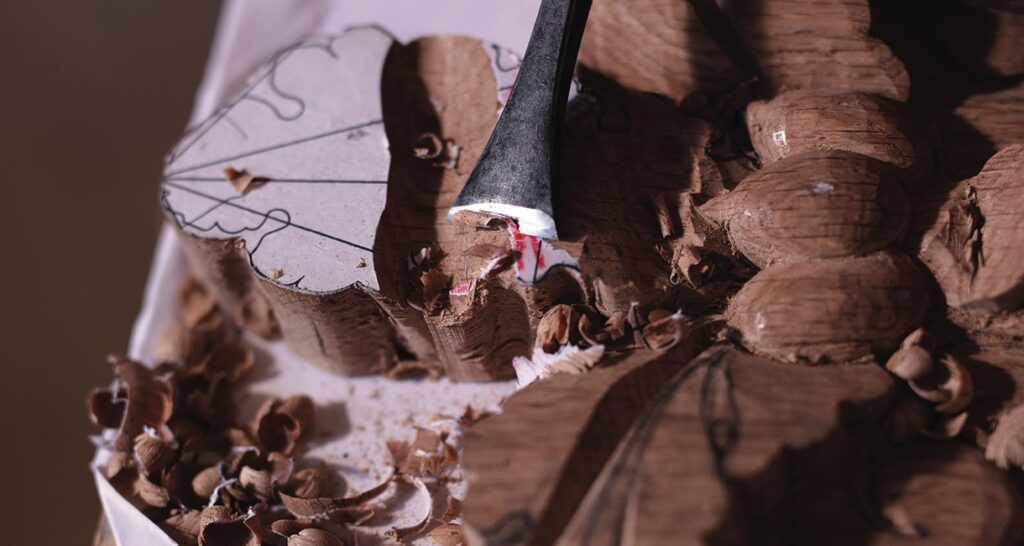
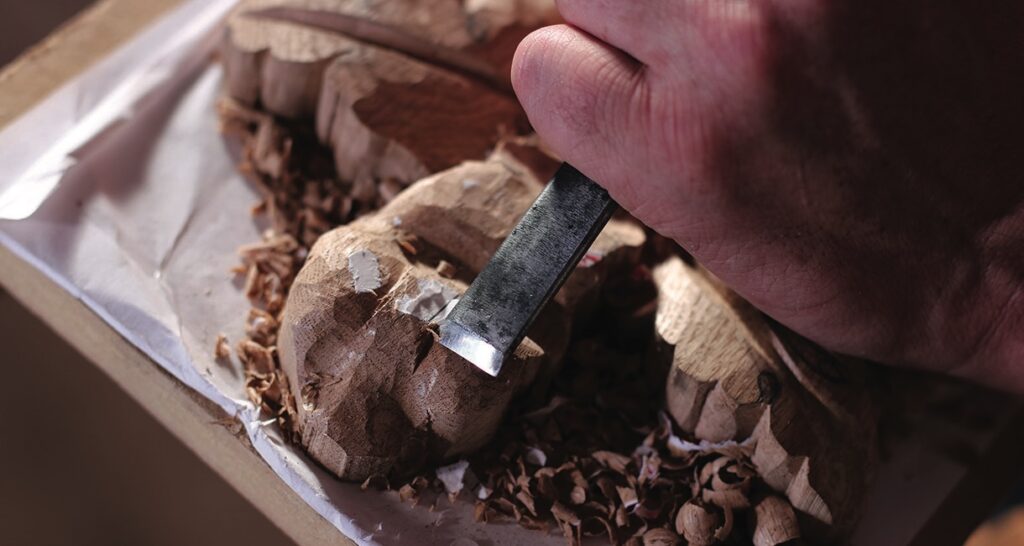
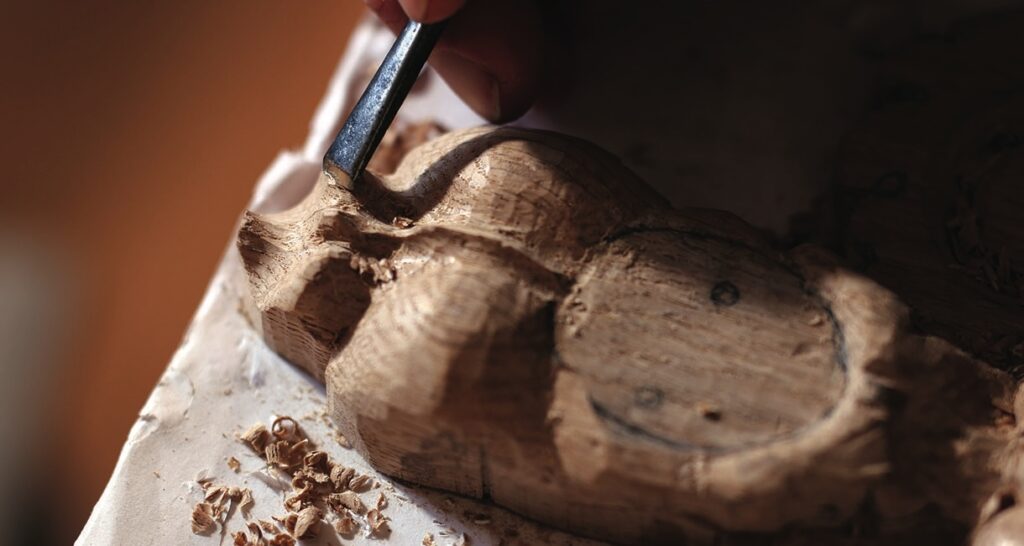
7. Round over the outer edges of the central acorn. Redraw the centre lines. Beginning with the central acorn use an inverted No.6, 8mm fishtail, working in both directions, carve along this central axis line lifting the handle to follow the spherical form. Repeat this cut for the other two acorns
8a. Redraw the eyes, spirals and veins. With a V-tool, cut the central curving veins of the two outer leaves
8b. Open the tip of the left outer leaf with a No.6, 13mm
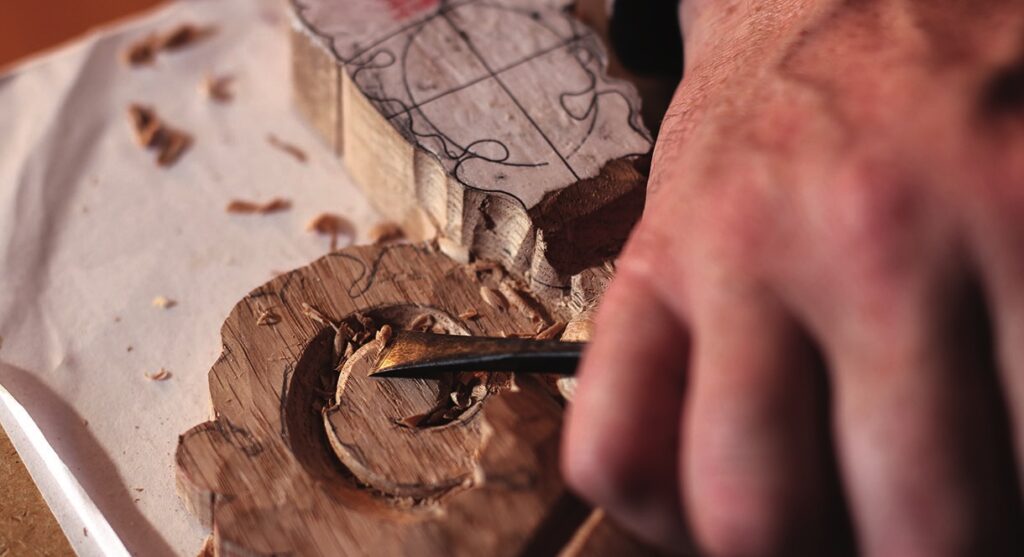
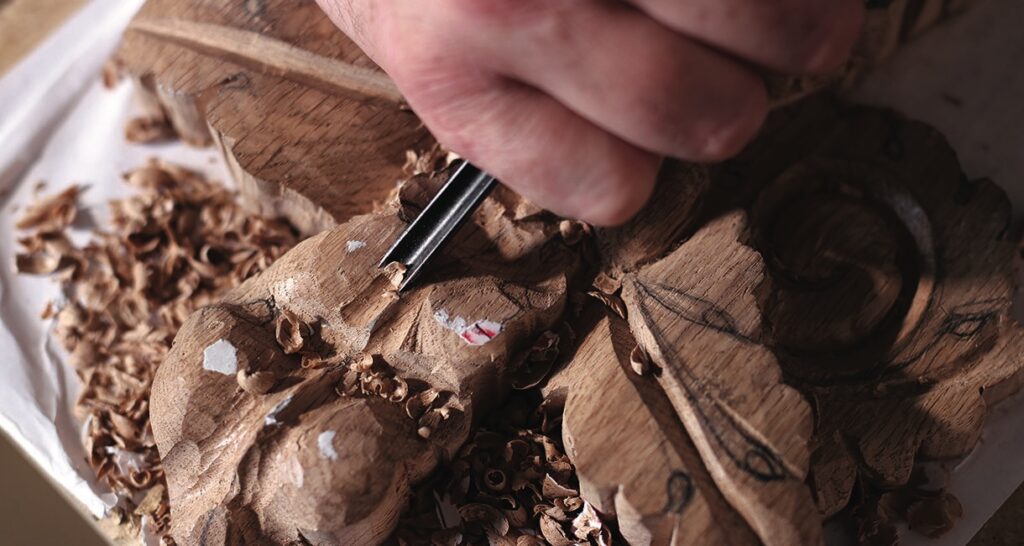
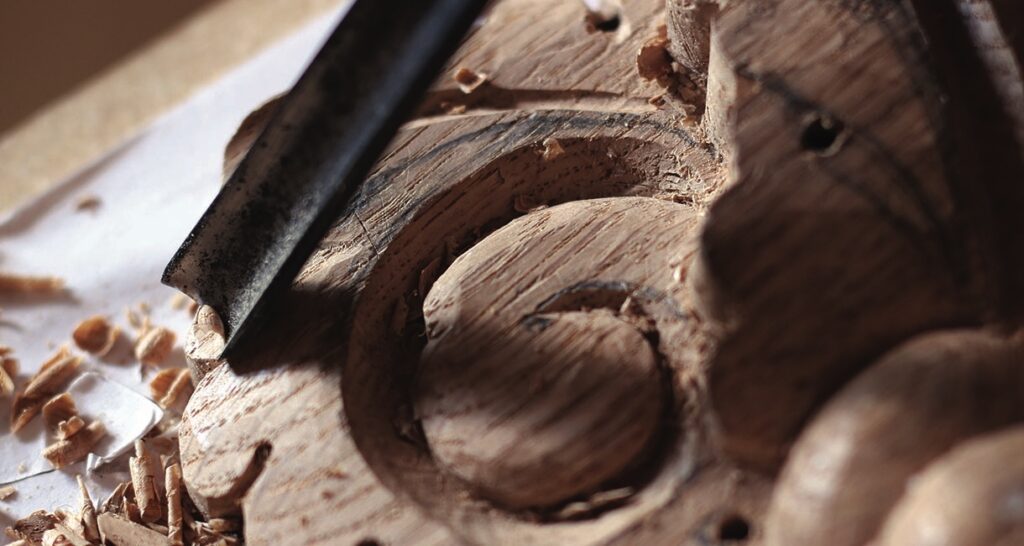
9. Stab the inner spiral with a No.5, 10mm. Clear the waste using a slicing cut. Alternate these cuts until you have a smooth, harmonious spiral. The ridge will act as the central vein of the leaf and must be accurately maintained and re-established throughout the carving process
10. Round over the heads of the spirals to an even curve with an inverted No.3, gouge
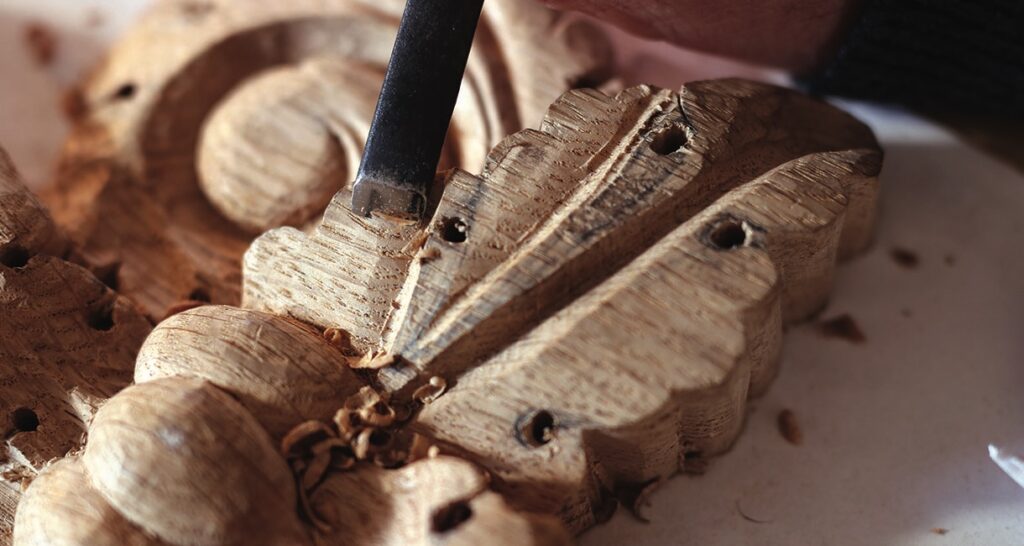
11a. With a No.8, 10mm, make two diagonal cuts across the top leaf, rolling the tool as it exits the cut to prevent chipping the edges
11b. Now with an inverted No.3 gouge, round over the ridges between the troughs 
12. With a No.6, 22mm, cut across the grain, reducing the height of the tip of the upper leaf, again rolling the tool as you exit the cut
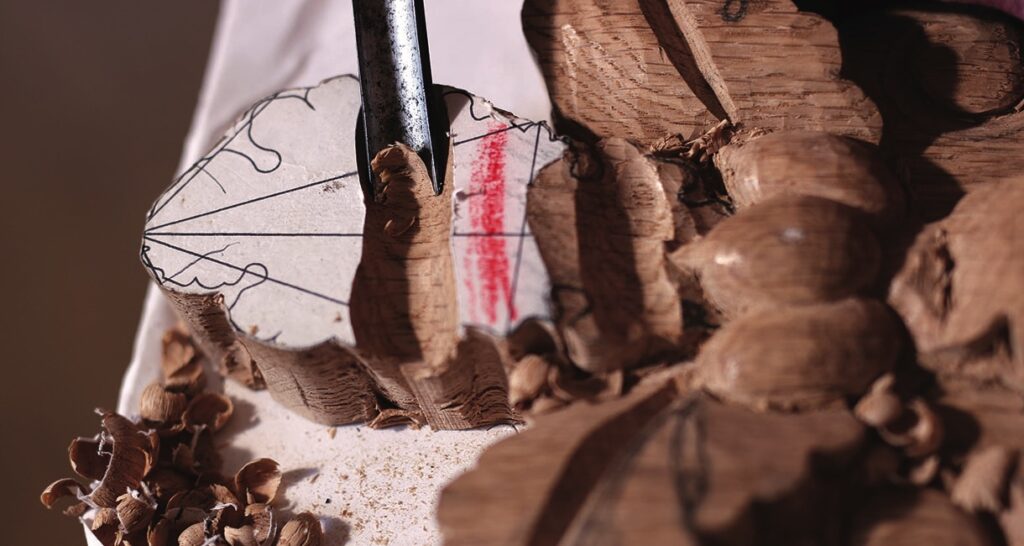
13. With a No.8, 10mm make two steep descending cuts either side of the tip. Take an inverted No.3 gouge and round over the outer mounds. Use the corner of the tool to separate these forms from the central vein
14a. Use a No.8, 6mm to carve two troughs either side of the central vein the full length of the leaf, splaying out to either side at the tip
14b. This will give the clearance needed to round over the mounds with an inverted No.3 gouge while simultaneously creating a sharp central vein
15. Clear the area for the hook to a snug fit. This should be done with a No.8, 10mm so as to leave a rounded edge. Flatten the mating surface with a No.3 gouge. Retrace the base of the hook and holes ensuring correct vertical alignment
16a. Shape the lower leaf in a similar way to the upper but this time make two cuts across the tip with the No.8, 10mm
16b. Finish as before by creating a strong central vein and rounding over the bulbous elements with an inverted No.3 gouge
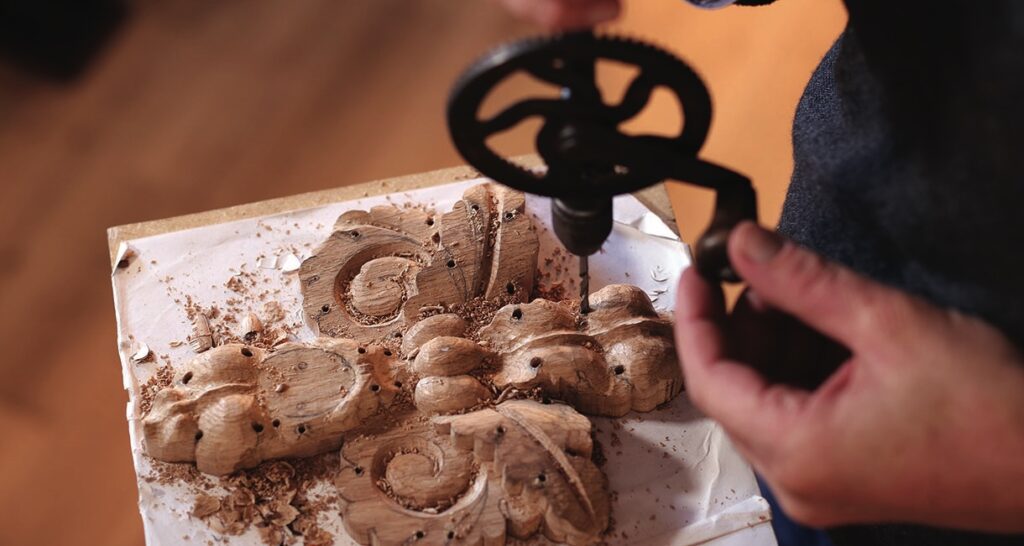
17. Drill all the eyes vertically to a good depth with the appropriate sized drills. Where the eyes are not enclosed multiple holes may be needed

Drilling Accurate Holes

Drilling accurate holes on sloping ground can be greatly assisted by the use of an awl. They generally have a flat spade tip that is pushed into the wood between the fibres and twisted, pushing the fibres apart. 
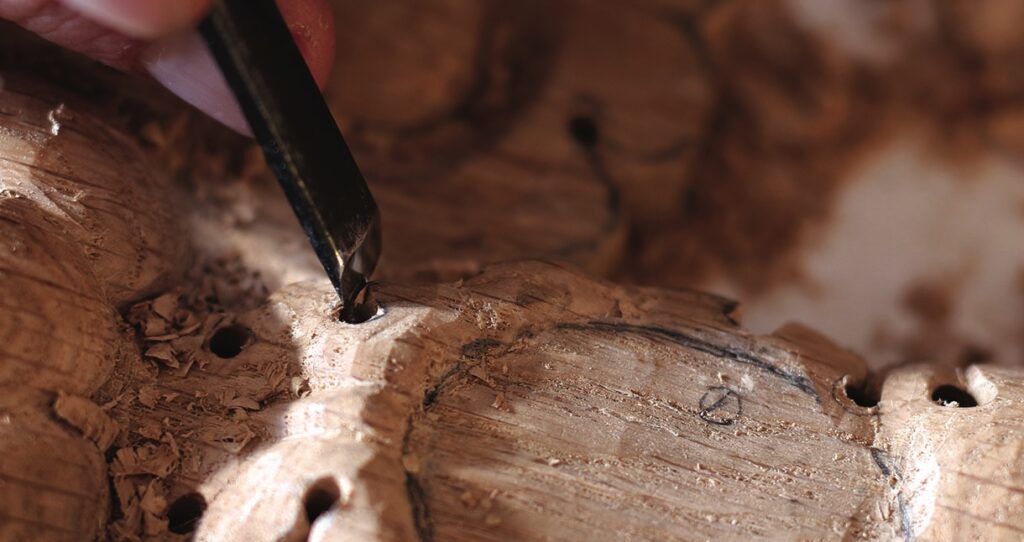

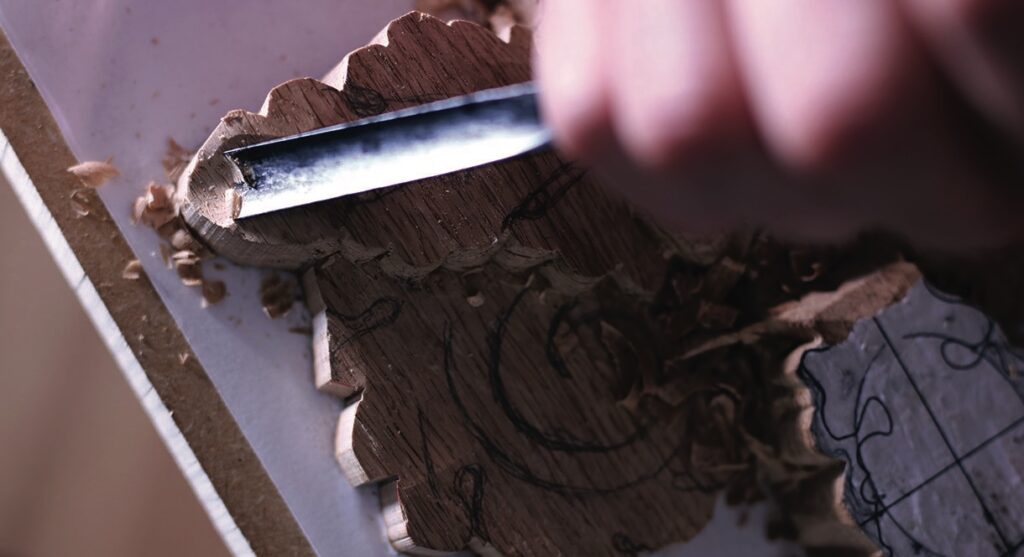
18. All the eyes are finished in much the same way. Redraw or imagine the outline of the two leaves meeting and insert a No.5, 8mm with the corner in the eye. Use vertical slicing cuts from both directions gradually separating the two forms
19a. Round over the outer edge of the spiralled leaves with an inverted No.3 gouge dipping the height of the ridge between the two lower eyes
19b. Hollow the tips of the leaves with a No.8, 10mm
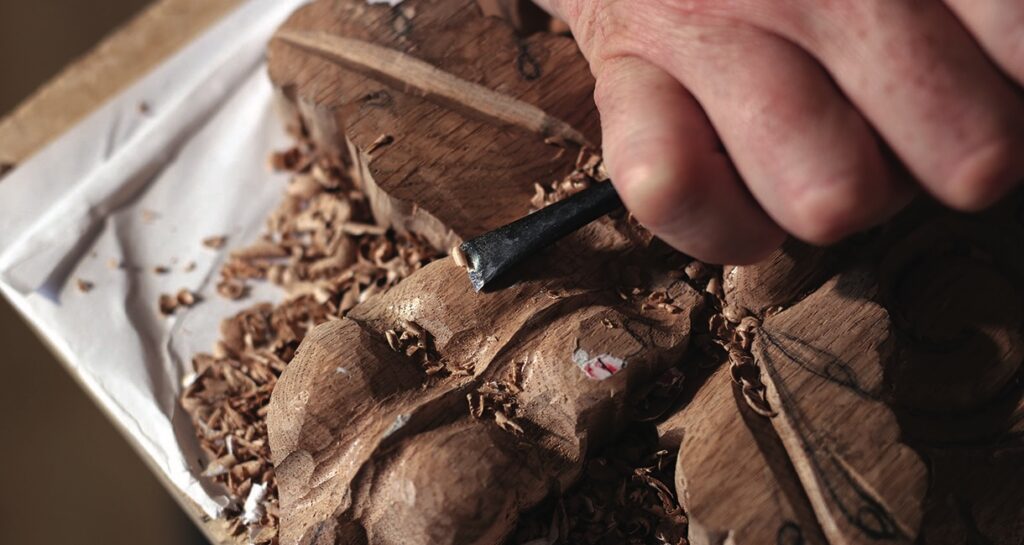
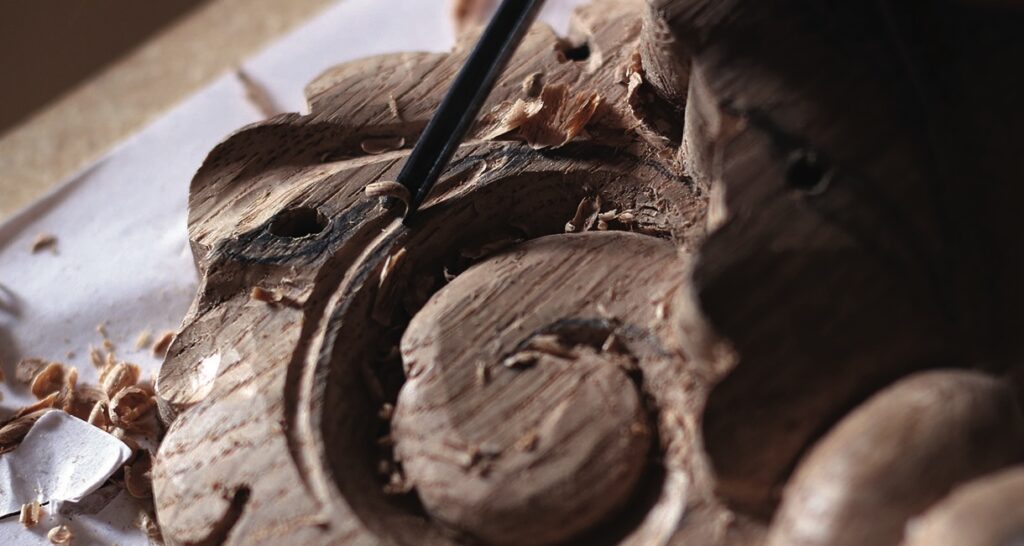
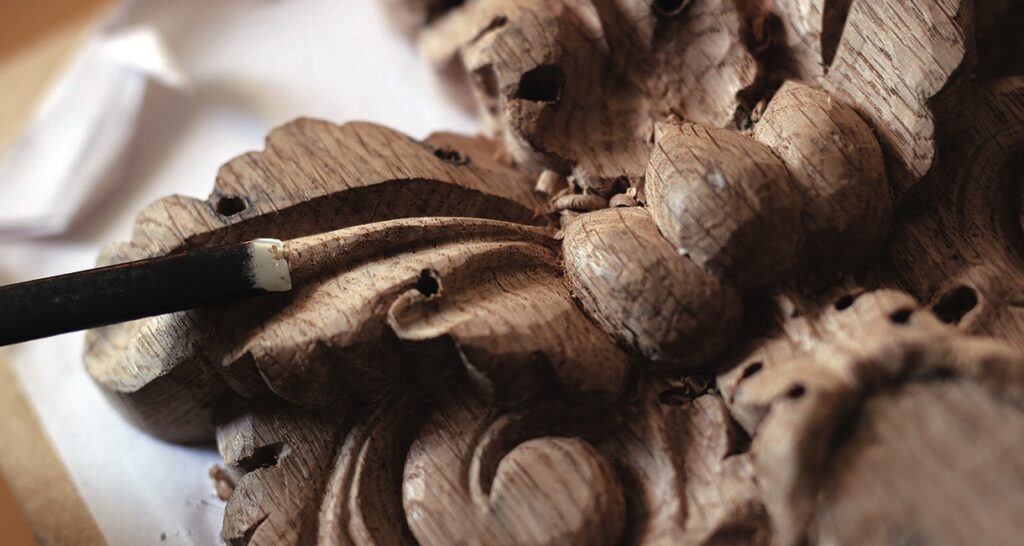
20. Re-establish the central vein of the leaf as in step 10, maintaining an accurate curve. Use a small No. 11, 1.5mm veining tool to establish the central vein by running the tool around the curve just shy of the ridge. Carefully soften both sides of the cut with an inverted No.6, 3mm. See the finished piece for a clear view of what is intended
21a. Run a No.11, 3mm along the outside of the tubes. Now with an inverted No.5, 8mm round over the leaf between
21b. Repeat this process until there is enough elevation to form a pleasing tube that radiates out from behind the acorns
22a. Open out the tips of the troughs with a No.8, 6mm gouge
22b. Round over the tubes with an inverted No.5, 8mm
23. Now we will form the acorn cups using a stop cut. Mark out the cups, and with a No. 1, 10mm gently stab in the line of the cups. With the No. 6, 16mm fishtail gouge complete the stop cut by carefully carving in toward the stab cut. Now working toward the tip clean up the acorn to a smooth even form
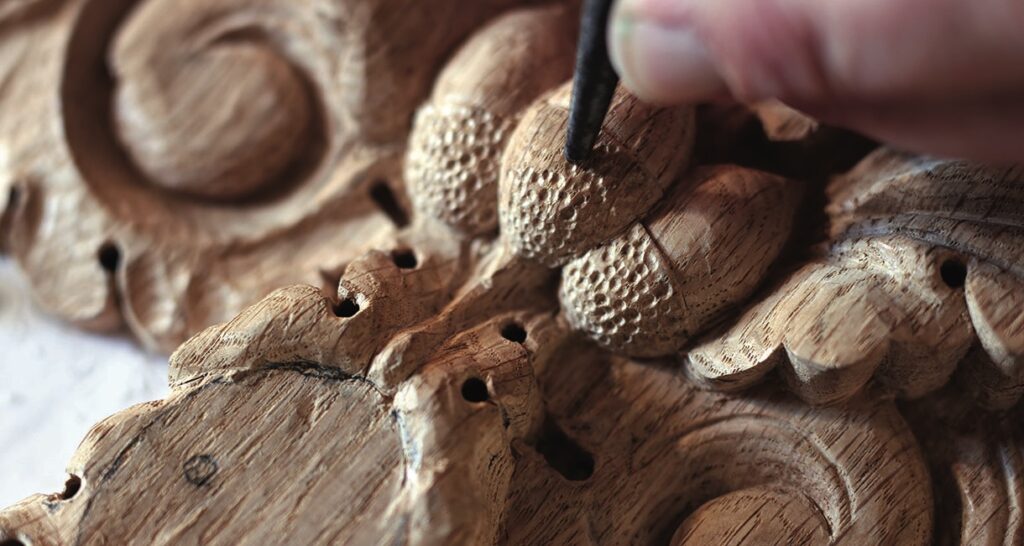
24. Ensuring the surfaces of the acorn cups are smooth and well formed we can texture it with a male punch or a blunted nail driven by a small hammer. It may be a good idea to experiment on a scrap first. Punch to random depths and avoid creating any uniform patterns
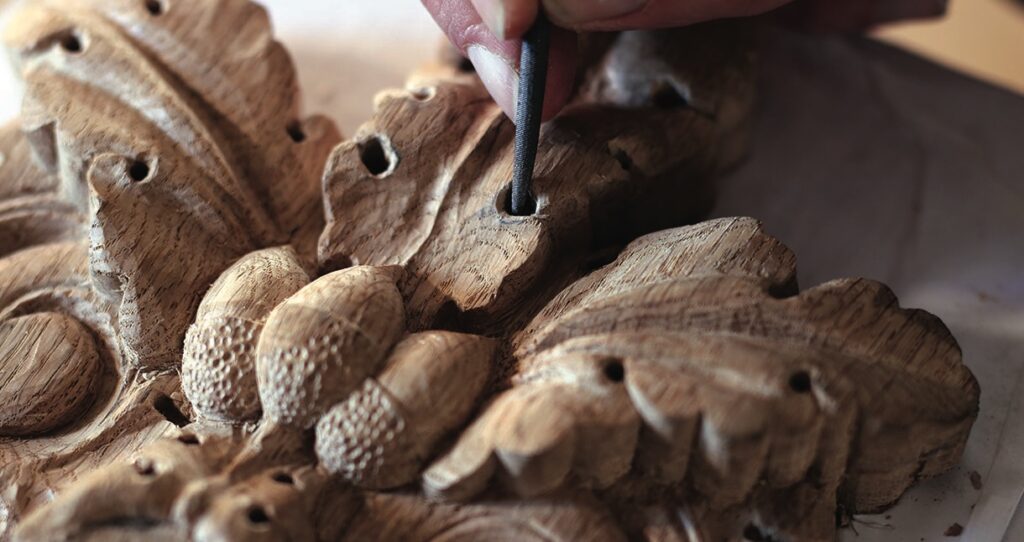
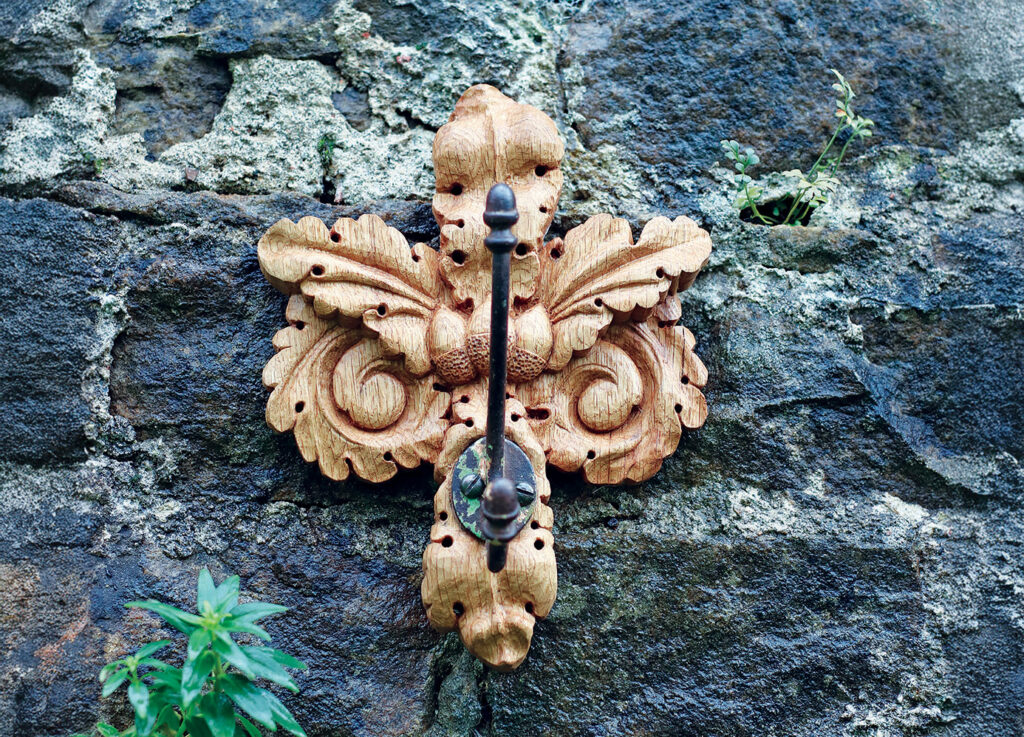
25. Use a riffler, file or rolled up piece of sandpaper to chamfer all the eyes. This creates a more comprehensive form that softens the entry holes by catching light on the rim. Remove the carving from its backing with a paint scraper. Oil with linseed oil and give a light coating of beeswax buffed to a soft sheen. Align the hook and drill screw holes. There are many possibilities for mounting. I have used dome-headed slotted screws that pass right through the carving and into rawl plugs set into the wall

Leave a Reply

Your email address will not be published. Required fields are marked *