Peter Benson investigates sources of inspiration
There is a common belief that there are only two sources from which you can get ideas for a new carving: copying pictures or the work of others, or thinking up ideas of your own. There is certainly a lot of truth in this but it is not quite as simple as it sounds. I know I have covered this before, but it bears repetition. Obviously you can copy anything for your own pleasure and use, and this can be a very good way to learn techniques as you will have a clear model or picture from which you can judge your success or failure. This is, however, difficult to do well and the end product will generally be only as good as, or worse than, the original. Any mistakes made by the original artist will almost certainly appear in your version as well. In addition, there may be serious copyright issues with anything that is copied from the work of others. More later.
Design & inspiration
It is said that ‘nothing is original’ and, bearing this in mind, you can get inspiration from the work of others or from pictures that are not your own. It is, however, important that the finished design is yours and the original work is not recognisable within it. I think most carvers and artists seek inspiration from anywhere they can and develop their designs using as much or as little as needed. To develop totally original pieces of work without using any kind of reference material requires a great deal of knowledge and skill that is beyond most hobby carvers and many skilled professionals. The ability to design carvings involves keeping your eyes open and actually seeing what is going on around you, studying your subject in depth (particularly what makes it what it is – its soul, for want of a better word). Going out into the countryside and photographing a horse in a field can be so much more fun than copying a picture from a book and, of course, you can take the pictures you need for your carving.
All this takes a considerable amount of time, which many carvers are not prepared to spend, and many don’t feel they have the ability to design something of their own. As a result, they continue to struggle with sometimes not very good copies and miss the considerable pleasure that can be gained from completing a piece of their own.
There are, of course, many ‘how to’ books and magazine articles that actively encourage readers to follow the steps to reproduce the subject featured and learn the skills and techniques involved. Many carvers spend their whole carving life following such instructions and getting a great deal of pleasure from doing so. If, however, these pieces are entered for competition or put up for sale, or you gain financially in any way from the piece, permission must be obtained from the original carver/artist whose work was featured as he/she or the magazine/ book publishers owns the copyright and due accreditation must be given.
Some books and magazines state the items shown are copyright free. These are what they say, but it is still best to credit the original artist and publication.
All of us, I am sure, have at some time seen a picture or piece of work that we just have to carve. What, then, can we do about it? If there is no chance that your carving will ever be sold, go on display, be entered into competition or be written about in any publication – in other words will not profit you in any way at all – and has been done as a learning exercise, you are usually clear of potential problems and need to do nothing. Having said that, each country has different laws regarding copyright and it is best to check to see that you are not stepping out of line.
If, however, this is not the case, you will need the permission of the original artists and/or publisher in writing before you can reproduce or develop any of their work, even if you have changed it, but it remains recognisable.
Recent projects
My wife, Em, and I have each been in this position recently and are currently busy carving the pieces involved. She will tell you her story later.
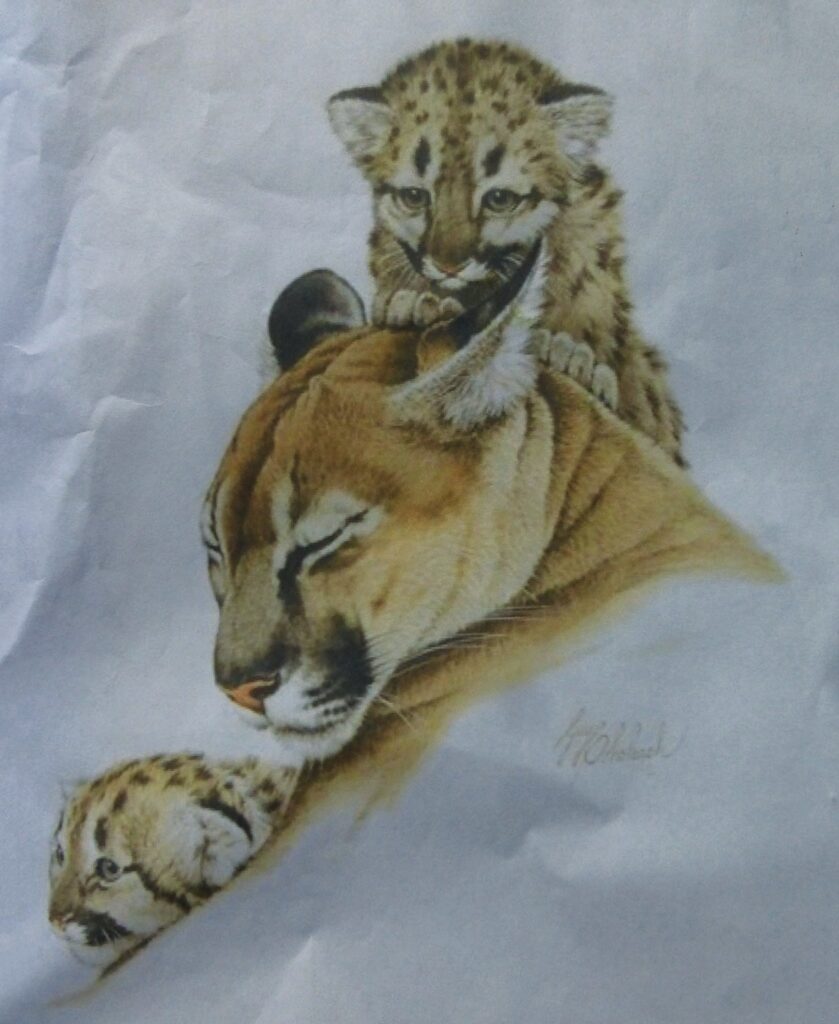
I was very struck by a painting I saw in an American magazine and was keen to make a large carving based upon it. I did not know who the artist was, so was resigned to it remaining somewhere in the house when completed. Sometime later I saw another picture on the internet that I felt would make a good teaching piece, so decided to contact the photographer for permission and was told that I could use the picture if I paid some considerable and unacceptable sum.
This spurred me to find the artist of the mountain lion carving that was now underway and, eventually, after trawling through the internet, I found him. I duly contacted him with a request to use his picture and undertook never to sell it and to give full accreditation should it be exhibited.
He very kindly replied with his consent. He also showed great interest in what I was doing and asked me to keep in touch with progress. A very different response from that of the first photographer I contacted.
I would like to thank Guy Coheleach (www.guycoheleachart.com) for allowing me to use his work and showing the support and interest that can be so lacking in others. Unfortunately, as this is a commercial publication, not only is permission needed to use the picture for the carving but it is also needed to show the original picture and, fortunately, this was also forthcoming, for which I am grateful.
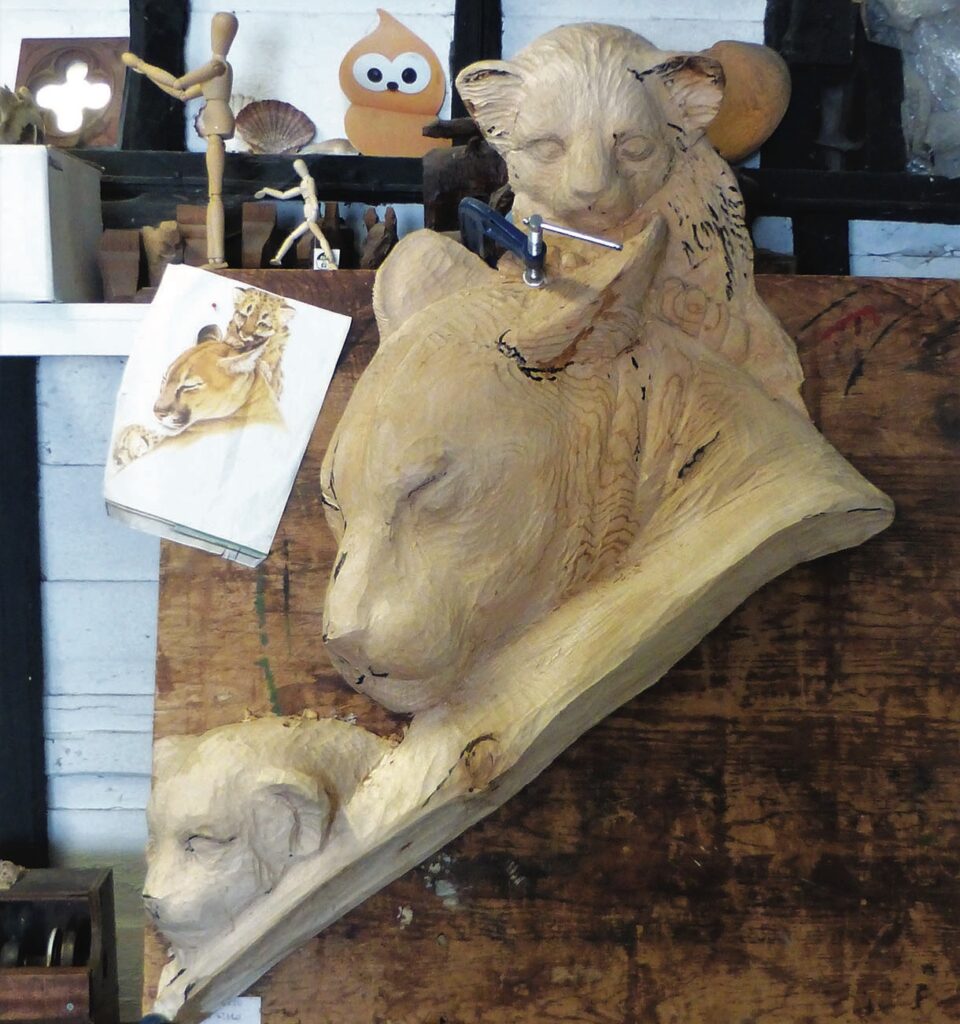
I know that carvers, probably more than other artists, tend to use the work of others as inspiration and to get an idea for a carving, even producing as near accurate copies as they can but they do need to realise that these artists need to earn a living. Photographers need to sell photographs and painters need to sell paintings and they deserve not to have their work plagiarised by others. Being up front and honest about the way you wish to use their work is, in our opinion, essential.
Em and I have both found that, by doing things the right way we not only feel happier but have made some very interesting contacts.
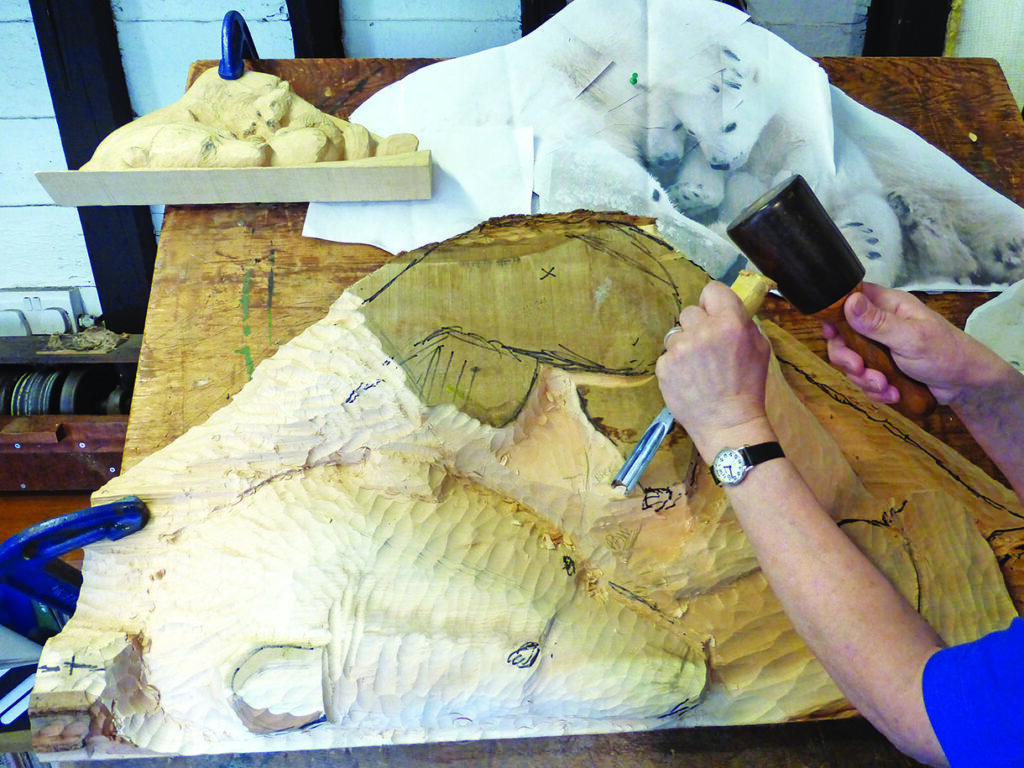
I can now continue with the carving with renewed energy knowing that it won’t be consigned to the workshop wall. Mind you, as it is around 1.2m long I don’t have many options for where to hang it. The picture above shows progress so far.
Polar bear
Em has been persuaded to tell her story and show her progress with the carving that she has undertaken, so I shall rest for a while and let her get on with it.
It started with an idea and an early morning cuppa. I had been playing around with an idea of carving a mother polar bear with her cubs but could never quite get the look I wanted, so it stayed as an idea, just kicking around him my head and occasionally getting refined by films or pictures that I saw.
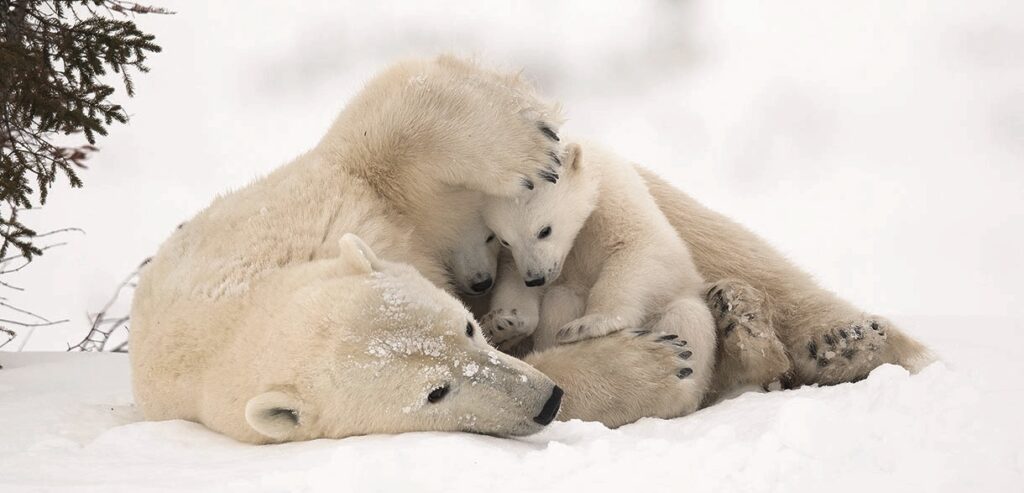
I enjoy surfing the net in the morning with my first cup of tea of the day, just me and the dog – we are the only voluntary early risers. On this morning I was looking through the entries to the Wildlife Photographer of the Year competition and there it was – what I was aiming for in one picture. The love and care that a mother has for her cubs was summed up in one picture. Even the title said it all – A Warm Embrace.
Living with a writer and teacher I knew that there was no way I could use the picture without permission, so we had a look for the photographer, Debra Garside (https://debragarsidephotography.com), and got in touch with a simple email to her detailing who we were and what we would like to do. This is one of those times I think technology is wonderful.
Contact
A flurry of emails followed back and forth as we discussed terms and limitations, during which we discovered Debra lived on a ranch in Alberta, Canada, had a gallery for her pictures, was a world-class horsewoman and had spent six hours in -35° waiting for the mother and cubs to emerge in order to get that picture. I love polar bears but not to that level of dedication. It is one of the reasons I think the photographers earn their copyright, often sitting in freezing cold, or a boiling jungle, having to remain still and unobtrusive just for that one picture. I wonder how many other pictures are taken that don’t make the cut. Making the effort to contact the owner is often the best part of sorting out copyright issue – you meet new people and, certainly after all our long-distance chats with Debra, we felt we had made a new friend.
Carving
The carving I intend to do is the first large carving I have attempted. It is 3ft long by 18in high and will be carved from a piece of 4in lime, so there will be quite a lot of foreshortening required, which is worrying me a little.
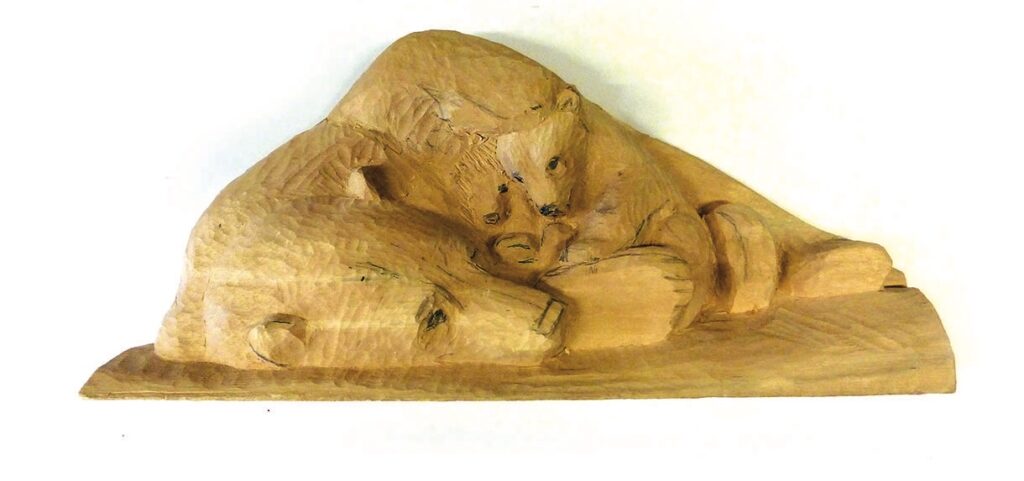
As there are many difficult angles to deal with in carving Debra’s picture I decided to do a smaller-scale maquette in jelutong (Dyera costulata) to sort out any problems that I might encounter. This should not only save a lot of time but also hopefully reduce the amount of stress involved. It isn’t intended to be a finished carving but just carved enough to see the issues and so that I can go back to it if anything arises during the full-sized carving. I will then be able to try to put it right on the maquette and repeat the process on the big piece. That way it is a working maquette that develops alongside the other carving.